Showing posts with label Singapore. Show all posts
Thursday, 4 April 2013
Ippudo - The Weight of Expectations
To those of you who aren't noodle geeks, Ippudo (一風堂) is a Japanese restaurant group famed for its ramen, in particular its tonkotsu ramen. In recent years it has expanded from its original Fukuoka base to other parts of Japan and beyond. In fact I first heard about Ippudo from rave reviews of its New York outlet. So when I found out there was a branch in Singapore plans were made to go there during my recent trip to the island state. But the thing with renowned restaurants is the weight of expectations. Would Ippudo come up to scratch?
I went for the Shiromaru Special (S$23) – a classic Hakata-style tonkotsu ramen featuring cha shu pork, braised pork belly (kakuni), cabbage, spring onions, egg (tamago), and bamboo shoots (menma). First impressions were good; I was asked how I wanted my noodles done (medium) and they did have a nice bite to them. And as is customary, they were the thin noodles that should be served with tonkotsu. The toppings were by and large of decent quality – in particular the pork belly. However, there wasn't much of the cha shu and the egg (oddly served whole) was decidedly weird with the white not entirely cooked through in some places despite the yolk not being runny.
I could forgive all of the above shortcomings if the tonkotsu broth was top class. It wasn't. Being in Asia, I expected the proper primeval, slightly disturbing whiff of molten collagen in a milky white broth. So I was disappointed when that wasn't the case. It was far from being a bad broth; it just wasn't as good as I thought it should be.
Onto the sides and I went for a pork bun and a shrimp bun. The actual steamed buns were of the finest quality, but the bun-to-filling ratio was all wrong. The respective fillings consisted of a tiny slice of pork belly and a solo breaded shrimp reminiscent of something found in a supermarket freezer cabinet. My overriding memory was just how much bloody lettuce there was in each bun. I guess I can't grumble too much, as the buns cost a mere S$3 each, but I will.
To be fair to Ipuddo, perhaps I was all-noodled out following the noodle crawl I had embarked on earlier that day. Or maybe I ordered the wrong things. Some mentioned on twitter that I should have ordered the Akamaru, which comes with a miso paste-bomb and black sesame oil. That's all well and good, but the underlying tonkotsu soup base would have been the same as the Shiromaru I ordered.
I had hoped Ippudo would be to ramen what Din Tai Fung is to xiao long bao (I wished I had gone to Din Tai Fung, as there were a couple of branches nearby). It wasn't. There wasn't that much wrong with my food, it's just that Ippudo promised so much more. That's the problem with expectations.
Ippudo, Mandarin Gallery, 333A Orchard Rd, Singapore 238897
(Tel: +65-6235-2797) Nearest MRT: Somerset
Tuesday, 26 March 2013
Singapore Noodles X 3
Following my trip to Bangalore, I spent a couple of nights in Singapore. While it really was a flying visit, I did have a spare Sunday to kill. This, of course, could only mean one thing: a noodle crawl. But this wasn't any normal noodle crawl, as Shu Han, author of Mummy I Can Cook, provided me with a list of noodle stalls I HAD to sample in Singapore. I couldn't visit all of her suggestions, but I thought going to three of them was feasible.
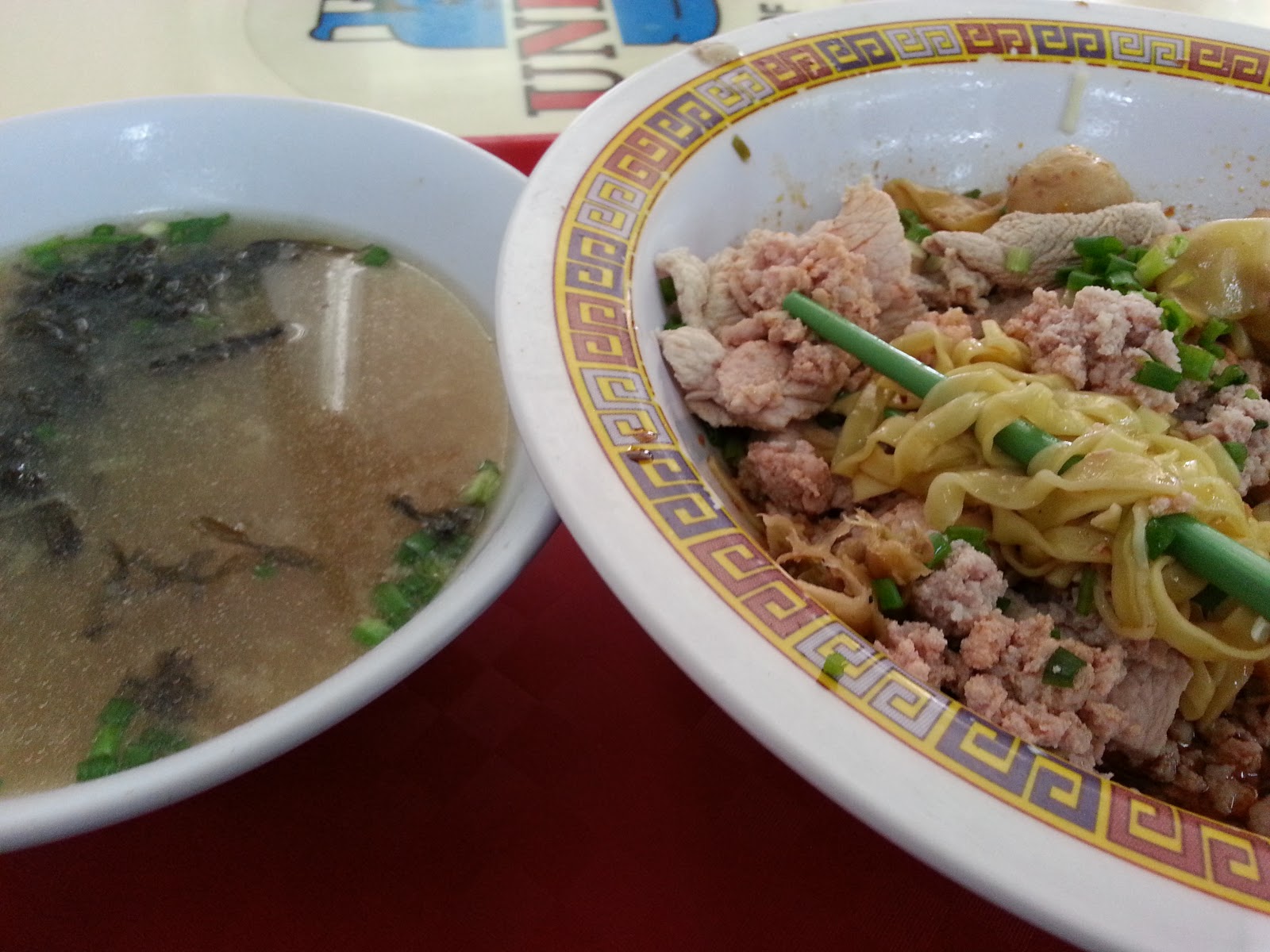
First up on my itinerary was a famous stall called Hill Street Tai Hwa Pork Noodle. Having arrived just before 11.30am, I thought I might miss the lunchtime rush. How wrong was I. In the end, I didn't get to eat my noodles until 12.50pm. I was going to go for either the S$6 or S$8 priced bowl, but having queued for so long I went for the large S$10 bowl of bak chor mee (肉脞面).
Given the length of time I queued, I was kind of cursing Shu Han. However, any ill will I may have had towards her soon dissipated when I tucked into this sumptuous dish of springy broad mee pok noodles (面薄) in a spiky mix of chilli and vinegar. The generous toppings of ground pork, sliced pork, meatballs, wontons and bits of crispy fried fish were good quality. (I asked for no liver, as I'm not the biggest fan.) On the side was a bowl of seaweed soup that I used to loosen up the noodles that can clag. With hindsight I should've asked for more chilli, but overall this was the finest bowl of noodles I've sampled so far this year.
I was ahead of schedule when I left the hotel but I was now some way behind. Having heard that the Hill Street Fried Kway Teow stall often sell out early, I decided to change my plans and headed east on the MRT to Bedok New Town to sample their char kway teow (炒粿条). Yet again there was a queue, but mercifully I managed to get my noodles by 2.10pm.
I'll be honest. Char kway teow isn't really one of my favourite noodle dishes, but this version could change my mind. It really did have the breath of the wok (鑊氣 wok hei) with a perfect balance of smoky, sweet with a hint of chilli heat. I went for the small S$3 portion, so there weren't as many cockles and Chinese sausage as I might have liked. This version had some egg noodles as well as ho fun rice noodles in the mix, but my favourite part of this dish were the crispy bits of pork fat. Mmm, pork fat.
After this second helping of noodles, I was a bit full. And having travelled so far out to Bedok, I decided to go for a stroll around the town centre. This would prove to be a big mistake. I thought I had time on my side, but by the time I rolled up to the Old Airport Road Food Centre, it was too late, too late to try the noodles at Nam Sing Hokkien Fried Mee. The guys at that stall had sold out of stuff by the time I got there. I felt that I had failed in my noodle quest, but then a phoenix rose from the flames. Well, more precisely a crumpled bit of paper with Shu Han's noodle tips on it. On there were the words: 'try fishball noodles at Old Airport Road???' and that's what I did.
I'm not sure how I came across the simply named Teochew Fishball 潮州魚丸 stall, but I do remember the fishball uncle asking me 'nei sik mat ye?' in Cantonese. Bowled over by his friendly greeting of 'what do you wanna eat?' I went through the various options with him: wet or dry? noodle type? fishballs or a mix of fishballs and fishcake? I plumped for dry fishball noodles (S$3). 'Dry' in this context means that the fishballs are served in a separate bowl of broth (by the way the broth is pretty flavourless, as its primary purpose is to loosen up the noodles). Springy is the word I would use to describe both the fishballs and thin noodles. Together with a zingy chilli dressing, this was a superior bowl of noodles.
Notwithstanding the Hokkien mee fail, the noodle crawl was a great success. If I were to do it again, I would have a late breakfast at Tai Hwa (I later found out the stall opens at 9am) before going onto the other stalls at Bedok and Old Airport Road. With a 9am start and allowing for travel time, I reckon you would be all done shortly after noon.
Hill Street Tai Hwa Pork Noodle, Block 466 Crawford Lane, #01-12 Singapore 190465
Nearest MRT: Lavender
Teochew Fishball, Old Airport Road Food Centre, Singapore 390019
Nearest MRT: Dakota
Hill Street Fried Kway Teow, #01-41 Bedok New Town Food Centre, Singapore 460549
Nearest MRT: Bedok
PS: Thanks once more to 面妹妹 aka Shu Han, I hope I did you proud!
First up on my itinerary was a famous stall called Hill Street Tai Hwa Pork Noodle. Having arrived just before 11.30am, I thought I might miss the lunchtime rush. How wrong was I. In the end, I didn't get to eat my noodles until 12.50pm. I was going to go for either the S$6 or S$8 priced bowl, but having queued for so long I went for the large S$10 bowl of bak chor mee (肉脞面).
Given the length of time I queued, I was kind of cursing Shu Han. However, any ill will I may have had towards her soon dissipated when I tucked into this sumptuous dish of springy broad mee pok noodles (面薄) in a spiky mix of chilli and vinegar. The generous toppings of ground pork, sliced pork, meatballs, wontons and bits of crispy fried fish were good quality. (I asked for no liver, as I'm not the biggest fan.) On the side was a bowl of seaweed soup that I used to loosen up the noodles that can clag. With hindsight I should've asked for more chilli, but overall this was the finest bowl of noodles I've sampled so far this year.
I was ahead of schedule when I left the hotel but I was now some way behind. Having heard that the Hill Street Fried Kway Teow stall often sell out early, I decided to change my plans and headed east on the MRT to Bedok New Town to sample their char kway teow (炒粿条). Yet again there was a queue, but mercifully I managed to get my noodles by 2.10pm.
I'll be honest. Char kway teow isn't really one of my favourite noodle dishes, but this version could change my mind. It really did have the breath of the wok (鑊氣 wok hei) with a perfect balance of smoky, sweet with a hint of chilli heat. I went for the small S$3 portion, so there weren't as many cockles and Chinese sausage as I might have liked. This version had some egg noodles as well as ho fun rice noodles in the mix, but my favourite part of this dish were the crispy bits of pork fat. Mmm, pork fat.
After this second helping of noodles, I was a bit full. And having travelled so far out to Bedok, I decided to go for a stroll around the town centre. This would prove to be a big mistake. I thought I had time on my side, but by the time I rolled up to the Old Airport Road Food Centre, it was too late, too late to try the noodles at Nam Sing Hokkien Fried Mee. The guys at that stall had sold out of stuff by the time I got there. I felt that I had failed in my noodle quest, but then a phoenix rose from the flames. Well, more precisely a crumpled bit of paper with Shu Han's noodle tips on it. On there were the words: 'try fishball noodles at Old Airport Road???' and that's what I did.
I'm not sure how I came across the simply named Teochew Fishball 潮州魚丸 stall, but I do remember the fishball uncle asking me 'nei sik mat ye?' in Cantonese. Bowled over by his friendly greeting of 'what do you wanna eat?' I went through the various options with him: wet or dry? noodle type? fishballs or a mix of fishballs and fishcake? I plumped for dry fishball noodles (S$3). 'Dry' in this context means that the fishballs are served in a separate bowl of broth (by the way the broth is pretty flavourless, as its primary purpose is to loosen up the noodles). Springy is the word I would use to describe both the fishballs and thin noodles. Together with a zingy chilli dressing, this was a superior bowl of noodles.
Notwithstanding the Hokkien mee fail, the noodle crawl was a great success. If I were to do it again, I would have a late breakfast at Tai Hwa (I later found out the stall opens at 9am) before going onto the other stalls at Bedok and Old Airport Road. With a 9am start and allowing for travel time, I reckon you would be all done shortly after noon.
Hill Street Tai Hwa Pork Noodle, Block 466 Crawford Lane, #01-12 Singapore 190465
Nearest MRT: Lavender
Teochew Fishball, Old Airport Road Food Centre, Singapore 390019
Nearest MRT: Dakota
Hill Street Fried Kway Teow, #01-41 Bedok New Town Food Centre, Singapore 460549
Nearest MRT: Bedok
PS: Thanks once more to 面妹妹 aka Shu Han, I hope I did you proud!
Thursday, 17 May 2012
Singapore - Scratching Beneath The Surface
I'm a great believer in local knowledge, and I doubt that I would've ended up in the Tiong Bahru (中峇鲁) neighbourhood if local entrepreneur and blogger Eunice hadn't suggested meeting up there. Although only a short cab ride from Singapore's CBD, Tiong Bahru has a very different feel from the mix of skyscrapers and regenerated shophouses found downtown. That's due in part to some enlightened town planning in the 1930s that saw elements of art deco incorporated into the architecture of Singapore's first public housing project.
Anyway, enough of the architecture and history lesson; this is, after all, a food blog! The reason for visiting Tiong Bahru was to check out Sin Hoi Sai (新海山). In local parlance, this is a zi char joint (煮炒), one step up from a hawker centre but still quite casual. To use an Italian analogy, think trattoria rather than full-blown ristorante.
The food at Sin Hoi Sai is a bit like Singapore itself: a fusion of traditional and modern influences. Dishes like cereal prawns (麦片虾) where deep-fried prawns are tossed in an amazing salty-sweet-spicy mix of oatmeal, butter, curry leaves and chilli. This is a true Singapore original, with the key ingredient being a breakfast cereal called Nestum (thanks to Goz for the knowledge). Sadly, I don't think Nestum is sold in the UK, which probably rules out ever seeing cereal prawns on these shores. This is a shame, as they're SO damn good.
Another Singapore classic is deep-fried prawn paste chicken (har cheong gai 虾酱鸡). Sod Colonel Sanders and his mix of herbs and spices, these have nothing on the pungent prawn paste (har cheong 虾酱) in which the chicken is marinated in before it's deep-fried. Moreish doesn't even begin to describe the super savoury-umami attack on the senses unleashed by this dish.
Although Singapore's ethnic Chinese have gone down their own culinary path, there are still plenty of southern Chinese classics such as steamed egg (水蒸蛋) to be found on the menus of zi char joints like Sin Hoi Sai. We ordered a deluxe version that was made with bits of century egg and salted duck egg. It was good, with the savoury egg custard being properly silky, smooth and wobbly, but I couldn't help but feel the salted duck egg element was a bit muted.
While zi char, in general, is seen as a good value casual dining option, that doesn't mean you can't treat yourself. And as Sin Hoi Sai's calling card is its seafood, we went for steamed fish with coriander as the centrepiece of dinner. I can't remember what the fish was, but it was perfectly cooked. With some greens, rice, drinks, freebie dessert and, most importantly, great company, it was a cracking meal. So thanks again to Eunice for suggesting Sin Hoi Sai!
Sin Hoi Sai Seafood Restaurant, Block 55 Tiong Bahru Road #01-59, Singapore 160055
(Tel: +65-6223-0810) Nearest MRT: Tiong Bahru, Outram Park
Another locals' joint I visited was the modestly named Sin Kee Famous Chicken Rice & Fish Porridge stall that's located in the Mei Ling Market & Food Centre in Queenstown. While I have no doubt that their fish porridge (congee/juk 粥) is excellent, I was here for the Hainanese chicken rice (海南雞飯).
As we were a large group, we ordered a whole chicken, which came on two separate plates, with the rice served in separate bowls. The chicken was nicely done to perfection, juicy and tender (although to someheathen western tastes, it may seem undercooked). And the rice (cooked with chicken stock) was so tasty that I ordered an extra bowl. This chicken rice was really good, and I can understand why people travel miles to this corner of town for it.
To bulk out our meal we also ordered some fried dumplings (guo tie 锅贴) from a neighbouring stall serving Shanghai-style dim sum. These were bloody tasty, with their crispy exterior and juicy pork filling.
All in all, it was a fabulous lunch! And for that I am thankful to my long suffering Singaporean colleagues for taking me there, as I wouldn't have otherwise known about the food centre at Mei Ling Market. So much so, I feel really guilty that I had, occasionally, got hacked off with them for not always taking me to places serving local food.
Sin Kee Famous Chicken Rice & Fish Porridge
Mei Ling Market & Food Centre, 159 Mei Chin Rd, Singapore 140159
Nearest MRT: Queenstown
For more Singapore tips, albeit from a couple of years ago, please check out my posts on the restaurant scene and the cheap eats scene.
Anyway, enough of the architecture and history lesson; this is, after all, a food blog! The reason for visiting Tiong Bahru was to check out Sin Hoi Sai (新海山). In local parlance, this is a zi char joint (煮炒), one step up from a hawker centre but still quite casual. To use an Italian analogy, think trattoria rather than full-blown ristorante.
The food at Sin Hoi Sai is a bit like Singapore itself: a fusion of traditional and modern influences. Dishes like cereal prawns (麦片虾) where deep-fried prawns are tossed in an amazing salty-sweet-spicy mix of oatmeal, butter, curry leaves and chilli. This is a true Singapore original, with the key ingredient being a breakfast cereal called Nestum (thanks to Goz for the knowledge). Sadly, I don't think Nestum is sold in the UK, which probably rules out ever seeing cereal prawns on these shores. This is a shame, as they're SO damn good.
Another Singapore classic is deep-fried prawn paste chicken (har cheong gai 虾酱鸡). Sod Colonel Sanders and his mix of herbs and spices, these have nothing on the pungent prawn paste (har cheong 虾酱) in which the chicken is marinated in before it's deep-fried. Moreish doesn't even begin to describe the super savoury-umami attack on the senses unleashed by this dish.
Although Singapore's ethnic Chinese have gone down their own culinary path, there are still plenty of southern Chinese classics such as steamed egg (水蒸蛋) to be found on the menus of zi char joints like Sin Hoi Sai. We ordered a deluxe version that was made with bits of century egg and salted duck egg. It was good, with the savoury egg custard being properly silky, smooth and wobbly, but I couldn't help but feel the salted duck egg element was a bit muted.
While zi char, in general, is seen as a good value casual dining option, that doesn't mean you can't treat yourself. And as Sin Hoi Sai's calling card is its seafood, we went for steamed fish with coriander as the centrepiece of dinner. I can't remember what the fish was, but it was perfectly cooked. With some greens, rice, drinks, freebie dessert and, most importantly, great company, it was a cracking meal. So thanks again to Eunice for suggesting Sin Hoi Sai!
Sin Hoi Sai Seafood Restaurant, Block 55 Tiong Bahru Road #01-59, Singapore 160055
(Tel: +65-6223-0810) Nearest MRT: Tiong Bahru, Outram Park
Another locals' joint I visited was the modestly named Sin Kee Famous Chicken Rice & Fish Porridge stall that's located in the Mei Ling Market & Food Centre in Queenstown. While I have no doubt that their fish porridge (congee/juk 粥) is excellent, I was here for the Hainanese chicken rice (海南雞飯).
As we were a large group, we ordered a whole chicken, which came on two separate plates, with the rice served in separate bowls. The chicken was nicely done to perfection, juicy and tender (although to some
To bulk out our meal we also ordered some fried dumplings (guo tie 锅贴) from a neighbouring stall serving Shanghai-style dim sum. These were bloody tasty, with their crispy exterior and juicy pork filling.
All in all, it was a fabulous lunch! And for that I am thankful to my long suffering Singaporean colleagues for taking me there, as I wouldn't have otherwise known about the food centre at Mei Ling Market. So much so, I feel really guilty that I had, occasionally, got hacked off with them for not always taking me to places serving local food.
Sin Kee Famous Chicken Rice & Fish Porridge
Mei Ling Market & Food Centre, 159 Mei Chin Rd, Singapore 140159
Nearest MRT: Queenstown
For more Singapore tips, albeit from a couple of years ago, please check out my posts on the restaurant scene and the cheap eats scene.
Sunday, 13 May 2012
The Republic of Din Tai Fung
I still can't get my head around the fact that there are 12 branches of Din Tai Fung (鼎泰豐) in Singapore (more than any other city in the world). It's as if the city-state should be renamed the 'Republic of Din Tai Fung' in honour of the legendary dumpling restaurant. I visited the branch at the Wisma Atria shopping mall (one of three branches on Orchard Road alone). Joining me was an old friend, Mr Pak Choi, who also happened to be passing through Singapore.
Naturally, we ordered some xiao long bao 小籠包 (which come in portions of 6's or 10's). These soup-filled dumplings were as good as ever. Of the two versions we tried, we preferred the pork & crab over the standard pork, as the crab lent some sweetness to the dumplings. Moreover, the pork dumplings were (by Din Tai Fung's standards) untidy in their construction.
Mr Pak Choi's favourite was the pork chop w/egg fried rice 排骨蛋炒飯. I maintain that Din Tai Fung's fried rice is the best in the world, and the pork chop was also better than I remember it being in Hong Kong. That's due in part to the five-spice powder not being as overpowering and the pork chop being on the bone.
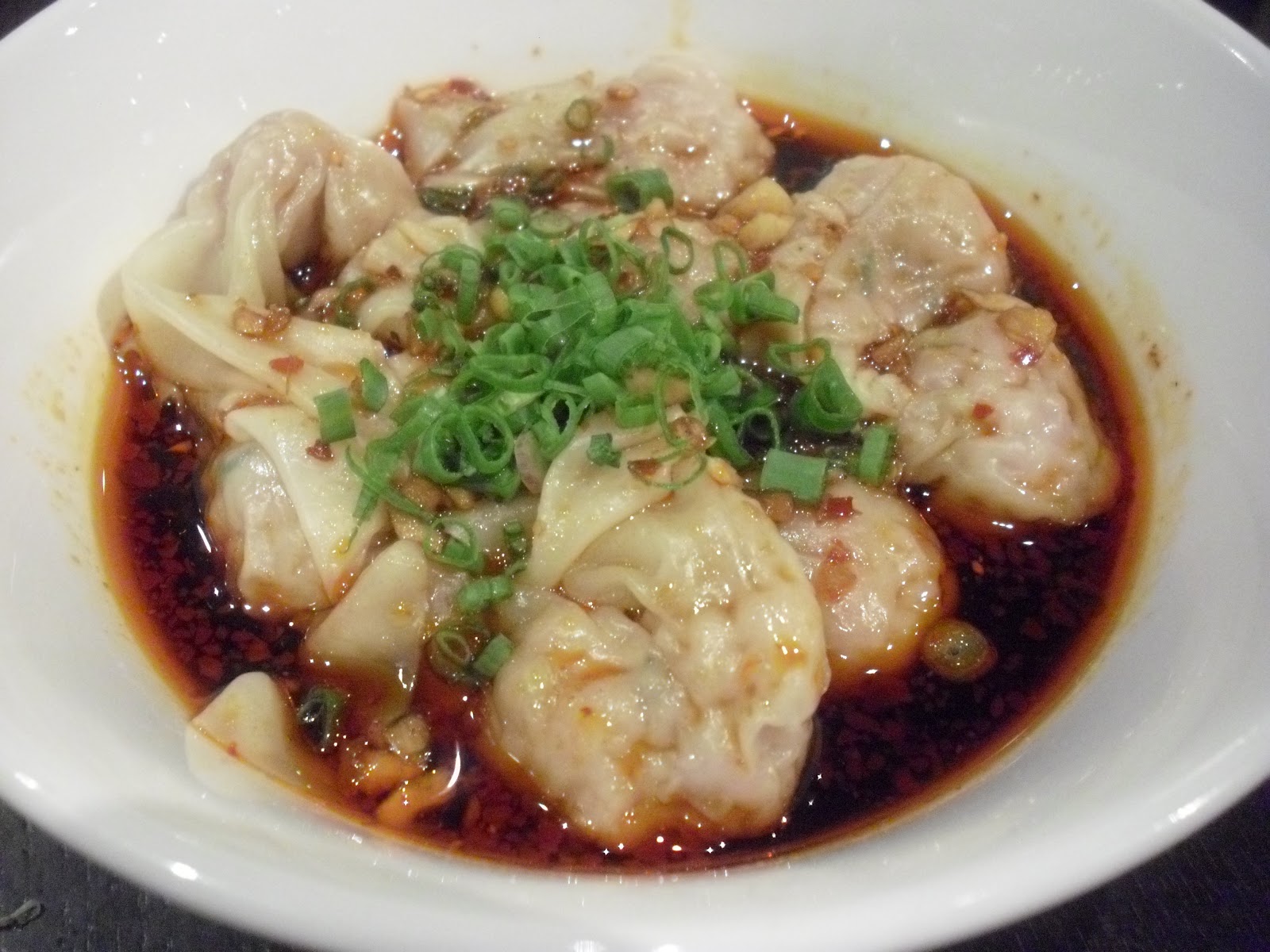
The wontons in black vinegar & chilli oil 紅油抄手 were good although I thought the vinegar/chilli oil ratio was skewed too much in favour of the former. Being a Sichuan dish, this dish should have been spicier than it was.
To complete our order, we went for some stir-fried spinach w/garlic and a portion of noodles in special sauce. Both were cooked to perfection, and I particularly liked the sweet soy dressing that came with the noodles. Having said that, I'm not sure Din Tai Fung should use the term 'special sauce' if they ever open up in the UK.

Six dishes between two was, probably, just about enough, but we couldn't resist something sweet in the form of peanut dumplings. This was, unbelievably, my first foray into Din Tai Fung's dessert selection, and the dumplings did not disappoint. These steamed mochi balls were filled with what tasted like molten peanut brittle laced with sesame – truly amazing!
What Mr Pak Choi didn't realise when he joined me for dinner was that he was being coerced into joining the campaign to bring Din Tai Fung to London. The thing is, and I don't mean this in a patronising way, he's more of a regular guy than me. He's neither a food blogger and nor is he obsessed with Chinese/East Asian cuisine. He's just someone who enjoys eating out while being receptive to different styles of food. In other words, exactly the kind of demographic that Din Tai Fung needs to attract if it is to be successful in London.
On the food front, Mr Pak Choi had no complaints, but he thought the ambience was lacking. I'm inclined to agree, as neither of us enjoyed dining in a space reminiscent of where a branch of Costa Coffee might be found in a British shopping centre. Apart from that, he could see no reason why Din Tai Fung wouldn't be a roaring success in London.
Long time readers of my blog will know what's coming next! This is where I beg you to add your name to the petition to bring Din Tai Fung to London by leaving a short comment on my other blog: Din Tai Fung London Fan Club.
Now I know some of you are thinking why you should bother supporting a campaign to bring a restaurant chain to London that you have never visited, and in all likelihood never even bloody heard of. Well the thing is you might not realise that Din Tai Fung is missing from your life, but until a few weeks ago nor did Mr Pak Choi. And you might NEVER know if Din Tai Fung doesn't open in London – so please sign the petition NOW!
Din Tai Fung, #02-48/53 Wisma Atria Shopping Mall, 435 Orchard Road, Singapore
(Tel: +65-6732-1383) Nearest MRT Station: Orchard
Naturally, we ordered some xiao long bao 小籠包 (which come in portions of 6's or 10's). These soup-filled dumplings were as good as ever. Of the two versions we tried, we preferred the pork & crab over the standard pork, as the crab lent some sweetness to the dumplings. Moreover, the pork dumplings were (by Din Tai Fung's standards) untidy in their construction.
Mr Pak Choi's favourite was the pork chop w/egg fried rice 排骨蛋炒飯. I maintain that Din Tai Fung's fried rice is the best in the world, and the pork chop was also better than I remember it being in Hong Kong. That's due in part to the five-spice powder not being as overpowering and the pork chop being on the bone.
The wontons in black vinegar & chilli oil 紅油抄手 were good although I thought the vinegar/chilli oil ratio was skewed too much in favour of the former. Being a Sichuan dish, this dish should have been spicier than it was.
To complete our order, we went for some stir-fried spinach w/garlic and a portion of noodles in special sauce. Both were cooked to perfection, and I particularly liked the sweet soy dressing that came with the noodles. Having said that, I'm not sure Din Tai Fung should use the term 'special sauce' if they ever open up in the UK.
Six dishes between two was, probably, just about enough, but we couldn't resist something sweet in the form of peanut dumplings. This was, unbelievably, my first foray into Din Tai Fung's dessert selection, and the dumplings did not disappoint. These steamed mochi balls were filled with what tasted like molten peanut brittle laced with sesame – truly amazing!
What Mr Pak Choi didn't realise when he joined me for dinner was that he was being coerced into joining the campaign to bring Din Tai Fung to London. The thing is, and I don't mean this in a patronising way, he's more of a regular guy than me. He's neither a food blogger and nor is he obsessed with Chinese/East Asian cuisine. He's just someone who enjoys eating out while being receptive to different styles of food. In other words, exactly the kind of demographic that Din Tai Fung needs to attract if it is to be successful in London.
On the food front, Mr Pak Choi had no complaints, but he thought the ambience was lacking. I'm inclined to agree, as neither of us enjoyed dining in a space reminiscent of where a branch of Costa Coffee might be found in a British shopping centre. Apart from that, he could see no reason why Din Tai Fung wouldn't be a roaring success in London.
Long time readers of my blog will know what's coming next! This is where I beg you to add your name to the petition to bring Din Tai Fung to London by leaving a short comment on my other blog: Din Tai Fung London Fan Club.
Now I know some of you are thinking why you should bother supporting a campaign to bring a restaurant chain to London that you have never visited, and in all likelihood never even bloody heard of. Well the thing is you might not realise that Din Tai Fung is missing from your life, but until a few weeks ago nor did Mr Pak Choi. And you might NEVER know if Din Tai Fung doesn't open in London – so please sign the petition NOW!
Din Tai Fung, #02-48/53 Wisma Atria Shopping Mall, 435 Orchard Road, Singapore
(Tel: +65-6732-1383) Nearest MRT Station: Orchard
Saturday, 23 October 2010
Wish You Were Here
TomEats inspired this post after he left a comment on my review of Mushu. The gist of his comment was that the likes of Crystal Jade and Din Tai Fung would clean up in London given Mushu's mediocre efforts at regional Chinese cuisine. To the uninitiated, Crystal Jade and Din Tai Fung are Chinese restaurant chains with branches across East Asia and beyond. However, these aren't chains like we know them in the UK. They consist of highly accomplished restaurants, so much so that one of Din Tai Fung's Hong Kong branches has a Michelin star.
Tom's comments made me wonder what other Chinese restaurant chains would excel in London. I soon came up with a Top 5 wish list; these aren't necessarily my favourites but rather those restaurants that I believe would 'work' in the capital. They're a varied bunch and hail from all across the Chinese-speaking world and it'd be amazing if just one of them came to these shores. I'm not getting my hopes up but you never know who might be reading.
1. Xiao Nan Guo 小南国
Style: High-end Shanghai
Based: Shanghai
Other Locations: Beijing, Dalian, Hong Kong, Nanjing, Suzhou, Tokyo
Review: Beijing Oriental Plaza (Sept 09) and Beijing Financial St (Sept 10)
The stylish and sophisticated Xiao Nan Guo would be my top choice to open in London as the capital is desperately short of restaurants that serve Shanghai cuisine. I'm pretty sure that their refined take on this cuisine, which can sometimes be too rich, would go down a storm. And whilst Xiao Nan Guo's dim sum isn't quite as good as 2nd placed Din Tai Fung, their exquisite main courses win the day. Moreover, their website mentions global expansion plans that includes Europe – please make it happen.
2. Din Tai Fung 鼎泰豐
Style: Xiao long bao and other Shanghainese dim sum
Based: Taipei
Other Locations: Beijing, Hong Kong, Jakarta, Kuala Lumpur, Los Angeles, Seoul, Shanghai, Singapore, Sydney, Tokyo, and other cities in China, Japan and Taiwan
Review: Shanghai (Aug 09)
In foodie circles, Din Tai Fung has legendary status and on another day I would've chosen this Shanghainese dim sum restaurant ahead of Xiao Nan Guo. There really ought to be a warning before you eat here because once you've sampled their xiao long bao, most other efforts at these soup-filled dumplings will seem second rate. From humble beginnings in Taiwan, this chain has spread far and wide. With branches in Los Angeles and Sydney, there is a chance that they might one day open in London.
3. Bellagio 鹿港小镇
Style: Casual Taiwanese and desserts
Based: Shanghai
Other Locations: Beijing, Dalian, Guangzhou, Jinan, Nanjing
Review: Beijing (Sept 10)
I can see Bellagio being hugely popular anywhere due to its universal appeal. It's more casual than the other places on my list and the kids would just love its trendy drinks and desserts. At the same time, there is a wide choice of Taiwanese classics to satisfy old gits like me. It's this beguiling mix that has seen more than one London blogger proclaim this café to be a Beijing must-visit. Sadly, I don't think there's much chance of Bellagio opening in London, as so far expansion has been limited to China.
4. Crystal Jade 翡翠
Style: Varies depending on branch; usually either Cantonese/dim sum or Lanzhou la-mian/xiao long bao
Based: Singapore
Other Locations: Bangkok, Beijing, Hangzhou, Ho Chi Minh City, Hong Kong, Jakarta, Kuala Lumpur, Seoul, Shanghai, Tokyo
Review: None to date (Last visit was as a civilian in 2008)
From a single restaurant in Singapore, Crystal Jade has expanded across East Asia with a mix of different cuisines and concepts. Originally renowned for its Cantonese dim sum, nowadays Crystal Jade is arguably better known for its 'La Mian Xiao Long Bao' concept. This combines Lanzhou hand-pulled noodles with Shanghai xiao long bao and London really could do with more of both. Here's hoping that the UK will be the first country in which this chain will operate in outside Asia.
5. Lei Garden 利苑
Style: Michelin star Cantonese including dim sum
Based: Hong Kong
Other Locations: Beijing, Chengdu, Guangzhou, Macau, Shanghai, Shenzhen, Singapore
Review: Singapore (Aug 10)
No less than six branches of Lei Garden have a Michelin star – there can't be too many restaurant chains that can boast that achievement. I've not eaten at any of their Michelin-starred outlets in Hong Kong or Macau but the dim sum feast I had at their Singapore restaurant was different class. That said TomEats was less than impressed by the IFC branch in Hong Kong. It's all academic anyway, as I think Lei Garden's expansion plans will focus on China for the time being.
There are some restaurants that I've omitted from my wish list not because they aren't good enough but because they're too good. For example, Beijing's Ya Wang breeds its own ducks and puts them on a special diet before roasting them in an oven that uses a particular kind of wood. I'm not sure you can replicate those conditions easily outside of Beijing. Then there's the amazing contemporary Chinese cuisine of Dadong. The quality of this Beijing mini-chain is inextricably linked to Chef Dong and I can't see how standards can be maintained if he also opens a restaurant in London.
As I mused at the beginning of this post, it's highly unlikely that any of these chains will actually open in London. So for now, I'll have to make do with my fantasy that Xiao Nan Guo is my local Chinese restaurant and that Din Tai Fung have taken over each and every branch of the execrable dim sum chain, Ping Pong.
Lastly, what restaurants from faraway places would you like to see open in London?
Tom's comments made me wonder what other Chinese restaurant chains would excel in London. I soon came up with a Top 5 wish list; these aren't necessarily my favourites but rather those restaurants that I believe would 'work' in the capital. They're a varied bunch and hail from all across the Chinese-speaking world and it'd be amazing if just one of them came to these shores. I'm not getting my hopes up but you never know who might be reading.
| Sautéed fresh river shrimp @ Xiao Nan Guo |
Style: High-end Shanghai
Based: Shanghai
Other Locations: Beijing, Dalian, Hong Kong, Nanjing, Suzhou, Tokyo
Review: Beijing Oriental Plaza (Sept 09) and Beijing Financial St (Sept 10)
The stylish and sophisticated Xiao Nan Guo would be my top choice to open in London as the capital is desperately short of restaurants that serve Shanghai cuisine. I'm pretty sure that their refined take on this cuisine, which can sometimes be too rich, would go down a storm. And whilst Xiao Nan Guo's dim sum isn't quite as good as 2nd placed Din Tai Fung, their exquisite main courses win the day. Moreover, their website mentions global expansion plans that includes Europe – please make it happen.
2. Din Tai Fung 鼎泰豐
Style: Xiao long bao and other Shanghainese dim sum
Based: Taipei
Other Locations: Beijing, Hong Kong, Jakarta, Kuala Lumpur, Los Angeles, Seoul, Shanghai, Singapore, Sydney, Tokyo, and other cities in China, Japan and Taiwan
Review: Shanghai (Aug 09)
In foodie circles, Din Tai Fung has legendary status and on another day I would've chosen this Shanghainese dim sum restaurant ahead of Xiao Nan Guo. There really ought to be a warning before you eat here because once you've sampled their xiao long bao, most other efforts at these soup-filled dumplings will seem second rate. From humble beginnings in Taiwan, this chain has spread far and wide. With branches in Los Angeles and Sydney, there is a chance that they might one day open in London.
| Dragon beans with garlic @ Bellagio |
Style: Casual Taiwanese and desserts
Based: Shanghai
Other Locations: Beijing, Dalian, Guangzhou, Jinan, Nanjing
Review: Beijing (Sept 10)
I can see Bellagio being hugely popular anywhere due to its universal appeal. It's more casual than the other places on my list and the kids would just love its trendy drinks and desserts. At the same time, there is a wide choice of Taiwanese classics to satisfy old gits like me. It's this beguiling mix that has seen more than one London blogger proclaim this café to be a Beijing must-visit. Sadly, I don't think there's much chance of Bellagio opening in London, as so far expansion has been limited to China.
4. Crystal Jade 翡翠
Style: Varies depending on branch; usually either Cantonese/dim sum or Lanzhou la-mian/xiao long bao
Based: Singapore
Other Locations: Bangkok, Beijing, Hangzhou, Ho Chi Minh City, Hong Kong, Jakarta, Kuala Lumpur, Seoul, Shanghai, Tokyo
Review: None to date (Last visit was as a civilian in 2008)
From a single restaurant in Singapore, Crystal Jade has expanded across East Asia with a mix of different cuisines and concepts. Originally renowned for its Cantonese dim sum, nowadays Crystal Jade is arguably better known for its 'La Mian Xiao Long Bao' concept. This combines Lanzhou hand-pulled noodles with Shanghai xiao long bao and London really could do with more of both. Here's hoping that the UK will be the first country in which this chain will operate in outside Asia.
| Har gau @ Lei Garden |
Style: Michelin star Cantonese including dim sum
Based: Hong Kong
Other Locations: Beijing, Chengdu, Guangzhou, Macau, Shanghai, Shenzhen, Singapore
Review: Singapore (Aug 10)
No less than six branches of Lei Garden have a Michelin star – there can't be too many restaurant chains that can boast that achievement. I've not eaten at any of their Michelin-starred outlets in Hong Kong or Macau but the dim sum feast I had at their Singapore restaurant was different class. That said TomEats was less than impressed by the IFC branch in Hong Kong. It's all academic anyway, as I think Lei Garden's expansion plans will focus on China for the time being.
There are some restaurants that I've omitted from my wish list not because they aren't good enough but because they're too good. For example, Beijing's Ya Wang breeds its own ducks and puts them on a special diet before roasting them in an oven that uses a particular kind of wood. I'm not sure you can replicate those conditions easily outside of Beijing. Then there's the amazing contemporary Chinese cuisine of Dadong. The quality of this Beijing mini-chain is inextricably linked to Chef Dong and I can't see how standards can be maintained if he also opens a restaurant in London.
As I mused at the beginning of this post, it's highly unlikely that any of these chains will actually open in London. So for now, I'll have to make do with my fantasy that Xiao Nan Guo is my local Chinese restaurant and that Din Tai Fung have taken over each and every branch of the execrable dim sum chain, Ping Pong.
Lastly, what restaurants from faraway places would you like to see open in London?
Thursday, 19 August 2010
A Break
I'm taking a break for a few weeks. In the meantime, if you've come across this blog for the first time, there are a few recent posts that I'd like to draw your attention to.
As well as recently celebrating its 1st birthday, the blog also celebrated its 100th post with a guest recipe from 3 Hungry Tummies. I've also had the honour of writing a guest post on The Grubworm where you can read about my efforts at making cha siu.
In recent years, Chinese regional cuisine has taken off in London and whilst Sichuan cuisine has broken through, could the food of Hunan province make a similar impact? Check out what I thought of traditional Hunan cuisine at Golden Day and in its Americanised guise in the form of General Tso's chicken.
I love eating on my travels and I really enjoyed the food in Kuala Lumpur and in Singapore, where I enjoyed the cheap eats as much as the restaurants. Closer to home, The Golden Noodle Awards 2009-10 celebrates some of London's finest restaurants and noodles.
See you in September!
| Cha siu |
In recent years, Chinese regional cuisine has taken off in London and whilst Sichuan cuisine has broken through, could the food of Hunan province make a similar impact? Check out what I thought of traditional Hunan cuisine at Golden Day and in its Americanised guise in the form of General Tso's chicken.
I love eating on my travels and I really enjoyed the food in Kuala Lumpur and in Singapore, where I enjoyed the cheap eats as much as the restaurants. Closer to home, The Golden Noodle Awards 2009-10 celebrates some of London's finest restaurants and noodles.
See you in September!
Sunday, 15 August 2010
Singapore Part 2 - Cheap Eats
I love Singapore's hawker centres. There's something great about checking out the different stalls and buying a snack or two, as you decide what to eat next. One of the most famous hawker centres in the island state is Lau Pa Sat, which means 'old market' in the local vernacular.
You come here for one dish above all others, the satay. You know when you're getting close to Lau Pa Sat when you can see the plumes of smoke coming from the outdoor grills. First up bag a seat outside and watch the satay being grilled but try to not to get too close to the smoky grill.
We ordered a combo of chicken, beef, and mutton satay. I thought it was all good although some thought that the honey baste was too sweet. I didn't mind so much as the accompanying zingy sauce counterbalanced the sweetness.
We also ordered bbq stingray w/chilli sauce and a dish of fried bee hoon (rice vermicelli). I really liked the chiili sauce that came with fish; so much so, I stirred it into the vermicelli. My hosts were truly mortified when I told them that in the UK, curry powder is added to fried bee hoon to make 'Singapore noodles'.
We then went inside this fine Victorian building for more food. To be honest, other than the satay, I don't think the stalls at Lau Pa Sat are the best in Singapore. I had trouble finding a decent laksa stall so I played it safe and went with an old fave, a bowl of shrimp dumpling soup noodle (sui gow mein) – a mere S$3.50 for a giant bowl including six plump dumplings.
Bak kut teh is another iconic dish found in Singapore and the name literally translates as 'meat bone tea'. Originally introduced to the region by Hokkien Chinese, there are many different versions of this pork rib broth found across Malaysia and Singapore. I'd previously tried the darker medicinal version but this was the first time that I'd sampled this lighter peppery variant.
We sampled the bak kut teh at Outram Park Ya Hua Rou Gu Cha located on the ground floor of the PSA Tanjong Pagar complex on Keppel Rd. This was like a hawker centre stall-restaurant hybrid in that it had its own seating – we even reserved a table – but the ambience was very much like a hawker centre.
I adored the bak kut teh, as the fatty meat fell away from the bone full of the flavour of the 'tea' (you can order lean rib but really what's the point in that?). This peppery version was quite different from the medicinal version I'd previously tried but enjoyable nonetheless. Some of the guys thought that it was too peppery but I didn't mind. I also liked dipping the you tiao (fried dough stick) into the 'tea'.
Whilst the bak kut teh may look like a meagre portion, there are unlimited top-up's of the 'tea' throughout the meal. We also shared loads of different dishes in addition to our individual bowls of bak kut teh and rice.
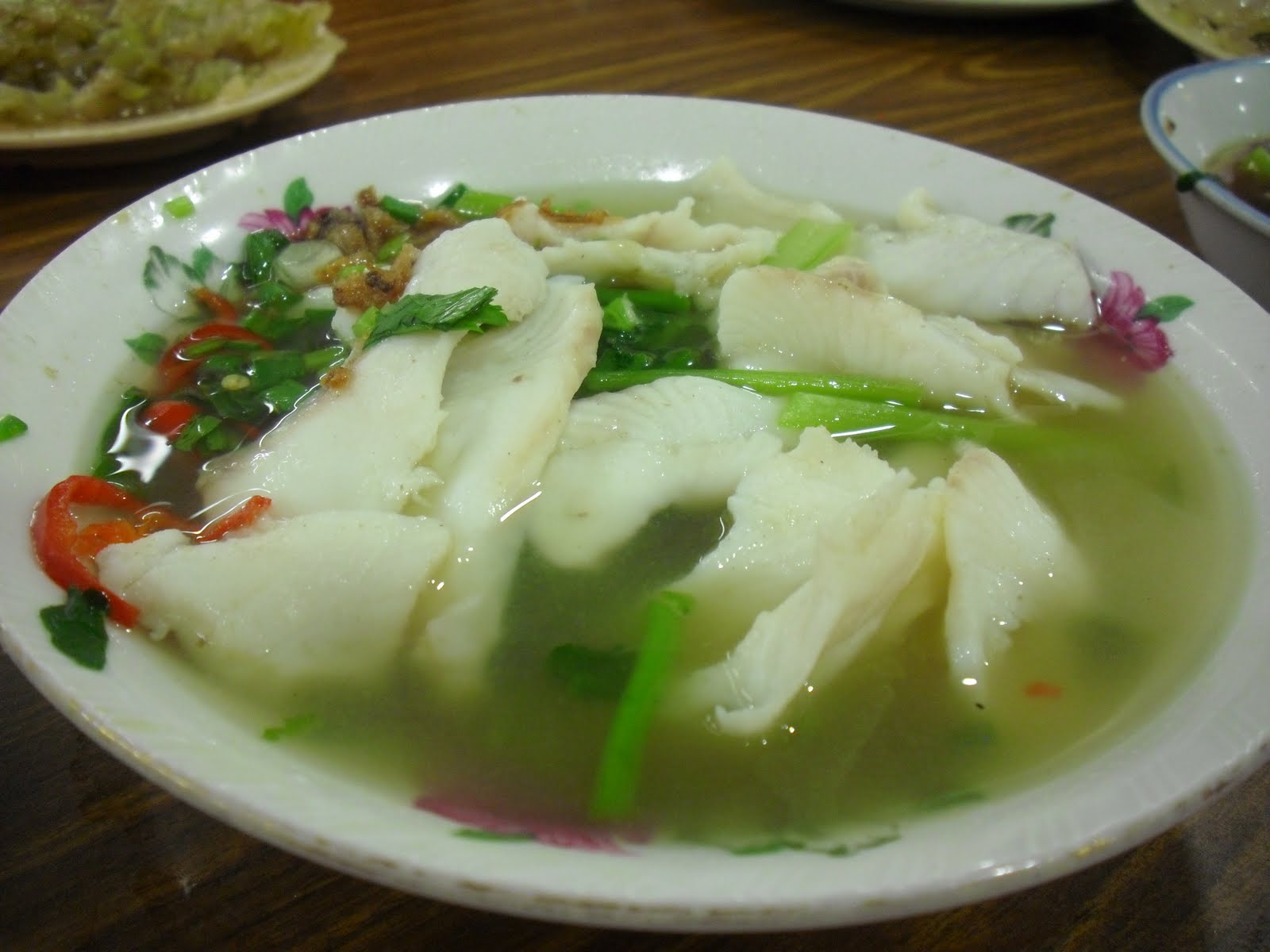
My favourites included separate bowls of fish slices, liver & kidney, and watercress – all served in broth. Oh and I managed to sneak in a crafty bowl of mee sua noodles! This rustic home-style food was a great counterbalance to some of the richer fare I'd eaten during the course of this trip.
The bak kut teh was my last lunch in Singapore and during the afternoon in the office, my thoughts started to drift to what to have for dinner. Although like many a Friday night, my plans for dinner were interrupted by an excursion to the pub. For a change I was vaguely sensible, as I still had to get to the airport that night. I stopped drinking, said my goodbyes and took a cab to the Maxwell Rd food centre.
I'd already had some nibbles at the pub so I didn't have room for a big meal. I went for an old favourite, chicken murtabak at a stall I vaguely remember visiting a couple of years ago, Hajmeer Kwaja Muslim Food. To the uninitiated, murtabak is a roti filled with meat (usually mutton or chicken), onion, and egg that's served with curry sauce.
This dish was introduced to Singapore by Tamil Muslims and you can't really get it in the UK, so I was glad that I managed to squeeze it in before I left. It was as good as I remembered, the flaky filled roti combining really well with the curry sauce. It was just what I needed before picking up my bags at the hotel. Now that I come to think of it, my last meal in Singapore was a curry after a few beers on a Friday night! Some things are universal.
As I left for home, I realised that there were so many other dishes I hadn't got round to sampling on this visit. In particular, nasi lemak, prawn noodle, laksa, and fish head curry. Next time, I hope there'll be a next time.
| Mixed satay |
| Lau Pa Sat satay stalls |
We ordered a combo of chicken, beef, and mutton satay. I thought it was all good although some thought that the honey baste was too sweet. I didn't mind so much as the accompanying zingy sauce counterbalanced the sweetness.
| BBQ stingray w/chilli sauce |
| fried bee hoon |
We then went inside this fine Victorian building for more food. To be honest, other than the satay, I don't think the stalls at Lau Pa Sat are the best in Singapore. I had trouble finding a decent laksa stall so I played it safe and went with an old fave, a bowl of shrimp dumpling soup noodle (sui gow mein) – a mere S$3.50 for a giant bowl including six plump dumplings.
Bak kut teh is another iconic dish found in Singapore and the name literally translates as 'meat bone tea'. Originally introduced to the region by Hokkien Chinese, there are many different versions of this pork rib broth found across Malaysia and Singapore. I'd previously tried the darker medicinal version but this was the first time that I'd sampled this lighter peppery variant.
| bak kut teh |
| you tiao (fried dough stick) |
Whilst the bak kut teh may look like a meagre portion, there are unlimited top-up's of the 'tea' throughout the meal. We also shared loads of different dishes in addition to our individual bowls of bak kut teh and rice.
| fish slices in broth |
| liver & kidney in broth |
The bak kut teh was my last lunch in Singapore and during the afternoon in the office, my thoughts started to drift to what to have for dinner. Although like many a Friday night, my plans for dinner were interrupted by an excursion to the pub. For a change I was vaguely sensible, as I still had to get to the airport that night. I stopped drinking, said my goodbyes and took a cab to the Maxwell Rd food centre.
I'd already had some nibbles at the pub so I didn't have room for a big meal. I went for an old favourite, chicken murtabak at a stall I vaguely remember visiting a couple of years ago, Hajmeer Kwaja Muslim Food. To the uninitiated, murtabak is a roti filled with meat (usually mutton or chicken), onion, and egg that's served with curry sauce.
This dish was introduced to Singapore by Tamil Muslims and you can't really get it in the UK, so I was glad that I managed to squeeze it in before I left. It was as good as I remembered, the flaky filled roti combining really well with the curry sauce. It was just what I needed before picking up my bags at the hotel. Now that I come to think of it, my last meal in Singapore was a curry after a few beers on a Friday night! Some things are universal.
As I left for home, I realised that there were so many other dishes I hadn't got round to sampling on this visit. In particular, nasi lemak, prawn noodle, laksa, and fish head curry. Next time, I hope there'll be a next time.
Wednesday, 11 August 2010
Singapore Part 1 - The Restaurants
I was fortunate enough to be in Singapore recently and I'm looking forward to share with you some of my foodie experiences. In this post, I'll be running the rule over restaurants serving up famous local dishes such as Hainanese chicken rice and chilli crab. For those of you who love food from Singapore's hawker centres, I'll be turning my attention to cheap eats in the next post.
What is Singapore's national dish ? A strong contender is Hainanese chicken rice, so it was a bit of a no-brainer when I was asked what I wanted for dinner on my first night in Singapore. I left it to my colleagues to choose the venue, as I'm a great believer in tapping into local knowledge.
I had no idea where I was going to be taken when we left the office and the CBD behind us. Normally, I am intolerant of taxi drivers who don't know where they're going but strangely I took it as a good sign that he got lost. I had visions of being taken to some illicit backstreet chicken rice shebeen.
I was therefore a little disappointed that we ended up on the East Coast Road, about 10km from the CBD. Just how the cabbie got lost is beyond me, as this was a brightly lit main road. My disappointment soon faded when I was told that the East Coast is a great foodie area. As we left the taxi, I could see a row of eateries jostling for our attention. My colleagues then pointed out where we were going to eat and all was well with the world again.
Our destination was Boon Tong Kee, a mini-chain of Chinese home-style restaurants specialising in chicken. This place seemed strangely familiar and then it dawned on me that Su-Lin of Tamarind and Thyme had already sung the praises of this place. That's just bloody typical of Su-Lin, not content to be the first to blog about London's more interesting eateries; she also gets there first in Singapore too !
We went for their signature poached chicken aka 'white-cut' chicken, which was served separately from the rice that was cooked in chicken stock. The bird was juicy and moist and actually tasted of chicken; it went really well with the ginger paste and the special chilli sauce. One minor grumble was that the chicken soup wasn't served with this dish. That said the rice was that tasty, it probably didn't need the broth.
Other dishes included sotong sambal (stir-fried chilli squid), deep fried tofu, and stir-fried gai-lan. These were all OK but you only really come here for the chicken. They also do a crispy fried chicken but we didn't try that. By the way, they also sell jars of the sauces such as ginger paste and chilli sauce (I am now a proud owner of both). Highly recommended but try to get a cabbie who knows his way round Singapore.
The other contender to be Singapore's national dish is chilli crab. Whilst Hainanese chicken rice is a dish that originated from China, chilli crab is an indigenous Singaporean creation. In common with Hong Kong, chefs from China that settled in Singapore utilised Western ingredients to create dishes long before the term 'fusion' ever came into use.
The crab is served with rich gravy made with chilli sauce, garlic, rice vinegar, soy sauce, and good old tomato ketchup. Egg is swirled in at the last minute to make it even richer, this gravy demands to be mopped up with deep-fried mantou (Chinese buns). Mixing my food metaphors, this is the Asian equivalent of soul food.
My Singapore colleagues really know the meaning of hospitality and they took me to the No Signboard Seafood restaurant to sample this dish. This mini-chain has a number of outlets and we pitched up at the Esplanade branch but if possible, try and get to the Geylang branch, which is the most atmospheric.
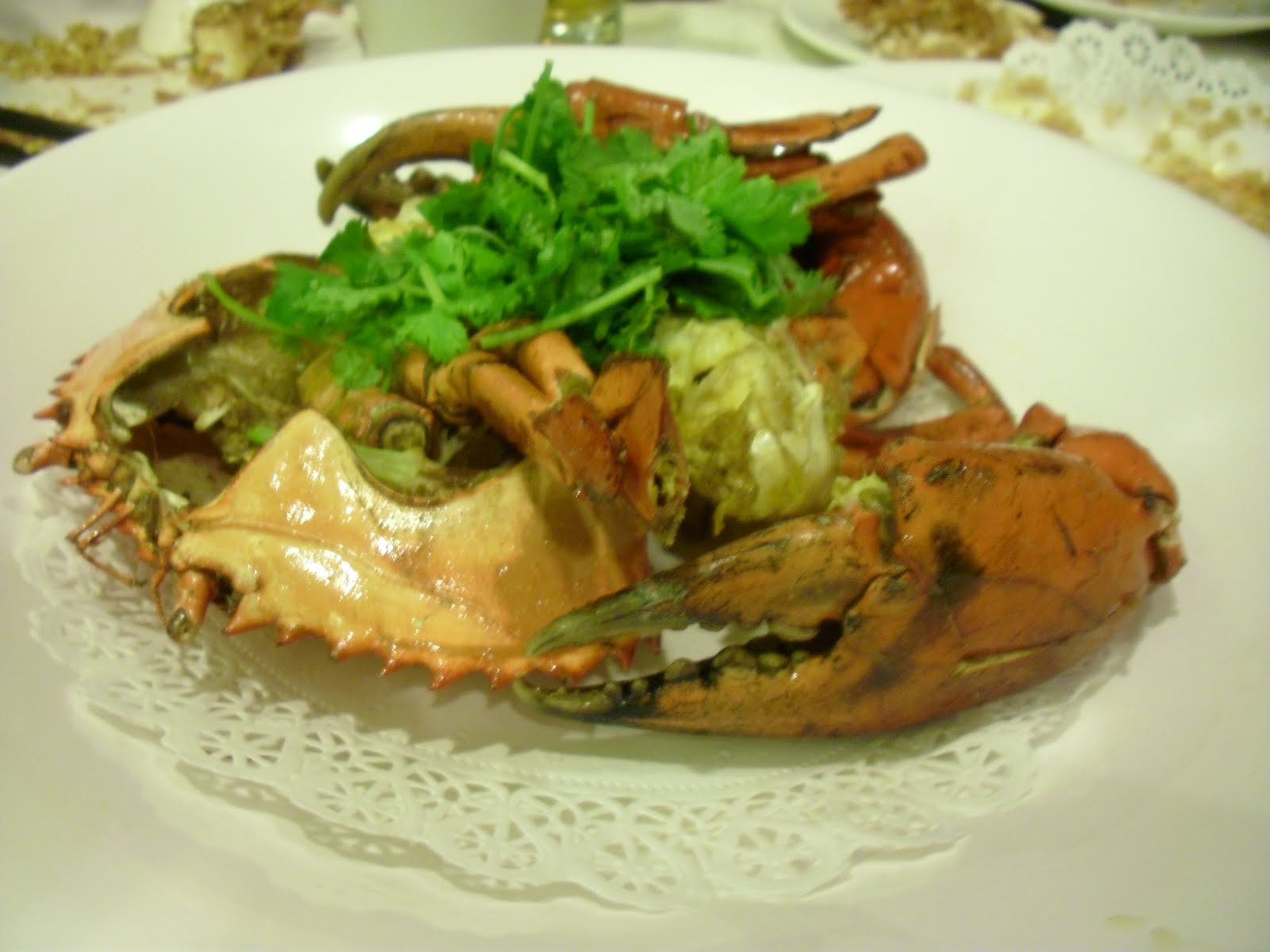
Their chilli crab is renowned and the meat just eased out of the slightly pre-cracked claw. I loved it and couldn't get enough of the gravy, which I ended up spooning into the shell before eating it with the hai-gou (crab innards).
In comparison, the butter crab was a bit boring but it would still better most crabs served in western restaurants. They also serve crab with ginger & spring onion as well as white pepper crab but strangely not the more renowned black pepper crab.
I also liked the cereal prawns, which is another Singapore creation, big fat prawns deep-fried with cereal. I could pick out cornflakes but maybe they were Frosties, as they were quite sweet. Actually, such is the popularity of this dish, a special cereal meal has been developed to be used in cereal prawns (or so I've been told!).
Many of the dishes here aren't exactly healthy so I was glad that we ordered steamed bamboo clams w/garlic. The just cooked sweet clam meat with garlic was a joy. Whilst crab is their signature dish, they also serve lobster, steamed fish, and a wide range of seafood. Another must visit.
Despite most of Singapore's population being ethnic Chinese, the Cantonese community is relatively small. However their influence on the local food scene is massive with many of the classier eateries being Cantonese.
One such example is Lei Garden, the Singapore outpost of a renowned Hong Kong restaurant group. This elegant restaurant is located in the Chijmes complex, a converted convent. Sometimes food in opulent surroundings can disappoint but the dim sum here didn't. In fact it was amongst the finest I've had in ages. Just look at how translucent the har gau wrappers are.
This exceptional quality ran through nearly all of the dim sum with the highlights being soupy Shanghai xiao long bao, silky smooth cheung fun, an amazing gingery cha siu bao filling and last but not least, wonderful black sesame balls. Oh and let's not forget the pork and century egg congee that was so tasty, we ordered an extra bowl. The dim sum menu is a bit on the short side but who cares when it's this good. If only London had a Cantonese restaurant of this quality.
PS: I've also been moonlighting and you can check out my guest post on The Grubworm by clicking here. Don't laugh but it's a recipe.
| Hainanese chicken rice |
I had no idea where I was going to be taken when we left the office and the CBD behind us. Normally, I am intolerant of taxi drivers who don't know where they're going but strangely I took it as a good sign that he got lost. I had visions of being taken to some illicit backstreet chicken rice shebeen.
I was therefore a little disappointed that we ended up on the East Coast Road, about 10km from the CBD. Just how the cabbie got lost is beyond me, as this was a brightly lit main road. My disappointment soon faded when I was told that the East Coast is a great foodie area. As we left the taxi, I could see a row of eateries jostling for our attention. My colleagues then pointed out where we were going to eat and all was well with the world again.
Our destination was Boon Tong Kee, a mini-chain of Chinese home-style restaurants specialising in chicken. This place seemed strangely familiar and then it dawned on me that Su-Lin of Tamarind and Thyme had already sung the praises of this place. That's just bloody typical of Su-Lin, not content to be the first to blog about London's more interesting eateries; she also gets there first in Singapore too !
| white-cut poached chicken |
| sotong sambal |
The other contender to be Singapore's national dish is chilli crab. Whilst Hainanese chicken rice is a dish that originated from China, chilli crab is an indigenous Singaporean creation. In common with Hong Kong, chefs from China that settled in Singapore utilised Western ingredients to create dishes long before the term 'fusion' ever came into use.
| chilli crab |
| deep-fried mantou |
My Singapore colleagues really know the meaning of hospitality and they took me to the No Signboard Seafood restaurant to sample this dish. This mini-chain has a number of outlets and we pitched up at the Esplanade branch but if possible, try and get to the Geylang branch, which is the most atmospheric.
Their chilli crab is renowned and the meat just eased out of the slightly pre-cracked claw. I loved it and couldn't get enough of the gravy, which I ended up spooning into the shell before eating it with the hai-gou (crab innards).
| butter crab |
| cereal prawns |
| steamed bamboo clams w/garlic |
Despite most of Singapore's population being ethnic Chinese, the Cantonese community is relatively small. However their influence on the local food scene is massive with many of the classier eateries being Cantonese.
One such example is Lei Garden, the Singapore outpost of a renowned Hong Kong restaurant group. This elegant restaurant is located in the Chijmes complex, a converted convent. Sometimes food in opulent surroundings can disappoint but the dim sum here didn't. In fact it was amongst the finest I've had in ages. Just look at how translucent the har gau wrappers are.
| har gau (prawn dumplings) |
| black sesame balls |
PS: I've also been moonlighting and you can check out my guest post on The Grubworm by clicking here. Don't laugh but it's a recipe.
Subscribe to:
Posts (Atom)