Showing posts with label Beijing. Show all posts

Friday, 10 August 2012

The Golden Noodle Awards 2011-12

Eat Noodles Love Noodles is three today, and there's no better way to celebrate than with The Golden Noodle Awards. The awards are a bit slimmed down this year, but to keep things interesting I've introduced a couple of new awards.

The Golden Noodle
Winner: Phở sốt vang by Phở Thinh, Hanoi

In common with last year's contenders, all of my favourite noodle dishes over the past year are from overseas, specifically China and Vietnam. And it's from the latter that the winner hails. Quite simply, the phở sốt vang from Phở Thinh in Hanoi is one of the best bowls of noodles I've ever eaten. The combination of anise-scented broth, slippery smooth broad rice noodles and stewed beef in wine with a side of fried dough sticks was simply amazing.

phở sốt vang @ Phở Thinh
But as much as I enjoyed the noodles in Vietnam, the silver and bronze medals go to Chinese dishes I sampled in Beijing. Din Tai Fung, better known for their xiao long bao, takes the silver for a rather special steamed chicken noodle soup. While taking bronze is a massive dish of belt noodles in spicy garlic sauce (originating from Shaanxi province) from Qin Tang Fu.

The Golden Dim Sum
Winner: Wasabi prawn dumplings by Phoenix Palace

This Golden Dim Sum is awarded to my favourite dim sum dish in London. There are many contenders for this accolade, but the award goes to an old favourite with a twist: wasabi prawn dumplings. These slightly plumper har gau (prawn dumplings) with a nasal passage-clearing wasabi hit are a must-order at Phoenix Palace. They're so good that I don't mind the £4.20 price-tag that their presence on the specials menu demands.

Wasabi prawn dumplings @ Phoenix Palace
Coming in a close second is Princess Garden's golden cuttlefish cheung fun. This triple textural delight consisting of springy cuttlefish paste, crispy tofu skin, and slippery smooth rice noodle is the best cheung fun dish in London. In bronze medal position is the capital's finest sweet dim sum dish: chrysanthemum custard buns by Pearl Liang – remember to order these deep-fried, not steamed.

The London Gold Award
Winner: Eat St

This award celebrates what I love best about London's food scene. However, it isn't the number of Michelin stars that I want to shout out about, it's the grassroots as represented by Eat St. To the uninitiated, this collective of street food traders most famous for its stalls on King's Boulevard (round the back of King's Cross station). My favourite vendors include The Rib Man, Banhmi11 and Eat My Pies. I visit Eat St most lunchtimes and it has improved my quality of life no end, which is why they win the inaugural London Gold award.

Rib Man @ Eat St
I'd also like to give a quick mention (and joint-silver medals) to Maltby St Market and Brixton Market/Village where the likes of Bea's Diner, Kaosarn and Mama Lan ply their trade. Sadly, there are some contrary voices deeming the various stalls and traders to be too hipster/middle class/gentrified. While we're all entitled to our opinions, I find much of the criticism to be lazy, shrill and self-loathing, and I think all of these places are a welcome addition to the capital's food scene.

Anyway, that's all folks! It's time for my blog to take its summer break - see you all in September!

Wednesday, 25 July 2012

THAT Black Truffle Xiao Long Bao @ Din Tai Fung


Come on now, you didn't think I'd go all the way to a city with a branch of Din Tai Fung 鼎泰豐 and not pay a visit? And so it was I ended up in one of the four Beijing outlets of this superior dumpling chain. Dining solo, I went for a small steamer of pork & crab xiao long bao 蟹粉小笼包 (5 pcs) and I tried pork & black truffle xiao long bao 黑松露小笼包 (5 pcs) for the first time.


To be honest, my first reaction was that the soup-filled dumplings had shrunk compared to previous visits to Din Tai Fung. That said, I might have been conditioned by having spent a week in Beijing where the portions are far from delicate.


Naturally, the dumplings were of the highest quality. In particular, the black truffle ones were in a league of their own, as the steaming process seemed to accentuate the flavour of the truffle. Simply, if you ever get the chance to try the pork & black truffle xiao long bao then you must take it with both hands.


But it's not just the dumplings that mark out Din Tai Fung. Rather like the annoying classmate at school who was academically smart and excelled at sport and anything else that took his or her fancy, Din Tai Fung has many strings to its bow. Take for example, its steamed chicken noodle soup (元盅鸡面), which ranks up there as one of the finest noodle dishes I've ever tasted – a perfect marriage of superior chicken soup to springy noodles.


To round off my meal, I went for some steamed sesame buns (芝麻大包), and these were also bloody excellent. Fluffy white buns with a melting black sesame filling; this was the perfect end to another exceptional meal at Din Tai Fung.

In addition to the excellent food, I would like to single out the service at this restaurant, as it ranks up there as some of the best I've ever experienced in China or for that matter anywhere. By that I mean the servers had a preternatural sense as to when I needed assistance as opposed to the phoney, pre-programmed 'is everything alright, sir?' school of service. Looking back, if anything, the service was too good, as it stretched me to my limits in Mandarin!

The only slight downside was the location. I'm not really a fan of the Asian practice of locating restaurants in shopping malls, but if you are sat looking in, not out, then you can just about imagine you're not eating in the basement of a department store. Having said that, there are worse examples of shopping mall restaurants than this particular one.

And as is customary on my blog, this is the point in my review of Din Tai Fung to implore you to sign the petition to bring this superior chain to London. Do it, now!

Din Tai Fung 鼎泰豐 @ Grand Pacific Mall 君太百货
Address 地址: 北京 西单北大街133号1楼/B1(君太百货)
Tel 电话:+86-10-6615-9028

I'd also like to give a quick mention to another xiao long bao specialist by the name of 一品小籠 (there's no English name but its name in pinyin is Yi Pin Xiao Long). The vibe at this eatery is more casual than Din Tai Fung, and while the dumplings aren't quite as good, they're a lot cheaper.


As well as xiao long bao, the menu consists of dim sum-sized dishes such as steamed egg. There are branches of 一品小籠 across Beijing, and they are ideal for a quick pit stop although I should warn you that the menu order sheet is written solely in Chinese.

Wednesday, 11 July 2012

The Joy of Instagram

I love Instagram, the photo-sharing app with the quirky filters, and I'd even go so far to say that it's my favourite social media. That's because it's the most fun and, in general, it's a better place to play than, say, twitter. I use it mainly to share photos of food, and it's where I increasingly chat to others about what and where I'm eating. For those of you not yet on Instagram, here's a taste of what you've been missing.


Exmouth Market
- one of my favourite streets in London, where the joys of pecan pie at Medcalf and duck egg with morcilla at Caravan can be found.


Japanese yakitori - two places where I enjoy eating it are Soho's Bincho, which serves a good value set lunch, and Sticks 'N' Sushi in Wimbledon, where they also knock out a great seaweed salad.


Chinese patisserie - these exquisite pumpkin pies and walnut buns (named for their appearance) were the most memorable dishes from a meal at South Beauty, a Sichuan restaurant in Beijing.


Eggs - an oozy Scotch egg and the eggy heart of a Gala pie from Egg Boss and Eat My Pies respectively. Incidentally, these guys are two of my favourite street food vendors.


Northern Chinese food - I adore the multi-coloured buns from Datanghong in Beijing, but northern Chinese food, like the dumplings by Mama Lan in Brixton, can also be found closer to home.


Street food - I love snacks from all over the world, and I'm lucky to live in London where I can sample Indian pani puri (from Horn OK Please at Eat St) as well as Spanish tortilla (from Jose at Maltby St Market).


Fried dough sticks - known as you jaa gwei 油炸鬼 in Cantonese, or you tiao 油条 in Mandarin, these treats are eaten for breakfast, usually as an accompaniment with juk (congee), and increasingly so with noodles.


Vietnamese treats - I love stuff like green bean cakes or a take-away bowl of pho. But you don't have to travel all the way to Vietnam to get this stuff – the pho is from Banhmi11 (various London stalls)

If you would like to see more photos like these then please check out my Instagram feed on your iPhone or Android smartphone. My Instagram handle is @eatlovenoodles

Wednesday, 4 July 2012

Three Famous Beijing Restaurants

By chance, and by choice, I ended up at three Beijing restaurants regularly mentioned in guidebooks and the interweb: Xiao Wang's Home Restaurant (小王府), Shun Yi Fu (顺一府) and Noodle Bar (面吧).

Xiao Wang's Home Restaurant 小王府
I am someone whose foodie mindset has been conditioned by living in the UK, where mediocre restaurant chains, peddling all things to all people, blight the landscape. In particular, tourist areas are badly afflicted by chain-blight; London's South Bank is a prime example. So one might assume that I would have issues with Xiao Wang's. After all, it has a pan-Chinese 'Greatest Hits' menu, is a mini-chain, and the branch I visited is located in Ritan Park, a popular Beijing tourist spot.


I needn't have worried. Dishes like the fried hot spicy chicken wings in Xinjiang-style (孜然鸡翅), which were liberally laced with not only chilli but also cumin, and deep-fried pork ribs with pepper salt (飘香排骨) really hit the spot. And for those of you who like to match booze to food, I recommend ice-cold lager in the form of the local Yanjing Beer (燕京啤酒).


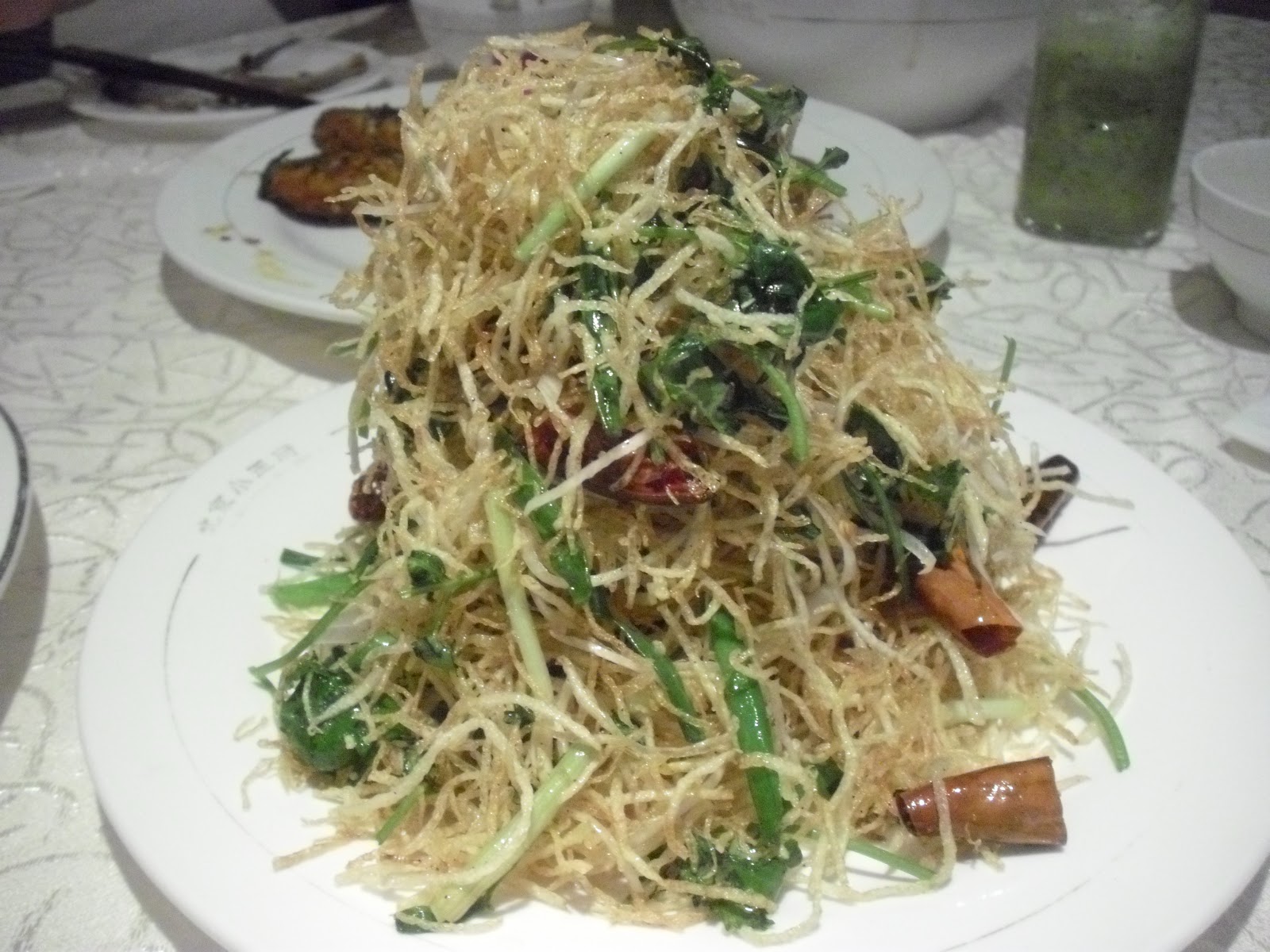
Another beer-friendly dish was an amazing giant mountain of fried potato slivers laced with spring onion, coriander & dried chillies. I know this dish is more than a bit trashy, but by god, these crispy spicy slivers of spud were SO addictive.


The squirrel-shaped Mandarin fish (松鼠桂鱼), so named because it's carved and cut up to look like a squirrel, was another winner. Don't be put off by the radioactive sweet & sour sauce; it went really well with the perfectly deep-fried Mandarin fish and pine nuts. Note to food geeks, although often thought of as a Shanghai speciality, it actually originates from Suzhou.


The classic hot & sour soup (酸辣汤) from Shandong province is found on Chinese menus worldwide, but like many famous dishes, it is often abused. Not at Xiao Wang's, where the use of top quality vinegar gave it a depth so often missing from versions that use the cheap stuff. And nor did they skimp on the other ingredients, especially the egg!

I know this meal appears to be a bit unbalanced with a, quite literally, unhealthy reliance on deep-fried treats. However, we did balance it out by ordering Cantonese-style pak choi with garlic, Sichuan cucumber salad and fresh wai-san in honey with cassia flower (the photo doesn't really do it any justice).


Wai-san (淮山) aka mountain yam is one of those Chinese ingredients that doesn't really taste of anything, but is highly valued due to its perceived health benefits. More commonly used in dried form in slow-cooked Cantonese soups; this was the first time I had tried it fresh. I really liked this dish with the slightly crunchy yam nicely complemented by the sweet honey. And as it's so healthy, it meant that I could bag that extra chicken wing without feeling guilty!

I like Xiao Wang's, and it shows that with enough expertise, a geographically diverse menu needn't mean compromises in the quality of the food. Combined with a comfortable European-style dining room and efficient service, this restaurant is an excellent option for those occasions when one is paralysed by the myriad choices found in Beijing.

Xiao Wang's Home Restaurant 北京小王府
Address 地址: 北京 日坛公园内北天门东侧
Tel 电话: +86-10-8561-7859 or +86-10-8561-5985

Shun Yi Fu 顺一府
Dinner at Xiao Wang's was my last meal with my Beijing colleagues, a fine bunch who looked after me really well. However, my food exploits were far from over, as I had a couple of days to myself armed with a shortlist of Beijing eateries. First on my list was Shun Yi Fu; I was really looking forward to eating at this dumpling joint after a previous visit three years ago. So you can't even begin to imagine how pissed off I was when I saw that the restaurant had been bricked up.

Mercifully, there was another branch about five minutes walk away, and once I found it, I ordered a steamer of pork & fennel dumplings (猪肉茴香蒸饺). There wasn't anything wrong with these but they could have done with having a more intense fennel flavour.


While I'm sure some of the other varieties of dumplings would have been more to my taste, there was something else that was wrong. The location. This newer branch is located in a shopping mall, and is totally devoid of the charm and character that made the original Shun Yi Fu so great. And while I wouldn't discount visiting this restaurant again, I won't go out of my way to do so.

Shun Yi Fu 顺一府饺子馆
Address 地址: 北京 王府井138号 APM Shopping Mall 5/F 新东安广场5层
Tel 电话: +86-10-6513-9558

Noodle Bar (面吧)
The simply named Noodle Bar is located in an upscale development called 1949 - The Hidden City that is also home to an art gallery, a wine bar, a cocktail bar, a private club, and two other restaurants including the highly rated Duck de Chine.


Noodle Bar is a tiny joint with just a dozen or so seats at a counter surrounding an open kitchen. Given the small scale of operations, the menu is brief with a few small plates supplementing the soup noodle selection. For the latter, the choice is beef brisket, tendon, tripe, a combination of all three, or wild mushroom (for the veggies) with a further choice of thin or thick noodles. I chose the beef brisket with thin noodles and from the selection of small plates I dodged the salads and went with spicy chicken wings.


Whilst the al dente hand-pulled noodles that I saw made before my very eyes were excellent, the rest of the combo was a big letdown. In particular, the broth lacked depth with little evidence of star anise, cinnamon or any of the other spices usually found in beef noodle soup. I had to give it a big kick-start from the pots of chilli oil and roasted garlic on the side along with the crispy bits from the spicy chicken wings. I also got the hump at how little beef there was, especially as there was a massive chunk of (unadvertised) mooli. I may have caught it on a bad day, but I find little to recommend Noodle Bar.

Noodle Bar 面吧 @ 1949 - The Hidden City
Address 地址: 北京 工体北路 太平洋百货南门对面
Tel 电话: +86-10-6501-1949

Sunday, 24 June 2012

The Staples of Shanxi 山西 & Shaanxi 陝西

The neighbouring northern Chinese provinces of Shanxi (山西) and Shaanxi (陝西) are often confused with one another. Not only do they sound alike but their respective cuisines also share many similarities. In particular, both provinces are famous for their noodles, and to a lesser extent, their bread. I know that this is a bit of a generalisation, but as people in China can't access my blog (Blogger is banned) it's one I'm going to try and get away with!


Beijing has many Shanxi restaurants, and I was taken to one called Datanghong (大唐红) where noodles are the main draw. Indeed, the noodle kitchen is on open view by the entrance of the restaurant. There are many different kinds of Shanxi noodles but arguably the most famous are honeycomb noodles (youmian kao laolao 莜面栲栳栳). Made from a grain indigenous to the province called naked oat, these noodles are intricately arranged in a honeycomb-shape in a bamboo steamer before being cooked. Simply served with a chilli oil-vinegar dip, they were really addictive.

As well as being eaten straight from the steamer, honeycomb noodles are also used in other dishes such as stir-fried honeycomb noodles with egg. Wok frying gave the noodles a slight char, and the texture, if not the flavour, was reminiscent of dry-fried ho fun noodles. It's a tough call to say whether these were better than the standard steamed version.

Other noodles I tried included cat's ears (mao er duo 猫耳朵) and knife-cut noodles (dao xiao mian 刀削面). These were served with sauces on the side such as egg & tomato, which are then stirred into the noodles. I could've eaten these all day, but for the fact that there was loads of other dishes to check out.


Just as impressive as the noodles were the sesame buns served with glass noodles, chillies and other bits and bobs. It was great fun making noodle sandwiches with the soft, spicy filling going really well with the buns that were slightly crispy on the outside.

I would have liked to write more about this restaurant, but alas I was disorientated by jetlag and the unfamiliarity of the food when I ate there. That said, between my camera and Instagram, I can tell you that I enjoyed tucking into Shanxi-style crispy duck, roast mutton, mixed mushrooms in a mini-wok, and some psychedelic multi-coloured buns amongst other treats. I really enjoyed eating at Datanghong, and I hope this first experience of Shanxi cuisine won't be my last.

Datanghong 大唐红酒楼
Address 地址: 北京 安定门外大街2号安贞大厦2楼(近环球贸易中心)
Tel 电话: +86-10-6448-2299


Given the ubiquity of roujiamo (肉夹馍) in Beijing, one might assume that it's a local speciality, but in fact these sandwiches (sometimes nicknamed Chinese burgers) originate from Shaanxi province. The ones at Qin Tang Fu (秦唐府) were damn tasty with strands of moist, slowly braised pork seasoned with five-spice encased in a crispy unleavened bun. These were so popular that it seemed compulsory for every diner to order one. I think these would go down a storm in the UK.


There's also a wide selection of noodles, and I chose a dish that went by the English name of noodles with garlic sauce. This name didn't really do justice to what was one of the best noodle dishes I've eaten in a long time. In one bowl came 'belt' noodles (think pappardelle, but even broader) in an intentionally bland soup with some greens. In a smaller bowl came a quite stunning spicy garlic sauce laced with sesame, bits of tomato, egg, wood-ear fungus and spring onion.


To eat this dish properly, the noodles are transferred into the bowl of sauce, and given a good old mix to make sure that they are all coated. With hindsight, I shouldn't have supersized my noodles, but when it only cost the equivalent of 20p to go large, the temptation was too great. Be warned, the portions very are generous and filling at this restaurant, and I barely made any inroads into my order of stir-fried greens.

I would love to revisit Qin Tang Fu, as there are loads of interesting Shaanxi dishes that I'd like to try. For more detailed reviews of this restaurant, please check out Rice & Pickle and Hungry Female (thanks for the tip, Shu).

There are four branches of Qin Tang Fu in Beijing, and the address below is of the one I visited:

Qin Tang Fu 秦唐府
Address 地址: 北京 东城区朝阳门 内南小街69号
Tel 电话: +86-10-6559-8135

Friday, 15 June 2012

The Culinary Wonders of Yunnan 云南


Banquet fatigue is not an affliction that I find too many people sympathetic to, but I think I've found the perfect cure: Yunnan cuisine. Yunnan is located in Southwest China, and is home to no less than 24 ethnic groups (comprising around a third of the population) in addition to the majority Han Chinese. Many of these ethnic groups can also be found in nearby Burma, Laos, Thailand and Vietnam. As such, the vibrant refreshing flavours found in Yunnan cuisine share many similarities to the food found in those countries. This makes it the ideal antidote to the sometimes-overwhelming hospitality that business visitors encounter in China.


In particular, the vegetarian dishes at Dian Ku Yunnan Restaurant (滇酷云南餐厅) were amongst my favourites during this (or any) visit to Beijing. (That last sentence extolling the virtues of vegetarian food was one I NEVER expected to write as a food blogger!) Dishes like stir-fried eggs with jasmine (茉莉花炒鸡蛋) were a revelation. It was quite weird eating a dish of eggs and edible flowers with the intensely fragrant, slightly bitter tones normally associated with jasmine tea. This dish is heaven on earth and one that goes really well with bamboo tube sticky rice (竹筒饭).


I also loved the Ruili pea congee (a terrible translation on the menu) that hails from the city of Ruili (瑞丽). This dish consists of wobbly blancmange-like strips (made from a kind of pea-flour) called doufen (豆粉). These strips didn't really taste of anything, but the accompanying spicy sesame oil dressing packed a punch while the herby-nutty topping gave the dish a contrast in textures.


Other vegetarian fare that hit the spot included fried towel gourd buds (炒絲瓜尖). This is another inadequate translation that doesn't really describe a tasty dish consisting of the buds and leaves from a young loofah plant stir-fried with dried chillies, garlic and ginger. The only (slightly) disappointing dish was the Ruili green papaya (瑞丽青木瓜); this Yunnan version of the famous Thai salad som tum was refreshing, but sadly lacked any real fire.


Lest you think I've gone completely veggie on you, we did order a couple of dishes with meat in them. First up was the air-pot chicken soup (气锅鸡), an amazing steamed chicken soup that came with abundant amounts of exotic mushrooms and goji berries. Like the rest of the meal, the flavours were ever so pure and natural.


Less successful was the crossing the bridge noodles (过桥米线), which disappointingly came ready assembled rather than in the customary D-I-Y style where you build your own bowl of rice noodles. There was nothing wrong with this dish; it's just that it compared unfavourably with the food that came before.


Although not strictly dessert, the meal was rounded off with pineapple sticky rice (菠萝饭). This was very moreish with the sweetness of the mixture of both black and white sticky rice cut through by the tartness of the pineapple. And while some quite potent black rice wine was on offer, we stuck to Yunnan’s other most famous drink: pu-erh tea (普洱茶) to accompany our meal.


I really liked Dian Ku; not only was the food top-notch, but the dining room was pretty cool, too. I don't remember much about the service, which probably means it was decent enough. However, as I mentioned in the last post, Beijing isn't the easiest city to get around. With that in mind, if you can't easily get to Dian Ku then alternative Yunnan restaurants in Beijing include: Dali Courtyard, No Name, South Silk Road and Yunteng Shifu (please don't laugh at my review of the latter, it was written when I had blogger L-plates on).

Dian Ku Yunnan Restaurant 滇酷云南餐厅
Address 地址: 北京 朝阳区和平西街小黄庄路1号
Tel 电话: +86-10-8428-5435