Showing posts with label Street Food. Show all posts
Sunday, 21 July 2013
Eating In Bangkok
Whilst I steadfastly insisted on ordering dishes 'Thai-spicy' at every opportunity during my stay in Hua Hin, I was ready to give my guts a breather by the time I arrived in Bangkok. This could only mean one thing for a good Chinese boy such as myself: a trip to Chinatown.
As darkness falls, the streets of Chinatown come alive with hawkers selling southern Chinese treats such as Cantonese BBQ, Teochew braised duck and Hainanese chicken rice. While the roast duck and wontons in my soup noodles aren't going to win awards, they were pretty good for the equivalent of 75p I spent on them.
The Chinese influence on how Bangkokians eat isn't just limited to Chinatown. This is most evident at breakfast time judging by the gusto at which the locals were tucking into bowls of congee and soup noodles. Naturally I started the day with the latter, which came with loads of goodies including fish balls, fish cake, pork slices, minced pork, some veg and fried wonton skin. I tended to go for the broad ho fun rice noodles (called sen yai in Thai) but most stalls offer a choice of noodles. The soup is often quite mild (ideal for breakfast) but there are loads of condiments on the side if you want to pimp your bowl up.
As you might have gathered I ate lots of noodles in Bangkok, and my favourite came from a stall on the edge of Chinatown. Through pointing and uttering random words of English, Chinese and Thai I ended up with a bowl of noodles that appeared to be the lovechild of Vietnamese pho and Chinese braised brisket noodle. By that I mean the herbs and crunchy beansprouts reminded me of pho whilst the anise-scented, melt-in-the-mouth brisket (with bits of tendon, too) was most definitely Chinese. My only regret was that I didn't order a second bowl.
Away from the soup noodles I also enjoyed eating in small hole-in-the-wall joints serving dishes such as duck red curry with kanom jin noodles and pad kra pow with pork. The latter with its aniseedy hit from the holy basil is one of my favourite dishes (remember to ask for it to be served with a crispy fried egg). In other places I may have baulked at the undersized portions but this isn't a problem in Bangkok's hot climate where it's better to eat small and eat often.
One thing I didn't dabble in as much as I would have liked is desserts and sweet snacks. That said I did enjoy crispy pancakes called mae prapha that were filled with egg, coconut, sugar and other stuff. They do look like tacos but I will resist the temptation to call them Thai tacos!
I wouldn't go so far to call it a disappointment but I expected more from the Soi 38 Night Market in Sukhumvit. The food I ate was OK and I may have been unlucky in my choice of stall, but there's a good buzz and when prices for pork skewers start at Baht 10 (less than 20p) one can't really complain.
By contrast I was more than pleasantly surprised by the offerings in food courts such as the one in the MBK Center. I particularly enjoyed the som tam Thai there; it was a damn fine green papaya salad which left me perspiring heavily as I insisted on Thai spicy.
Thinking about it I preferred the som tam from the food court to the one I had at Somtam Convent in Silom. Thankfully, their larb was a far better offering and it went down well with sticky rice. While I liked this hole-in-the-wall, the food was a mixed bag; the dry and overcooked gai yang (Isarn-style grilled chicken) was particularly disappointing. There probably is better Isarn-style food in Bangkok but I lacked the language skills and radar to have discovered it.
Wednesday, 10 July 2013
Eating In Hua Hin
Hua Hin is about three hours by road from Bangkok, and as such is a very popular getaway for those from the Thai capital. It isn't, by any stretch, the liveliest resort in Thailand, but I'm an old git so I don’t really care. Besides, who needs full moon parties when there is abundant seafood!
My favourite restaurant in Hua Hin is Lung Ja Seafood, which can be found on a stretch of Daychanuchit Road where the night market is located. On my first visit I ordered a whole red snapper in tom yum soup laced with coconut milk. This was a quite amazing dish with a proper spicy soup (just look at the amount of aromatics they put in it) coupled with tender, just-cooked fish. I wasn't sure about the coconut milk at first, but it made the dish into a kind of hot and sour curry, which is no bad thing in my book. By the way, remember to insist on this dish to be cooked 'Thai spicy'.
On my second visit I went for lobster. Whilst it was perfectly cooked on the barbecue, with hindsight I wouldn't have gone with the sweet tamarind sauce, as there just wasn't enough zing. On the other hand I was very pleased with the morning glory, which was stir-fried with plenty of garlic and chilli.
Of the other places I tried in Hua Hin, Koti Restaurant is probably my next favourite. It can also be found on Daychanuchit Road albeit across the road from where the night market starts. The menu is quite comprehensive with all the greatest hits from the Thai canon along with a smattering of Chinese and Thai-Chinese dishes. I really liked the warm salad of seafood & glass noodle (yum woon sen), which had a pleasing yet powerful, spicy sour kick to it. The wok skills here are also very good as exemplified by dishes like stir-fried seafood with peppercorns.
I also liked the crab sausage, which is to all intents and purposes the Teochew-Chinese dish of ngo hiang 五香 - crab and pork meat wrapped in beancurd skin, then deep-fried. Unlike the Chinese version, I couldn't really discern any five-spice flavour, but it was tasty and moreish nonetheless. Incidentally, versions of this dish are very popular in Malaysia and Singapore.
Hua Hin's night market is great for a stroll although I didn't really eat any proper meals there. However, I did enjoy snacks such as rotee (the local Romanised spelling of roti) and the coconut custard puddings known as khanom krok (thanks to MiMi for letting me know what these are). I think I liked the idea of khanom krok, with its crispy outer and wobbly centre, more than the execution, as the ones I tried weren't that sweet or coconutty. Perhaps they're meant to be like that.
The various guidebooks and online guides often cite Sang Thai and Chao Lay as Hua Hin's 'go-to' seafood restaurants. Both have excellent locations with piers stretching into the sea and serve dishes such as fried mantis shrimp (pissing prawns) with garlic, blue swimmer crab & glass noodle claypot, oyster omelette and mixed seafood platters. Both places were decent enough, but I think Lung Ja Seafood is a better restaurant in terms of value and quality. Next stop, Bangkok.
Tuesday, 7 May 2013
#Tokyoagram
To be honest I have very little clue where and what I ate when in Tokyo a couple of weeks ago. The thing is I'm no expert in Japanese food. Combine that with jetlag and being a bit pissed most evenings means that this isn't going to be one of those blog posts that people will be referring to when planning a trip to Tokyo.
Having said that I do know a little about noodles, and as I ate these for lunch it also meant I wasn't inebriated. Of the noodles I sampled, by far the best was a quite amazing mutant-tonkotsu ramen (photo, below left) from a place called Kiwamiya, where the broth was made with not only pork but also chicken, beef, seafood and vegetables with a shot of shoyu (soy sauce) for good measure. This rich, viscous broth was packed full of flavour and was augmented with top quality pork and egg. The only slight negative was that the ramen noodle used was a bit too thick; I really shouldn't gone with kaedama (refill of noodles), as it left me in a noodle coma all afternoon. I can still scarcely believe that lunch here cost Yen 880 (less than the equivalent of £6).

Of the other noodles I tried, I liked the classic Hakata-style tonkotsu ramen (photo, above right) from a place called HRC. Less viscous than the broth at Kiwamiya, it still packed a porky punch. London's tonkotsu contenders could learn a thing or two from this broth although its oily nature may scare off some punters. Oh, and rather bizarrely, this bowl of ramen came with a free bowl of rice. All this for the equivalent of a fiver – who said Japan was expensive?

A concept in some Japanese restaurants is the set menu with a 'drink-all-you-can' element comprising of an unlimited pour of local beers, sake and shochu (sadly, there's no premium booze on the list). I'm pretty sure that if anyone offered free booze with meals in Britain, they'd be bankrupt within a week. Of the couple of places with this concept I went to, I really enjoyed the barbecue at Namiu – the scallops were amazing. As was the whole spread that kicked off with various cold dishes including sashimi and ended with a bowl of cold soba noodles.
The other place I went to has no English name nor website and all I can remember was that it served food from the southern island of Kyushu. The surroundings were more casual than Namiu but the sashimi (photo, top right) was just as good, if not better.

Course after course came, as did the booze. Dishes were either served as a platter to share or on individual plates. I was taken aback by one of the courses, which consisted of a fried chicken wing with a slice of lemon. It was nice chicken, but somehow it felt wrong in the middle of a banquet that otherwise did a fine job in showcasing the regional cuisine of Kyushu. In terms of atmosphere, this was my favourite despite walking into the toilet when a salaryman was having a dump (in my defence he hadn't locked the toilet door).

The other evening meals were a bit more casual with a fantastic sushi / sashimi dinner one night and chicken skewers at a yakitoria (is that a real word?) on the other. Despite not being 'drink-all-you-can', I enjoyed both with the yakitoria edging it on ambience. Of the food, my favourite dish was the tsukune (chicken meatballs) and extra portions were ordered. I would love to tell you more about these places but neither joint has a website and both are tucked away in impossible-to-find alleys.

Last but not least, Tokyo's late night snacks are pretty tasty, too. The gyoza was a bargain at Yen 250 (less than £2) for half a dozen. These were made using a special gyoza cooker consisting of a hotplate with a hinged lid that steamed as well as grilled the dumplings. I also enjoyed some takoyaki (octopus balls) smothered with what tasted like a thickened Worcestershire sauce. These were damn tasty and with a cheeky beer, I recall getting change from a 1000 Yen note – another bargain!
All told, I enjoyed eating in Tokyo and for that I must thank my colleagues N and S who both looked after me superbly. I was particularly touched that they remembered how much I adore ramen from my previous visit.
Having said that I do know a little about noodles, and as I ate these for lunch it also meant I wasn't inebriated. Of the noodles I sampled, by far the best was a quite amazing mutant-tonkotsu ramen (photo, below left) from a place called Kiwamiya, where the broth was made with not only pork but also chicken, beef, seafood and vegetables with a shot of shoyu (soy sauce) for good measure. This rich, viscous broth was packed full of flavour and was augmented with top quality pork and egg. The only slight negative was that the ramen noodle used was a bit too thick; I really shouldn't gone with kaedama (refill of noodles), as it left me in a noodle coma all afternoon. I can still scarcely believe that lunch here cost Yen 880 (less than the equivalent of £6).

Of the other noodles I tried, I liked the classic Hakata-style tonkotsu ramen (photo, above right) from a place called HRC. Less viscous than the broth at Kiwamiya, it still packed a porky punch. London's tonkotsu contenders could learn a thing or two from this broth although its oily nature may scare off some punters. Oh, and rather bizarrely, this bowl of ramen came with a free bowl of rice. All this for the equivalent of a fiver – who said Japan was expensive?

A concept in some Japanese restaurants is the set menu with a 'drink-all-you-can' element comprising of an unlimited pour of local beers, sake and shochu (sadly, there's no premium booze on the list). I'm pretty sure that if anyone offered free booze with meals in Britain, they'd be bankrupt within a week. Of the couple of places with this concept I went to, I really enjoyed the barbecue at Namiu – the scallops were amazing. As was the whole spread that kicked off with various cold dishes including sashimi and ended with a bowl of cold soba noodles.
The other place I went to has no English name nor website and all I can remember was that it served food from the southern island of Kyushu. The surroundings were more casual than Namiu but the sashimi (photo, top right) was just as good, if not better.

Course after course came, as did the booze. Dishes were either served as a platter to share or on individual plates. I was taken aback by one of the courses, which consisted of a fried chicken wing with a slice of lemon. It was nice chicken, but somehow it felt wrong in the middle of a banquet that otherwise did a fine job in showcasing the regional cuisine of Kyushu. In terms of atmosphere, this was my favourite despite walking into the toilet when a salaryman was having a dump (in my defence he hadn't locked the toilet door).

The other evening meals were a bit more casual with a fantastic sushi / sashimi dinner one night and chicken skewers at a yakitoria (is that a real word?) on the other. Despite not being 'drink-all-you-can', I enjoyed both with the yakitoria edging it on ambience. Of the food, my favourite dish was the tsukune (chicken meatballs) and extra portions were ordered. I would love to tell you more about these places but neither joint has a website and both are tucked away in impossible-to-find alleys.

Last but not least, Tokyo's late night snacks are pretty tasty, too. The gyoza was a bargain at Yen 250 (less than £2) for half a dozen. These were made using a special gyoza cooker consisting of a hotplate with a hinged lid that steamed as well as grilled the dumplings. I also enjoyed some takoyaki (octopus balls) smothered with what tasted like a thickened Worcestershire sauce. These were damn tasty and with a cheeky beer, I recall getting change from a 1000 Yen note – another bargain!
All told, I enjoyed eating in Tokyo and for that I must thank my colleagues N and S who both looked after me superbly. I was particularly touched that they remembered how much I adore ramen from my previous visit.
Tuesday, 26 March 2013
Singapore Noodles X 3
Following my trip to Bangalore, I spent a couple of nights in Singapore. While it really was a flying visit, I did have a spare Sunday to kill. This, of course, could only mean one thing: a noodle crawl. But this wasn't any normal noodle crawl, as Shu Han, author of Mummy I Can Cook, provided me with a list of noodle stalls I HAD to sample in Singapore. I couldn't visit all of her suggestions, but I thought going to three of them was feasible.
First up on my itinerary was a famous stall called Hill Street Tai Hwa Pork Noodle. Having arrived just before 11.30am, I thought I might miss the lunchtime rush. How wrong was I. In the end, I didn't get to eat my noodles until 12.50pm. I was going to go for either the S$6 or S$8 priced bowl, but having queued for so long I went for the large S$10 bowl of bak chor mee (肉脞面).
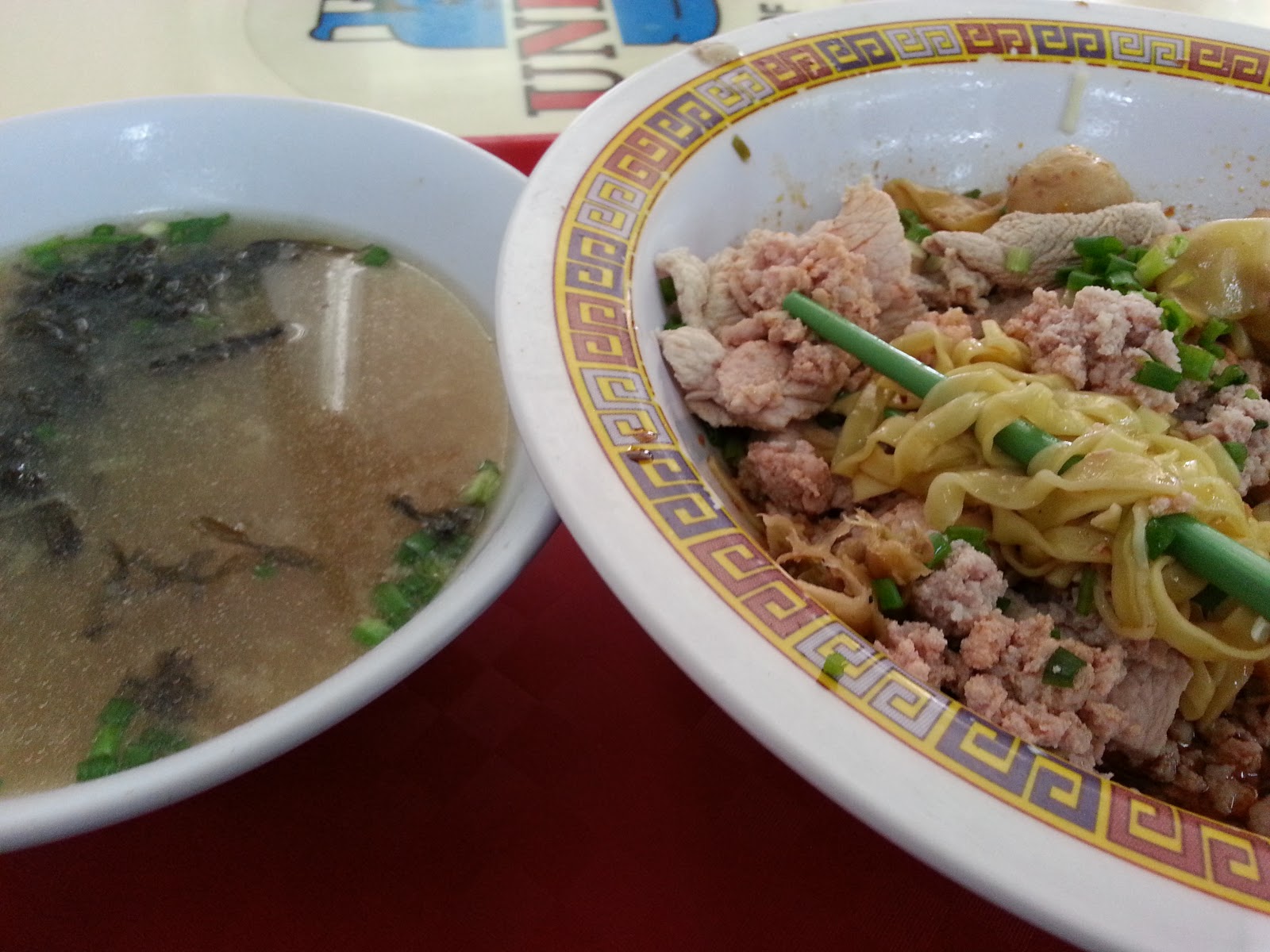
Given the length of time I queued, I was kind of cursing Shu Han. However, any ill will I may have had towards her soon dissipated when I tucked into this sumptuous dish of springy broad mee pok noodles (面薄) in a spiky mix of chilli and vinegar. The generous toppings of ground pork, sliced pork, meatballs, wontons and bits of crispy fried fish were good quality. (I asked for no liver, as I'm not the biggest fan.) On the side was a bowl of seaweed soup that I used to loosen up the noodles that can clag. With hindsight I should've asked for more chilli, but overall this was the finest bowl of noodles I've sampled so far this year.
I was ahead of schedule when I left the hotel but I was now some way behind. Having heard that the Hill Street Fried Kway Teow stall often sell out early, I decided to change my plans and headed east on the MRT to Bedok New Town to sample their char kway teow (炒粿条). Yet again there was a queue, but mercifully I managed to get my noodles by 2.10pm.
I'll be honest. Char kway teow isn't really one of my favourite noodle dishes, but this version could change my mind. It really did have the breath of the wok (鑊氣 wok hei) with a perfect balance of smoky, sweet with a hint of chilli heat. I went for the small S$3 portion, so there weren't as many cockles and Chinese sausage as I might have liked. This version had some egg noodles as well as ho fun rice noodles in the mix, but my favourite part of this dish were the crispy bits of pork fat. Mmm, pork fat.
After this second helping of noodles, I was a bit full. And having travelled so far out to Bedok, I decided to go for a stroll around the town centre. This would prove to be a big mistake. I thought I had time on my side, but by the time I rolled up to the Old Airport Road Food Centre, it was too late, too late to try the noodles at Nam Sing Hokkien Fried Mee. The guys at that stall had sold out of stuff by the time I got there. I felt that I had failed in my noodle quest, but then a phoenix rose from the flames. Well, more precisely a crumpled bit of paper with Shu Han's noodle tips on it. On there were the words: 'try fishball noodles at Old Airport Road???' and that's what I did.
I'm not sure how I came across the simply named Teochew Fishball 潮州魚丸 stall, but I do remember the fishball uncle asking me 'nei sik mat ye?' in Cantonese. Bowled over by his friendly greeting of 'what do you wanna eat?' I went through the various options with him: wet or dry? noodle type? fishballs or a mix of fishballs and fishcake? I plumped for dry fishball noodles (S$3). 'Dry' in this context means that the fishballs are served in a separate bowl of broth (by the way the broth is pretty flavourless, as its primary purpose is to loosen up the noodles). Springy is the word I would use to describe both the fishballs and thin noodles. Together with a zingy chilli dressing, this was a superior bowl of noodles.
Notwithstanding the Hokkien mee fail, the noodle crawl was a great success. If I were to do it again, I would have a late breakfast at Tai Hwa (I later found out the stall opens at 9am) before going onto the other stalls at Bedok and Old Airport Road. With a 9am start and allowing for travel time, I reckon you would be all done shortly after noon.
Hill Street Tai Hwa Pork Noodle, Block 466 Crawford Lane, #01-12 Singapore 190465
Nearest MRT: Lavender
Teochew Fishball, Old Airport Road Food Centre, Singapore 390019
Nearest MRT: Dakota
Hill Street Fried Kway Teow, #01-41 Bedok New Town Food Centre, Singapore 460549
Nearest MRT: Bedok
PS: Thanks once more to 面妹妹 aka Shu Han, I hope I did you proud!
First up on my itinerary was a famous stall called Hill Street Tai Hwa Pork Noodle. Having arrived just before 11.30am, I thought I might miss the lunchtime rush. How wrong was I. In the end, I didn't get to eat my noodles until 12.50pm. I was going to go for either the S$6 or S$8 priced bowl, but having queued for so long I went for the large S$10 bowl of bak chor mee (肉脞面).
Given the length of time I queued, I was kind of cursing Shu Han. However, any ill will I may have had towards her soon dissipated when I tucked into this sumptuous dish of springy broad mee pok noodles (面薄) in a spiky mix of chilli and vinegar. The generous toppings of ground pork, sliced pork, meatballs, wontons and bits of crispy fried fish were good quality. (I asked for no liver, as I'm not the biggest fan.) On the side was a bowl of seaweed soup that I used to loosen up the noodles that can clag. With hindsight I should've asked for more chilli, but overall this was the finest bowl of noodles I've sampled so far this year.
I was ahead of schedule when I left the hotel but I was now some way behind. Having heard that the Hill Street Fried Kway Teow stall often sell out early, I decided to change my plans and headed east on the MRT to Bedok New Town to sample their char kway teow (炒粿条). Yet again there was a queue, but mercifully I managed to get my noodles by 2.10pm.
I'll be honest. Char kway teow isn't really one of my favourite noodle dishes, but this version could change my mind. It really did have the breath of the wok (鑊氣 wok hei) with a perfect balance of smoky, sweet with a hint of chilli heat. I went for the small S$3 portion, so there weren't as many cockles and Chinese sausage as I might have liked. This version had some egg noodles as well as ho fun rice noodles in the mix, but my favourite part of this dish were the crispy bits of pork fat. Mmm, pork fat.
After this second helping of noodles, I was a bit full. And having travelled so far out to Bedok, I decided to go for a stroll around the town centre. This would prove to be a big mistake. I thought I had time on my side, but by the time I rolled up to the Old Airport Road Food Centre, it was too late, too late to try the noodles at Nam Sing Hokkien Fried Mee. The guys at that stall had sold out of stuff by the time I got there. I felt that I had failed in my noodle quest, but then a phoenix rose from the flames. Well, more precisely a crumpled bit of paper with Shu Han's noodle tips on it. On there were the words: 'try fishball noodles at Old Airport Road???' and that's what I did.
I'm not sure how I came across the simply named Teochew Fishball 潮州魚丸 stall, but I do remember the fishball uncle asking me 'nei sik mat ye?' in Cantonese. Bowled over by his friendly greeting of 'what do you wanna eat?' I went through the various options with him: wet or dry? noodle type? fishballs or a mix of fishballs and fishcake? I plumped for dry fishball noodles (S$3). 'Dry' in this context means that the fishballs are served in a separate bowl of broth (by the way the broth is pretty flavourless, as its primary purpose is to loosen up the noodles). Springy is the word I would use to describe both the fishballs and thin noodles. Together with a zingy chilli dressing, this was a superior bowl of noodles.
Notwithstanding the Hokkien mee fail, the noodle crawl was a great success. If I were to do it again, I would have a late breakfast at Tai Hwa (I later found out the stall opens at 9am) before going onto the other stalls at Bedok and Old Airport Road. With a 9am start and allowing for travel time, I reckon you would be all done shortly after noon.
Hill Street Tai Hwa Pork Noodle, Block 466 Crawford Lane, #01-12 Singapore 190465
Nearest MRT: Lavender
Teochew Fishball, Old Airport Road Food Centre, Singapore 390019
Nearest MRT: Dakota
Hill Street Fried Kway Teow, #01-41 Bedok New Town Food Centre, Singapore 460549
Nearest MRT: Bedok
PS: Thanks once more to 面妹妹 aka Shu Han, I hope I did you proud!
Thursday, 14 March 2013
Bangalore
I'm such a slack blogger these days. There was a time I would've knocked out a series of posts on my recent trip to Bangalore, but I really can't be arsed so you'll have to make do with just one. It's not that I ate badly, far from it, but the sheer variety left me bewildered on how to make sense of it all. For instance, I ate at places described as North Indian, South Indian, Veg, Non-veg, Punjab, Parsi, Gujarati, Rajasthani, Coastal, Railway-style, Multi-cuisine and Chinese (no, really). This scattergun approach manifested itself in one place that had minestrone and burgers on its otherwise North Indian menu. This isn't apparently unusual, as restaurateurs widen the net to pull in Bangalore's bright young things, many of who hail from other parts of India.
Of the food I tried (and I tried a lot) my favourite was South Indian cuisine. In particular, I adored breakfast dishes such as a bowl of sambar ready to be dipped with idli and vada, and of course the classic masala dosa. It wasn't just breakfast, I loved mopping up all kinds of curry with various breads, pancakes and stringhoppers for lunch and dinner, too. One place that does this style of food well is Karavalli (round the back of the Gateway Hotel). Don't be put off by the fact it's a hotel restaurant, as it manages to maintain a discrete identity. Let the waiters guide you on ordering, but make sure you order loads of appam, neer dosa and super-flaky Malabar paratha.


I would love to tell you more about the curries I ate but I often didn't get to see a menu, and when I asked, the reply was 'chicken', 'fish', 'veg' etc. Having said that, I didn't have much of a clue of what I was eating when I did order at Rajdhani. This restaurant served vegetarian thali from Rajasthan and Gujarat. Yes, that's right I am recommending a fully vegetarian restaurant in my blog. To be honest, the fact it didn't serve booze irked me more than the lack of meat and fish.
I ordered the Maharaja set thali, which consisted of countless dishes served up by blokes who buzzed around the tables with fresh pots of various curries, dhals and all kinds of stuff. A man with freshly baked breads and another guy with rice and khichuri (rice-dhal combo) did the rounds, too. Looking back, bread guy along with potato curry man came round our table most frequently. From start to finish, I enjoyed it all.


I usually found myself too full to sample Indian sweets, but on the occasions that I did, I found them too sweet. That's a shame, as I really like the idea of gulab jamun and jalebi. Quite possibly the strangest thing I ate was the local Chinese food. I wasn't a big fan of the couple of places I went to, as they were caught between the two stools of casual Indo-Chinese food and the real deal. Mind you, there was one dish I liked: chicken lollipops (aka Drums of Heaven in the posher places I was taken to). These spicy, tangy chicken wings were very moreish. I'm pretty sure I've barely scratched the surface of the food in Bangalore, and I wish I had the chance to explore a few more places freestyle. Having said that, I was fed well and my love of Indian food has been rekindled.
![]() |
| South Indian Breakfast |


I would love to tell you more about the curries I ate but I often didn't get to see a menu, and when I asked, the reply was 'chicken', 'fish', 'veg' etc. Having said that, I didn't have much of a clue of what I was eating when I did order at Rajdhani. This restaurant served vegetarian thali from Rajasthan and Gujarat. Yes, that's right I am recommending a fully vegetarian restaurant in my blog. To be honest, the fact it didn't serve booze irked me more than the lack of meat and fish.
![]() |
| Thali |


I usually found myself too full to sample Indian sweets, but on the occasions that I did, I found them too sweet. That's a shame, as I really like the idea of gulab jamun and jalebi. Quite possibly the strangest thing I ate was the local Chinese food. I wasn't a big fan of the couple of places I went to, as they were caught between the two stools of casual Indo-Chinese food and the real deal. Mind you, there was one dish I liked: chicken lollipops (aka Drums of Heaven in the posher places I was taken to). These spicy, tangy chicken wings were very moreish. I'm pretty sure I've barely scratched the surface of the food in Bangalore, and I wish I had the chance to explore a few more places freestyle. Having said that, I was fed well and my love of Indian food has been rekindled.
Tuesday, 19 February 2013
Roujiamo 肉夹馍 by Mama Wang's Kitchen
Originally from the province of Shaanxi 陝西, roujiamo 肉夹馍 is a common sight in China's larger cities, but it's rarely seen in the West. So I was really intrigued when I heard that a street stall called Mama Wang's Kitchen was knocking out this sandwich near Archway tube station.
To the uninitiated, roujiamo simply consists of slow-braised pork in a crispy unleavened bun, but in common with many street food dishes, vendors like to put their own spin on this classic. Mama Wang's Chairman Mo (£5 for a large one) is a generously filled sandwich full of red-braised pork cheeks (think of a pot bubbling away with star anise, cassia bark, cardamom amongst other aromatics), tiger salad and pork scratchings.
The pork cheeks are a great idea, as the tender meaty strands soak up the fragrant braising liquor. However, I would've liked to see some extra pork fat as well as more punch from the star anise. I'd also ditch the tiger salad; it was a good salad but the coriander was fine on its own and the julienned carrot and cucumber felt surplus to requirements. On the plus side, the pork scratchings are a welcome addition giving a contrast in texture as well as injecting some naughtiness to the sarnie.
As purveyors of traditional Shaanxi-style flatbreads are a bit thin on the ground in north London, Mama Wang's use English muffins. I'm not sure the muffin really works in the same way as the flatbread does in the original version, but there aren't too many alternatives. The only one I can think of is pitta bread, but then again that's probably too thin for roujiamo. Some of you may be thinking steamed Chinese mantou could be the answer. This would no doubt make a great sandwich, but it wouldn't be a roujiamo. If any of you can think of a solution to this conundrum, do let Mama Wang's know.
I fear I'm coming across as a bit of a grumpy bollocks in this review. I don't mean to. All told, Mama Wang's roujiamo is a more than welcome addition to London's street food scene. Yes, they could tweak it more to my tastes, but then again not everyone is a salad dodging, pork fat loving, star anise worshipper. So if you do find yourself down on the Holloway Road on a Saturday, give the Chairman Mo a try.
Mama Wang's Kitchen - stall outside Budgens on Holloway Road
Open Saturdays 10am-4pm
Nearest stations: Archway, Upper Holloway
To the uninitiated, roujiamo simply consists of slow-braised pork in a crispy unleavened bun, but in common with many street food dishes, vendors like to put their own spin on this classic. Mama Wang's Chairman Mo (£5 for a large one) is a generously filled sandwich full of red-braised pork cheeks (think of a pot bubbling away with star anise, cassia bark, cardamom amongst other aromatics), tiger salad and pork scratchings.
The pork cheeks are a great idea, as the tender meaty strands soak up the fragrant braising liquor. However, I would've liked to see some extra pork fat as well as more punch from the star anise. I'd also ditch the tiger salad; it was a good salad but the coriander was fine on its own and the julienned carrot and cucumber felt surplus to requirements. On the plus side, the pork scratchings are a welcome addition giving a contrast in texture as well as injecting some naughtiness to the sarnie.
As purveyors of traditional Shaanxi-style flatbreads are a bit thin on the ground in north London, Mama Wang's use English muffins. I'm not sure the muffin really works in the same way as the flatbread does in the original version, but there aren't too many alternatives. The only one I can think of is pitta bread, but then again that's probably too thin for roujiamo. Some of you may be thinking steamed Chinese mantou could be the answer. This would no doubt make a great sandwich, but it wouldn't be a roujiamo. If any of you can think of a solution to this conundrum, do let Mama Wang's know.
I fear I'm coming across as a bit of a grumpy bollocks in this review. I don't mean to. All told, Mama Wang's roujiamo is a more than welcome addition to London's street food scene. Yes, they could tweak it more to my tastes, but then again not everyone is a salad dodging, pork fat loving, star anise worshipper. So if you do find yourself down on the Holloway Road on a Saturday, give the Chairman Mo a try.
Mama Wang's Kitchen - stall outside Budgens on Holloway Road
Open Saturdays 10am-4pm
Nearest stations: Archway, Upper Holloway
Sunday, 21 October 2012
Thai Curry Noodles @ Vanduke
Thai curry noodles: three magical words that lured me to London's South Bank to check out Vanduke. I know it's very easy to be blasé about yet another street food van, but it's not as if these guys are serving up burgers or hot dogs. In fact, Vanduke offers a type of noodle I've not knowingly eaten before: kanom jin, a northern Thai noodle made from fermented rice.
The kanom jin noodles are available with a choice of three different toppings, and I went for the naam yaa neua, a beef red curry (the alternatives are chicken in wild ginger sauce and prawn coconut curry). This was one of the best bowls of noodles I've eaten in London in a long, long time. The beef curry had a decent kick from the galangal and lemongrass, and was liberally laced with pea aubergines. The garnish of fresh Thai basil and beansprouts offered a contrast in texture and tempered the fire of the curry a little. It also came with a soft-boiled egg whose runny yolk further enhanced this glorious dish (although on a second visit, the egg was sadly hard). And to cap it off, the rice noodles soaked all of this tasty goodness up. Delicious.
Being a street food van, I'm not sure whether Vanduke's pitch on the South Bank (by the Royal Festival Hall, next to Giraffe) is permanent, but it can be found there every day except Friday nights when it decamps to Hackney Downs Studios for Street Feast London. It's probably best to check their website or various social media feeds for their location. Anyway, regardless of where they pitch-up, just go, you won't regret it.
Friday, 10 August 2012
The Golden Noodle Awards 2011-12
Eat Noodles Love Noodles is three today, and there's no better way to celebrate than with The Golden Noodle Awards. The awards are a bit slimmed down this year, but to keep things interesting I've introduced a couple of new awards.
The Golden Noodle
Winner: Phở sốt vang by Phở Thinh, Hanoi
In common with last year's contenders, all of my favourite noodle dishes over the past year are from overseas, specifically China and Vietnam. And it's from the latter that the winner hails. Quite simply, the phở sốt vang from Phở Thinh in Hanoi is one of the best bowls of noodles I've ever eaten. The combination of anise-scented broth, slippery smooth broad rice noodles and stewed beef in wine with a side of fried dough sticks was simply amazing.
But as much as I enjoyed the noodles in Vietnam, the silver and bronze medals go to Chinese dishes I sampled in Beijing. Din Tai Fung, better known for their xiao long bao, takes the silver for a rather special steamed chicken noodle soup. While taking bronze is a massive dish of belt noodles in spicy garlic sauce (originating from Shaanxi province) from Qin Tang Fu.
The Golden Dim Sum
Winner: Wasabi prawn dumplings by Phoenix Palace
This Golden Dim Sum is awarded to my favourite dim sum dish in London. There are many contenders for this accolade, but the award goes to an old favourite with a twist: wasabi prawn dumplings. These slightly plumper har gau (prawn dumplings) with a nasal passage-clearing wasabi hit are a must-order at Phoenix Palace. They're so good that I don't mind the £4.20 price-tag that their presence on the specials menu demands.
Coming in a close second is Princess Garden's golden cuttlefish cheung fun. This triple textural delight consisting of springy cuttlefish paste, crispy tofu skin, and slippery smooth rice noodle is the best cheung fun dish in London. In bronze medal position is the capital's finest sweet dim sum dish: chrysanthemum custard buns by Pearl Liang – remember to order these deep-fried, not steamed.
The London Gold Award
Winner: Eat St
This award celebrates what I love best about London's food scene. However, it isn't the number of Michelin stars that I want to shout out about, it's the grassroots as represented by Eat St. To the uninitiated, this collective of street food traders most famous for its stalls on King's Boulevard (round the back of King's Cross station). My favourite vendors include The Rib Man, Banhmi11 and Eat My Pies. I visit Eat St most lunchtimes and it has improved my quality of life no end, which is why they win the inaugural London Gold award.
I'd also like to give a quick mention (and joint-silver medals) to Maltby St Market and Brixton Market/Village where the likes of Bea's Diner, Kaosarn and Mama Lan ply their trade. Sadly, there are some contrary voices deeming the various stalls and traders to be too hipster/middle class/gentrified. While we're all entitled to our opinions, I find much of the criticism to be lazy, shrill and self-loathing, and I think all of these places are a welcome addition to the capital's food scene.
Anyway, that's all folks! It's time for my blog to take its summer break - see you all in September!
The Golden Noodle
Winner: Phở sốt vang by Phở Thinh, Hanoi
In common with last year's contenders, all of my favourite noodle dishes over the past year are from overseas, specifically China and Vietnam. And it's from the latter that the winner hails. Quite simply, the phở sốt vang from Phở Thinh in Hanoi is one of the best bowls of noodles I've ever eaten. The combination of anise-scented broth, slippery smooth broad rice noodles and stewed beef in wine with a side of fried dough sticks was simply amazing.
| phở sốt vang @ Phở Thinh |
The Golden Dim Sum
Winner: Wasabi prawn dumplings by Phoenix Palace
This Golden Dim Sum is awarded to my favourite dim sum dish in London. There are many contenders for this accolade, but the award goes to an old favourite with a twist: wasabi prawn dumplings. These slightly plumper har gau (prawn dumplings) with a nasal passage-clearing wasabi hit are a must-order at Phoenix Palace. They're so good that I don't mind the £4.20 price-tag that their presence on the specials menu demands.
| Wasabi prawn dumplings @ Phoenix Palace |
The London Gold Award
Winner: Eat St
This award celebrates what I love best about London's food scene. However, it isn't the number of Michelin stars that I want to shout out about, it's the grassroots as represented by Eat St. To the uninitiated, this collective of street food traders most famous for its stalls on King's Boulevard (round the back of King's Cross station). My favourite vendors include The Rib Man, Banhmi11 and Eat My Pies. I visit Eat St most lunchtimes and it has improved my quality of life no end, which is why they win the inaugural London Gold award.
![]() |
| Rib Man @ Eat St |
Anyway, that's all folks! It's time for my blog to take its summer break - see you all in September!
Labels:
American,
BBQ,
Beijing,
British,
Cantonese,
China,
Chinese,
Dim Sum,
Dumplings,
Hanoi,
London,
Noodles,
Restaurants,
Shaanxi,
Street Food,
Taiwanese,
Thai,
The Golden Noodle Awards,
Vietnam,
Vietnamese
Wednesday, 11 July 2012
The Joy of Instagram
I love Instagram, the photo-sharing app with the quirky filters, and I'd even go so far to say that it's my favourite social media. That's because it's the most fun and, in general, it's a better place to play than, say, twitter. I use it mainly to share photos of food, and it's where I increasingly chat to others about what and where I'm eating. For those of you not yet on Instagram, here's a taste of what you've been missing.

Exmouth Market - one of my favourite streets in London, where the joys of pecan pie at Medcalf and duck egg with morcilla at Caravan can be found.

Japanese yakitori - two places where I enjoy eating it are Soho's Bincho, which serves a good value set lunch, and Sticks 'N' Sushi in Wimbledon, where they also knock out a great seaweed salad.

Chinese patisserie - these exquisite pumpkin pies and walnut buns (named for their appearance) were the most memorable dishes from a meal at South Beauty, a Sichuan restaurant in Beijing.

Eggs - an oozy Scotch egg and the eggy heart of a Gala pie from Egg Boss and Eat My Pies respectively. Incidentally, these guys are two of my favourite street food vendors.
Northern Chinese food - I adore the multi-coloured buns from Datanghong in Beijing, but northern Chinese food, like the dumplings by Mama Lan in Brixton, can also be found closer to home.

Street food - I love snacks from all over the world, and I'm lucky to live in London where I can sample Indian pani puri (from Horn OK Please at Eat St) as well as Spanish tortilla (from Jose at Maltby St Market).

Fried dough sticks - known as you jaa gwei 油炸鬼 in Cantonese, or you tiao 油条 in Mandarin, these treats are eaten for breakfast, usually as an accompaniment with juk (congee), and increasingly so with noodles.

Vietnamese treats - I love stuff like green bean cakes or a take-away bowl of pho. But you don't have to travel all the way to Vietnam to get this stuff – the pho is from Banhmi11 (various London stalls)
If you would like to see more photos like these then please check out my Instagram feed on your iPhone or Android smartphone. My Instagram handle is @eatlovenoodles

Exmouth Market - one of my favourite streets in London, where the joys of pecan pie at Medcalf and duck egg with morcilla at Caravan can be found.

Japanese yakitori - two places where I enjoy eating it are Soho's Bincho, which serves a good value set lunch, and Sticks 'N' Sushi in Wimbledon, where they also knock out a great seaweed salad.

Chinese patisserie - these exquisite pumpkin pies and walnut buns (named for their appearance) were the most memorable dishes from a meal at South Beauty, a Sichuan restaurant in Beijing.

Eggs - an oozy Scotch egg and the eggy heart of a Gala pie from Egg Boss and Eat My Pies respectively. Incidentally, these guys are two of my favourite street food vendors.
Northern Chinese food - I adore the multi-coloured buns from Datanghong in Beijing, but northern Chinese food, like the dumplings by Mama Lan in Brixton, can also be found closer to home.

Street food - I love snacks from all over the world, and I'm lucky to live in London where I can sample Indian pani puri (from Horn OK Please at Eat St) as well as Spanish tortilla (from Jose at Maltby St Market).

Fried dough sticks - known as you jaa gwei 油炸鬼 in Cantonese, or you tiao 油条 in Mandarin, these treats are eaten for breakfast, usually as an accompaniment with juk (congee), and increasingly so with noodles.

Vietnamese treats - I love stuff like green bean cakes or a take-away bowl of pho. But you don't have to travel all the way to Vietnam to get this stuff – the pho is from Banhmi11 (various London stalls)
If you would like to see more photos like these then please check out my Instagram feed on your iPhone or Android smartphone. My Instagram handle is @eatlovenoodles
Labels:
BBQ,
Beijing,
British,
Cakes,
Cantonese,
Congee,
Dumplings,
Indian,
Instagram,
Japanese,
London,
Noodles,
Pies,
Restaurants,
Shanxi,
Spanish,
Street Food,
Vietnamese
Subscribe to:
Posts (Atom)