Showing posts with label Cooking. Show all posts

Wednesday, 3 July 2013

The Joy of Hake

I love fish. I love it so much that if given the stark choice of giving up meat or fish, I'd go pescatarian. It'd be tough giving up juicy steaks and wondrous Cantonese BBQ but it'd be tougher giving up fish, lobster, prawns, scallops, clams, crab and all the other amazing treats from the sea. One of my favourite fish is hake, which despite being caught off British shores, isn't that popular in the UK. Sadly, most of the British catch goes to Spain, a country where hake is revered. (Not for the first time I wonder whether the much-vaunted food revolution in the UK is an illusion when so much brilliant British fish and seafood ends up abroad.)

Steamed hake with ginger & spring onion
Hake's flaky texture is similar to that of cod but the flesh is softer. Indeed, it's great battered and fried as fish & chips. It can also be grilled, pan-fried, roasted or steamed. When I cook hake, I like to treat it the traditional Cantonese way by steaming it, topping it with ginger and spring onion, splashing hot oil over it before adding a dash of light soy sauce. Alternatively, I sometimes give hake a Southeast Asian flavour by mixing up a dressing of fish sauce, lime juice, sugar, garlic and chilli to pour over the steamed fish.

Hake also goes well when paired with meat or seafood. I remember a restaurant in Barcelona that served hake with clams in the most amazing sauce. It was so good, I shocked my friends and waiting staff alike by my new found fluency in Spanish by asking for 'mas pan por favor, mas pan' to mop up the sauce. Alas, I can't remember the name of the restaurant; it was a long time ago, I was on a stag do and it was in the days when I was a civilian.

Anyway, can you guys please eat more hake? For those of you in London, the Furness Fish Stall in Borough Market sells hake steaks from Shetland. I'm sure other quality fishmongers have it in stock and I've seen hake on sale at Marks & Spencer.

Friday, 9 November 2012

The Ultimate Fried Egg Sandwich

It doesn't take much to set me off. So it should come as no surprise that I did one when I saw an article in The Guardian on how to cook the perfect fried egg. What particularly stoked my ire was the writer's cavalier dismissal of fried eggs with a crispy bottom. I still can't bloody believe Felicity Cloake likened crispy egg white to a hairball! But really, what is the point of frying an egg if you don't want a crispy egg white? If you're going to fry an egg slowly on a low heat, you might as well not bother; poach it instead.


So what's the best way to fry an egg? Well of course, it's the Asian way. I'm transporting myself to Vietnam where I enjoyed the ultimate fried egg sandwich. Think of a crispy fried egg with a runny yolk laced with chilli-infused soy sauce (although as Mimi points out below, Maggi seasoning is more likely to be used in Vietnam) inside a light airy crusty roll. If a famous brand of Danish lager did sandwiches...

To cook a crispy fried egg, heat a frying pan with a generous amount of groundnut oil until it's very, very hot. Crack an egg into the pan and watch it crisp up. Turn down the heat and spoon hot oil over the top, or alternatively flip it over very briefly before removing from the pan. Of course you can season with salt and pepper, but a few chopped chillies in soy sauce will give it that taste of the east. Unfortunately, light airy Vietnamese rolls aren't readily available in the UK, but crusty bread rolls are a decent substitute. And there you have it, a PROPER fried egg sarnie.

Tuesday, 11 September 2012

Xinjiang-style Chilli & Cumin Chicken Wings

Like many people, I dream about recreating dishes from my travels. The thing is, though, these dreams stay largely in my head. Why? Well to draw a sporting analogy, cooking is very much like diving or gymnastics. By that I mean both 'difficulty' and 'execution' come into play when judging how well a particular dish turns out. And as I am far from being adept in the kitchen, I'm limited to dishes that aren't that 'difficult'. So sorry guys, my attempt at knocking up xiao long bao will just have to wait another day.


Instead, here's a simple recipe inspired (not for the first time) by a Beijing restaurant: Xinjiang-style chilli & cumin chicken wings. I tried these out at a joint called Xiao Wang's, and while I have no idea if it's an authentic dish as rustled up by the Uyghur people from Xinjiang in China's Wild West, who really cares? After all, these chicken wings, liberally laced with chilli and cumin, are proper fiery, super-tasty and highly addictive. And the best thing of all is that even kitchen-numpties, like me, can score high 'execution' marks!


Xinjiang-style Chilli & Cumin Chicken Wings
The ingredients and instructions are just a guide, and you should feel free to experiment and play around with the ingredients in proportions that work for you.

Ingredients
12 chicken wings (around 1kg)

For the marinade
Minced garlic
Shot glass of sesame oil
Juice of one lemon

For the spice mix
Dried chilli flakes
Coarse sea salt
Toasted cumin seeds

For the garnish
Lemon wedges
Iceberg Lettuce

Method
1) Mix the juice of a lemon with a shot glass of sesame oil in a bowl.

2) Mince a couple of cloves of garlic and add to the marinade.

3) Place chicken wings in a large freezer bag and add the marinade.

4) Give the bag a bit of a grope to ensure the marinade covers all the wings.

5) Tie the bag and leave for a few hours (twitter consensus says 3 hours is plenty).

6) Pre-heat oven to 200C.

7) Line an oven tray with foil and place a wire rack over it.

8) Arrange chicken wings on rack and place tray in oven for 40-45 mins.

9) Toast cumin seeds in a dry frying pan for 5 mins or so.

10) Add the toasted cumin seeds along with dried chilli flakes and coarse sea salt to a mortar & pestle and give them a good old grind.

11) Remove chicken wings from oven and test a larger one to check that it's cooked through.

12) Add some of the chilli cumin salt mix to a mixing bowl.

13) Add a couple of the wings to the bowl and toss in the mix until covered to your satisfaction.

14) Repeat steps 12) and 13) until all the wings are covered in the spice mix.

15) Serve chicken wings on top of some lettuce with some lemon wedges on the side.

Top Tips
1) Toast the cumin seeds on the lowest heat and give them an occasional toss to prevent burning.

2) Make plenty of spice mix – you don't want to be left short with a few wings to go! Any spice mix you don't use can be saved and used in other dishes e.g. spare ribs and lamb chops.

Wednesday, 1 August 2012

Lies, Damn Lies and Fish Sauce

Although I was born in the northwest of England, my culinary upbringing was strictly Chinese. I didn't really have much choice. In common with many immigrants, my folks fought off homesickness through rustling up the dishes they grew up with. The food they cooked was typical of their hometown of Canton (now known as Guangzhou) as well as Hong Kong, where they lived before coming to the UK.

In particular, Sunday lunch was always a very special meal. My mum would get up at an ungodly hour to put a slow-cooked soup, made with pork bones and mysterious dried herbs, on the boil. My dad was in charge of the roast. Not beef or lamb, but a slab of pork belly or maybe a whole duck roasted in the traditional Cantonese way. Sometimes, there would be a steamed fish, other times, some stir-fried seafood. And then there were vegetables, which my mum would ALWAYS make me eat. I didn't properly appreciate it when I was younger, but I am forever grateful to my parents for instilling in me a deep love of my native cuisine.


So you can imagine my shock and horror when I discovered my folks have never ever used fish sauce when cooking. This revelation got me thinking what other liberties they were taking in the kitchen? After all, according to no less an authority than Gok Wan, fish sauce is a Chinese store cupboard staple. And it must be true because this rather special TV chef would liberally slap shedloads of crappy Squid Brand fish sauce into most of the dishes he rustled up on his comedy cookery show, Gok Cooks Chinese.

I am, of course, taking the piss. Don't get me wrong, I like fish sauce. Without it, Thai and Vietnamese food wouldn't be the same. However, when it comes to Chinese food, fish sauce isn't really that common. In fact, it is traditionally only used and manufactured in a small corner of southeast China by the local Chiu Chow (Teochew) and Hokkien communities. Even then I'm not so sure how common it is as a Chinese condiment, as the shelves of the shops I visited in London's Chinatown were full of fish sauce from Thailand or Vietnam with nary a bottle of Chinese-branded fish sauce to be seen.

So why is Gok Wan perpetuating the lie that fish sauce is essential for Chinese cooking? My theory is that fish sauce is being used as a shortcut to gain that elusive xian (鮮) or umami taste. The alternatives would be either to do it the old fashioned way, or to use the much-maligned MSG. (I don't really want to go into the MSG debate right now, but scientific evidence debunks the mass of hypocritical borderline-racist bullshit written about this subject.)

Just to be clear, I'm not saying fish sauce shouldn't be used in Chinese food outside of those traditional Chiu Chow/Hokkien dishes in which it already features. What I resent is that, along with a load of other misconceptions, fish sauce is portrayed as a traditional Chinese staple on Gok Cooks Chinese. It would have been more honest if Gok said that he was using fish sauce to give the recipe a twist, or as a bit of cheat. But no, he gave birth to a lie. It's one I want to stamp out.

Thursday, 8 March 2012

Ramen Class @ Yuki's Kitchen

I don't know if you've noticed but I've been a little bit obsessed with ramen lately. This obsession reached its apotheosis when I signed up to a ramen class at Yuki's Kitchen. Yuki doesn't usually run ramen classes, but a pair of fellow noodle fanatics asked her to run one, which I subsequently also signed up to.


The class was a demonstration on how to make shoyu ramen with Japanese cha siu (醤油チャーシューラーメン), a noodle classic if there ever was one! Over the course of three hours or so, Yuki rustled up some chicken stock, prepared some Japanese cha siu, and assembled a cracking bowl of ramen. Some of you may be thinking that this is a bit quick, but it's not impossible with the aid of a pressure cooker. Moreover, the course was more about Yuki sharing her knowledge about the techniques used rather than attaining noodle nirvana.


I'm not going to give away all of Yuki's tips and tricks, as otherwise there's a danger that you may not sign up to the course! However, I do want share with you some of the things that I learnt. For example, I discovered that Japanese cha siu is very different from the Cantonese original, as the pork is braised rather than roasted or BBQ'ed. For a twist, Yuki added green tea and sake to the shoyu (soy sauce) in the braising liquor – proper genius.


After the cha siu was cooked and sliced, Yuki started assembling the bowl of ramen. The soup was made by combining the chicken stock with a glug of the braising liquor. Added to this were perfectly cooked al dente ramen noodles (sadly, the noodles used are only available in Japan). The accoutrements of negi (spring onion), wakame (seaweed) and nori (dried seaweed) were added together with half a boiled egg, and finally, a few slices of cha siu pork.

The finished article was a belter, although without wishing to sound too churlish, the pork could've been tenderer. But as I mentioned earlier, time wasn't really on our side and it's more important to learn the techniques.

I certainly picked up a lot of knowledge from Yuki, and that's in no small part to her enthusiasm and passion for food. So if you have some spare time then I recommend popping along to one of her courses.

The ramen course cost £50, which includes the ingredients - for further details about the Japanese cooking courses that Yuki runs, please check out her website. I learnt about Yuki's class through Edible Experiences, an online resource that helps you discover food & drink experiences in London – for further details click on the logo below:

Edible Experiences

Thursday, 23 February 2012

Steamed Scallops with Glass Noodles 粉絲蒸帶子

When it comes to starters in a Chinese restaurant, many diners look no further than No.1 on the menu: the ubiquitous mixed starter platter. This usually consists of sesame prawn toast, seaweed, spring rolls, spare ribs and something else from the freezer which has been deep-fried. I'm not that much of a food snob to deny that these snacks have their charms, but they are a bit boring. Especially after they've been ordered for the thousandth time.

So what are the alternatives? Well, personally, my starter of choice is steamed scallops with glass noodles 粉絲蒸帶子. Like many Cantonese classics, it's relatively simple to prepare and cook. So much so, even a kitchen-numpty like me can manage to rustle it up.


In restaurants, this dish is usually served with the scallop on the half-shell, but I couldn't find any so I used scallops off the shell. My recipe is for a portion that can be served as a light meal (with a side of greens), or as a starter to share between two. It can, of course, be scaled up accordingly.


Soak 50g of glass noodles aka mung-bean vermicelli (粉絲 fensi) in a bowl of hot, but not boiling, water for about 15 minutes to soften. I use the Longkou (龍口) brand, which can be found in handy multipacks of 50g bags (Londoners, these can be found at SeeWoo on Lisle St in Chinatown).


As the noodles are soaking, prepare the soy-based dressing with the following ingredients:

4 parts soy
1 part sesame oil
Finely chopped spring onions
Ginger slivers
Chiu Chow Chilli Oil (optional)
Prickly Oil (optional)


To give it a bit of a kick, I added some chilli oil and prickly oil. However, if you don't like it hot then these can be omitted.


Next, mince some garlic to put on top of the scallops. Steam the scallops for around two minutes (the optimal cooking time depends on the size of the scallops and the kind of steaming equipment that you're using).

As the scallops are cooking, plunge the softened glass noodles in a pan of boiling water for around a minute before draining. Put the noodles in a bowl and arrange the scallops on top.


Lastly, spoon some dressing over the scallops and the noodles to your taste (any leftover dressing can be kept in the fridge for a day or so). The observant among you will have noticed there were eight raw scallops but only seven in the final dish. That's because I ate one to test whether it had cooked through. So when preparing this dish, it might be worth your while to throw in an extra scallop or two!

PS: I've just realised I've posted recipes in consecutive blog posts. That's never happened before! The book deal is surely just round the corner...

Thursday, 16 February 2012

Brioche French Toast Marmalade Sandwich

It's been a long time since I've posted a recipe on the blog. That's not a surprise, as I'm not exactly a wizard in the kitchen. However, from time to time, I get a little inspiration. In this instance, from a brioche and marmalade dessert that rounded off a rather splendid meal at The Ten Bells (I have to say The Young Turks are pretty damn good).


Now I'm not saying that my creation is better than The Young Turks' efforts, but it's certainly more sinful! After all, there are few things that aren't improved by dipping in egg and frying in oil. So without further ado, I present my brioche French toast marmalade sandwich – ideal for brunch or dessert.

Ingredients (makes 2 sandwiches)
4 slices of brioche
2 eggs
Marmalade
Vegetable oil (for frying)


Spread some marmalade on the sliced brioche (I cheated big time and used a sliced brioche loaf from M&S) and make two sandwiches.


Dip the sandwiches in the beaten eggs. Allow the sandwich to soak up the egg.


Shallow-fry the sandwiches over medium heat until golden brown on both sides. Drain on kitchen paper before serving.


You don't have to cut it in half, but I just wanted to show off the oozy warmed-up marmalade filling.

Serving Suggestions
If you want to go all trendy (or impress a boy/girl) then you can sprinkle some icing sugar on top, and serve with some fruit; mandarin segments and berries would go well on the side. However, if you want go the full Homer Simpson then serve with butter (for brunch) or a scoop of ice cream (for dessert).

I don't want to blow my own trumpet but I'm pretty chuffed with this dish. Who knows? Perhaps I'll get round to posting some more recipes!

Sunday, 25 September 2011

Adventures with Prickly Oil 花椒油


What is prickly oil? It's a mix of rapeseed oil (88%) and Sichuan pepper (12%). There aren't any actual Sichuan peppercorns in the oil, and I guess a chemical process beyond my understanding has somehow extracted the numbing heat of Sichuan pepper into oil form. It is potent stuff and I love it. So, what's the best way to use prickly oil? Well, there's a reason why I'm called Mr Noodles, which is why I used it in a knockout dressing for noodles!


Sichuan Chilli Soy Dressing 
Soy sauce
Chiu Chow chilli oil (other kinds of chilli oils/sauces can also be used)
Sesame oil
Prickly oil
Spring onion

1) Mix soy sauce, sesame oil and the Chiu Chow chilli oil in a bowl.

2) Finely chop the spring onion and add to the bowl. Give it a stir.

3) Add prickly oil (little by little). Give it another stir.

I hate measurements when it comes to stuff like this. This is food we're talking about, not a chemistry practical. Just mix the ingredients to your own taste, but do take care when adding the prickly oil – a few drops go a long way.


Serving Suggestion
In the above photo, I tossed some Shanghai noodles (上海麵) and fishballs in the dressing before garnishing with some pak choi. As well as noodles, I reckon this versatile dressing would go brilliantly with dumplings.

Where can I buy prickly oil?
I bought this bottle of prickly oil at Wing Yip in Croydon but do let me know if you see it stocked elsewhere. And as Dean (see comments) points out, you can also get this oil at the Chinatown branch of SeeWoo, where it's called Sichuan Hanyuan Pepper Oil.

Thursday, 24 March 2011

World of Noodles 7: Nissin Raoh ラ王


Nissin Foods are legends of the noodle world having invented instant noodles with their Nissin Ramen (出前一丁) range before having the bright idea of Cup Noodles, which revolutionised noodle eating forever. Nevertheless, it'd be fair to say that neither of these iconic brands truly resembles fresh ramen noodles.


I guess that's where the Nissin Raoh ラ王 range comes in. From the red and gold packaging, you know that this is a premium noodle product.


There are numerous sachets including rich soy, soup mix, dried beansprouts and a slice of almost bacon-like fatty pork (freeze dried maybe?). Now I was a bit nervous at working out how to 'cook' these noodles but this handy video explains all.


So how do these noodles taste? Damn good is the answer; I'd go so far to say that they're the best instant noodles I've ever tasted. They actually resemble real ramen with a springy QQ texture in a rich broth. I had a few reservations about the astronaut food qualities of the pork and beansprouts, but both actually tasted pretty good. That said, of all the elements, it was the rich soy that stole the show – I'd buy bottles of it if I could.

Sadly, I don't think these noodles are available in Britain and I picked up this packet on my recent trip to Tokyo. If I'd known how tasty they were going to be, I would've filled a suitcase full of Nissin Raoh before coming home.

PS: Whilst I couldn't track down these noodles in London, you can buy other varieties of Japanese noodles at the Japan Centre, either at their store in Piccadilly or online. I appreciate charity is a very personal matter but you can make donations for the victims of the recent earthquake on their website when you shop online.

Thursday, 20 January 2011

Hot & Sour Soup Noodles (Inspired by Ottolenghi)

Got the January blues? Then this hot & sour soup is just the thing to banish them away. It won't transport you to south-east Asia but it will make you feel better. The original recipe is by Yotam Ottolenghi and is taken from his Guardian column.


Hot & Sour Soup Recipe (serves 4 as a main/up to 8 as a starter)
My version has some changes due to personal taste, and the fact that it was a royal pain in the arse tracking down all the ingredients. I gave up looking for Thai basil after the third shop I visited didn't have any (despite seemingly stocking every other Thai herb going). I didn't even bother looking for coriander root and I forgot to buy the prunes.

3 medium onions, peeled and cut into large pieces
3 medium carrots, peeled and cut into large pieces

6 sticks of celery, roughly chopped (I used more cos I bloody hate celery, and have no other use for it)
6 garlic cloves, peeled (I used more cos the cloves were small)
3 knobs of ginger, peeled and roughly chopped (original recipe calls for 75g but who in their right mind weighs ginger?)
Groundnut oil

3 lemongrass stalks, roughly chopped (I used 2, as that's all I bought)

3 red chillies, roughly chopped (add more if you like it hot)
6 star anise (I used an extra star or two to finish off a jar)

1 cinnamon stick (not in original recipe but it goes well with star anise)
2 tbsp soy sauce

6 lime leaves

Coriander leaves (I used a 20g bag)
Juice of 2 limes

4 tsp tamarind paste

Salt (optional - I didn't add any)
Sesame oil, to finish (optional - I didn't bother)

Toppings
You can finish off the soup with your favourite toppings but for the pictured version, I went with:

Fresh Ho Fun rice noodles
Fish balls
Enoki mushrooms
Baby leaf spinach

Fresh Ho Fun rice noodles (河粉) can be found in Chinese supermarkets but if you can't track them down then dried rice noodles will do. In fact, you can use just about any type of noodle but there is something especially satisfying about using silky smooth rice noodles in this dish.

Other suggestions for toppings include different varieties of mushrooms, beansprouts, green beans, pak choi, poached egg, prawns, or anything else that takes your fancy.

Method
1. In a large pan, char the onion, carrot, celery, garlic and ginger in a tiny amount of oil for about five minutes.

2. Add 2.25 litres (4 pints) of water, the lemongrass, chillies, star anise, cinnamon, soy sauce, lime leaves and half the coriander. Cook on a low simmer for an hour to infuse.

3. Strain the stock, return to the pan and bring to a very low simmer.

4. If any of the toppings e.g. fish balls, need to be heated through, then put them in the soup now.

5. In a separate pan, cook the noodles, drain then place in bowls.

6. Add the tamarind paste and lime juice to the soup, and heat through for a minute.

7. Add any toppings that don't really need cooking e.g. enoki mushrooms and baby leaf spinach, to the soup.

8. Taste, adjust the seasoning as needed and ladle into the waiting bowls of noodles.

9. Garnish with remaining coriander (and Thai basil if you can find it), and add a couple of drops of sesame oil, if you fancy.

Tuesday, 4 January 2011

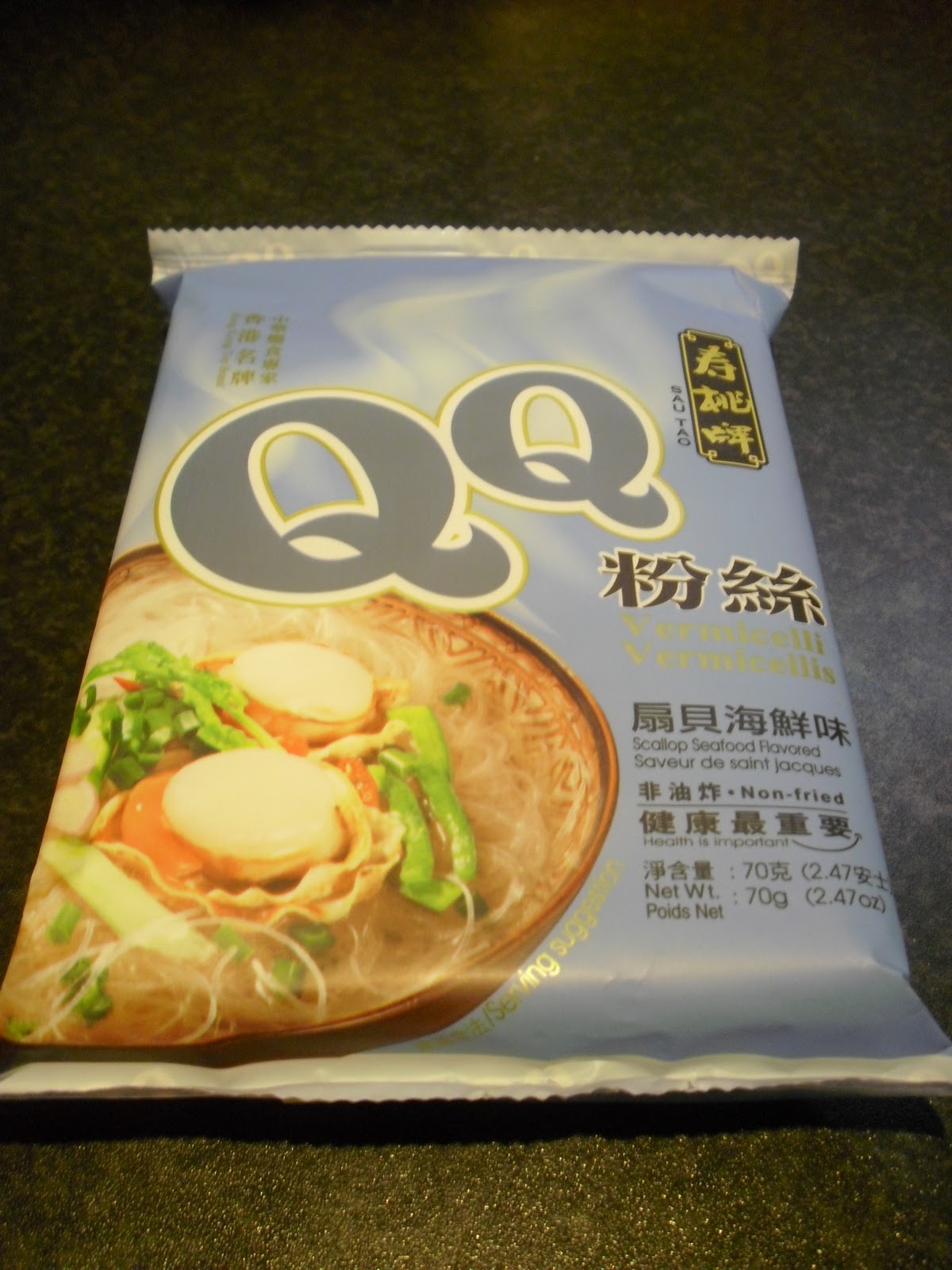
World of Noodles 6: QQ Vermicelli 粉絲


For those of you who think that the whole 'Mr Noodles' tag is a mere affectation, I assure you that nothing could be further from the truth; I really am a noodle obsessive. For example, when I bumped into fellow blogger, Catty, yesterday, I was laden down with shopping. If I was a normal person then I might've banged on about the discounts on the clothes I bought. But no, like a crazy man, I showed off my big bag of noodles (BTW – I'm convinced Catty's boyfriend thinks I'm a total nut-job).

The reason for my excitement was that inside my big bag of noodles was an instant noodle that I hadn't previously seen before: QQ Vermicelli 粉絲 by Sau Tao, a renowned Hong Kong noodle manufacturer. My normal instant soup noodle of choice is Nissin Ramen but I thought I'd try these glass noodles aka mung bean vermicelli (fensi 粉絲).


Cooking these noodles is a matter of following the instructions on the packet and I combined them with some pak choi 白菜, homemade fish balls 魚蛋 (homemade as in my Dad made them), and a garnish of spring onions. This was a great combination that complemented the scallop seafood flavour soup base.

But what about the noodles? And are they QQ* enough? They were good, and whilst I like mung bean vermicelli, I prefer Nissin Ramen and Sau Tao's Noodle King range. I'm also not sure why these noodles have been branded as 'QQ', if anything ramen and san mein (生麵) are more QQ.

QQ Vermicelli (粉絲) by Sau Tao is available at SeeWoo supermarket on Lisle St in London's Chinatown. They cost 55p per packet and come in a variety of flavours.

* = QQ is a slang term that I've come across in Hong Kong and Singapore (I'm not sure whether the term is used in mainland China or Taiwan) to describe a desirable springy texture in noodles. Thanks to 3 hungry tummies, who points out the Taiwanese origins of this term that derives from the Minnan (Hokkien) language.

Wednesday, 24 November 2010

Spanish Fried Rice 西班牙炒飯


As you may have gathered by now, I'm no great shakes in the kitchen. That said I do have a few dishes in my rather limited repertoire, one of which is fried rice.

Usually, I make this with whatever I have lying around. Stuff like leftover chicken might get bunged in a wok with some eggs, spring onion, and rice. Season with soy and finish off with some sesame oil and voila, a quick supper. Bit bloody boring really.

So one day I decided it to give my fried rice, an Iberian flavour with some chorizo, smoked paprika, peppers, onions and a couple of prawns. The end result needs some fine-tuning but I will be making this again.

Thursday, 4 November 2010

Yook Hwei 육회

I'm often asked why I started blogging. The answer is that I wanted to remember. I've been privileged over the years to sample great food from all over the world. But there's only so much that the mind can store and that's why I started taking photos and writing inelegant prose.


And it's just as well I do blog, as a few short months after being introduced to yook hwei (육회) by Catty, I nearly forgot all about it. It's a bit crap when you have to refer to your own blog archives to remember to order such a magnificent dish! Anyway, I reacquainted myself with the Korean version of steak tatare at Koba recently.

Before it's mixed at the table, this dish looks pretty scary with a raw egg perched on top of raw beef and nashi pear (bae 배). Once mixed though, the contrast between the textures of the beef and the crunchy pear combined with the sesame oil marinade is amazing. Here's a link to a recipe if you fancy making it at home.

Thursday, 30 September 2010

Gai Lan with Wasabi Soy Dip

I made this, honest I did!
This is the last of my Beijing posts and to sign off, I'm going to do something a little different by recreating a dish that I ate at a restaurant. This isn't something that I'd normally attempt, as one of the main reasons I eat out is to try food that I can't make at home. That and the fact that I'm a bit crap in the kitchen!

Anyway, this simple dish of gai lan with wasabi soy dip that I sampled at Beijing's Modern China (金满庭) seemed easy enough to have a crack at. The unusual thing about this dish is that the gai lan is served ice-cold. In fact in the restaurant, it was served on top of some ice in a fancy dish.

I feel a bit silly posting this recipe now, as this is a dish that's best enjoyed at the height of summer rather than at the onset of autumn. Just imagine how refreshing the ice-cold crunchy gai lan stalks enlivened by a spiky wasabi soy dip would be on a sweltering day.

Gai lan with Wasabi Soy Dip
6 stalks of gai lan
a slice of ginger
wasabi paste
light soy
ice cubes

This dish is all about preparation so before you start cooking, set up an ice bath with loads of ice cubes topped up with cold water.

Wash the gai lan and trim off the tough bottoms and loose bits. Stick into a pan of salted boiling water with a slice of ginger and cook for 3-4 minutes.

Remove the gai lan and plunge into the ice bath so that it stops cooking. Leave it in the ice bath for a while until it gets ice cold.

Shake off the excess water and plate up the gai lan. Prepare the wasabi and soy dip to serve on the side.

Some Hints
My first attempt at this dish wasn't a total success, as some of the gai lan stalks weren't as crunchy as I would've liked. On further analysis, these were the thinner stalks as the thicker stalks were al dente. Therefore, I recommend that you choose stalks of a similar thickness and adjust cooking time accordingly.

Looking back, my ice bath was also a bit inadequate, as I should've loaded it up with more ice. This would've stopped the cooking process and got the temperature down a lot quicker resulting in crunchier veg. Another factor to consider is the quality of the produce. The gai lan I used was fresh but I can imagine this dish being a bit of a shocker if you used tired vegetables on the verge of wilting.

About Gai Lan
Gai lan (芥蘭/芥兰), like many Chinese vegetables is known by a multitude of names in English, the most common of which are kai-lan and Chinese broccoli. This vegetable is widely available in Chinese supermarkets but isn't as common in High St supermarkets, although the likes of Sainsbury's and Waitrose might stock it.

Gai lan is very common in Chinese cuisine, in particular Cantonese cuisine as it originates from the south of China. Popular dishes that feature this vegetable include steamed gai lan with oyster sauce (蠔油芥蘭) and stir-fried gai lan with garlic (蒜茸芥蘭).

About The Dish
Modern China, where I sampled this dish, is ostensibly a Cantonese restaurant but one where they obviously like to experiment. My colleague who ordered this dish is originally from Hong Kong but she's never seen it in her hometown or anywhere else for that matter. Her suspicion is that this dish is unique to this Beijing restaurant.

Thursday, 19 August 2010

A Break

I'm taking a break for a few weeks. In the meantime, if you've come across this blog for the first time, there are a few recent posts that I'd like to draw your attention to.

Cha siu
As well as recently celebrating its 1st birthday, the blog also celebrated its 100th post with a guest recipe from 3 Hungry Tummies. I've also had the honour of writing a guest post on The Grubworm where you can read about my efforts at making cha siu.

In recent years, Chinese regional cuisine has taken off in London and whilst Sichuan cuisine has broken through, could the food of Hunan province make a similar impact? Check out what I thought of traditional Hunan cuisine at Golden Day and in its Americanised guise in the form of General Tso's chicken.

I love eating on my travels and I really enjoyed the food in Kuala Lumpur and in Singapore, where I enjoyed the cheap eats as much as the restaurants. Closer to home, The Golden Noodle Awards 2009-10 celebrates some of London's finest restaurants and noodles.

See you in September!

Sunday, 25 July 2010

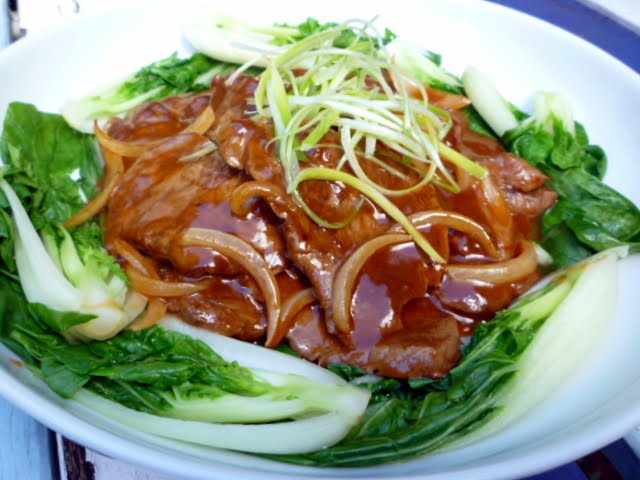
Chinese Style Beef Steak by 3 Hungry Tummies

It's the 100th post on Eat Noodles Love Noodles and rather than post one of my half-arsed reviews of a London restaurant, I've decided to do something special to celebrate. So it is my pleasure to present a guest post by one of my favourite bloggers, Suresh from 3 Hungry Tummies.

Suresh originally hails from Malaysia but he now calls Melbourne (or as I know it, Brunchtown) home. From his little kitchen, he knocks out the most amazing dishes, not just from his homeland but from across Asia and all over, to share on his blog. 


When Mr. Noodles of Eat Noodles Love Noodles asked me to do a guest post for his blog I said yes without any hesitation. It is not just any guest post; it is his 100th post and with such an honour bestowed upon me, I put my mind to work right away for something appropriate for such occasion. A noodle post might be an easy option but I decided against it and instead chosen a dish that might represent who he is - a British-born Chinese, whose parents emigrated from Hong Kong, who is also very passionate and proud of his heritage.

What I have chosen is this Cantonese classic created by talented Hong Kong cooks using both Chinese and English ingredients. It looks unmistakably Chinese that is until you have your first taste of the sauce that has all the English condiments in it, more importantly the Chineseness of the dish has not been compromised with the added foreign sauces. For Mr Noodles' friends who are still not convinced by the beauty of Chinese food, this might be a good dish to show them how versatile and diverse the cuisine can be. I am looking forward to the day we meet; there will be beers, wine and zha jiang mian.... oops! I mean dan dan mian! Last but not least, congratulations on your 100th post and am looking forward to the 200th and 300th...


serves 4 as part of a Chinese meal
you'll need;
500 g of beef fillet - sliced across the grains to roughly 8 mm slices*
1 tbs of light soy
1 tsp of white pepper
1 tbs of corn flour
2 tbs of peanut oil
2 garlic cloves, chopped
1/2 brown onion, sliced
1 bunch of bokchoy or Asian greens of your choice, halved lengthwise and blanched just before serving
1 spring onion, cut into 5 cm lengths and julienne
* Place beef in the freezer for 20 minutes to firm up to make slicing easier.

for the sauce;
6 tbs of tomato ketchup
3 tbs of HP sauce
1 tbs of worcestershire sauce
1 tbs of oyster sauce
dash of sesame oil
2 tbs of sugar
1/2 cup of stock
dash of white pepper
corn flour solution


Mix everything for the sauce in a bowl (except the corn flour solution) and set aside.


Slice beef across the grains and lightly pounded with a kitchen mallet.


Marinate beef with soy, white pepper, corn flour and peanut oil.


Pan fry beef in a hot pan without using any oil (a non stick pan is best) for 15 seconds on each side and set aside.


Saute garlic and onion for a minute then add in the sauce mixture and cook for a minute. Check for seasonings and thicken with a little corn flour solution.


Return beef to the wok and lower the heat. Coat beef pieces with the sauce and warm through, take care not to cook the beef any further.


Blanch Asian greens very briefly and drain well.


Serve beef with blanched greens and top with some julienne spring onions. I hope Mr Noodles will be making this for his Chinese food sceptic friends sometime soon.

Thanks once again to 3 Hungry Tummies for this recipe, which brings back a few childhood memories. Unbeknown to Suresh, my Dad cooked a very similar dish when I was growing up but with pork fillet instead of beef.

Thursday, 27 May 2010

Linguine Chinese Style

Being called Mr Noodles, it should come as no surprise that I also like pasta. One of my favourite pasta dishes is spaghetti all'aglio, olio e peperoncino. I mean what's not to love about noodles coated with olive oil, garlic and chilli ?

This simple dish is something that I occasionally rustle up but over the years I've adapted it depending on what I have in the store cupboard. On this particular evening, it took on a Chinese hue as I combined linguine (I didn't have any spaghetti in) with Chiu Chow chilli oil*, sesame oil, olive oil and last but not least, garlic.

Gently warm slithers of garlic in olive oil whilst the pasta is cooking. When the pasta is cooked, add to the olive oil and garlic. Add a dollop of the Chiu Chow chilli oil and mix in thoroughly. I also like to add sesame oil at the end. Serve as a main or as an accompaniment as I did with some steamed fish and pak choi.

* = Named after the city from which it originates, Chiu Chow chilli oil is a blend of dried garlic, chilli pepper powder, salted chilli peppers, soy sauce, and sesame oil in a soybean oil. It's widely available in Chinese supermarkets and I recommend the Lee Kum Kee brand.

Friday, 2 April 2010

New Pages

Eat Noodles Love Noodles has been going through some growing pains so I've decided to make life easier for readers, new and old. The observant amongst you will have noticed the appearance of a section entitled 'Pages' on my sidebar.

These pages have been under construction but they are now fully operational. Rather than trawl through archives or use the search toolbar, you can now track down the review or post you were looking for more easily.

A-Z London Restaurant Reviews - this pretty much does what it says on the tin. The restaurants are categorised as Chinese or Other and I've highlighted my favourites. As well as links to individual restaurant reviews, this page also includes links to the 'Off the Blog' series and other London guides.

Cooking & Culture - this page includes links to my posts on Chinese food culture as well as the occasional series, World of Noodles. If you want to have a good laugh, you'll also find links to my efforts at recipes.

Food & Travel - this page rounds up my eating adventures outside of London. These include links to individual restaurant reviews and city guides.

By the way if there are any restaurants that you think I should visit then please send an e-mail to eatlovenoodles@googlemail.com

Happy Easter ! 

Friday, 5 March 2010

Fishball Noodle Soup

I'm not sure I can get away with calling this a recipe as I'm merely heating stuff up. Mind you, what I'm doing isn't too far removed from what many Chinatown caffs do when they serve up fishball noodle soup or yu dan tang mein as it's called in Cantonese.

I know us bloggers are a precious bunch as we bang on about how you can't get a decent burger/pizza/burrito in London. But you really can't get fishball noodles in London that compare to those found in cities like Hong Kong and Singapore. I could spend an entire post on why that is but suffice to say fishballs are one of those Chinese staples that don't quite cut it in blighty. In fact, the only time I've given a place a really bad write-up was over a bowl of fishball noodles at HK Diner.  

So anyway, you might as well make this at home but before you do, you need to visit your local Chinese supermarket to get some pre-cooked fishballs (£3.60/450g pkt) and some fresh egg noodles (£1.35/400g pkt). These fresh egg noodles are called san mein in Cantonese and they are usually labelled as wonton noodles in English. It will come as no surprise that they are most commonly used in wonton noodle soup!

If you can't get hold of fresh noodles then rice vermicelli or dried egg noodles can be used instead. You'll also need some pak choi (or other leafy veg), spring onion, coriander, ginger, star anise, and a stock cube.

Fishball Noodle Soup (serves one)
This recipe serves one but by using the power of multiplication, you can make multiple portions. There are some tips in italics.

1) Dissolve a fish stock cube in 500ml of boiling water (you can use chicken stock instead or if you’re a pro, you may have your own stock).

2) Add ginger, star anise, coriander, spring onion to the fish stock and simmer for about 25-30 minutes.

3) Add fish balls then wait a couple of minutes before adding pak choi to soup, cook for a further 3 minutes. (between 8 and 10 fish balls per person is ample, you can also add sliced Chinese fish cake too).

4) In a separate saucepan, cook one nest of noodles for 30 seconds, drain then rinse under cold tap, and shake off excess water (always rinse fresh egg noodles otherwise they'll have a 'soapy' aftertaste).

5) Remove ginger, coriander, spring onion, and star anise from soup and discard.

6) Put noodles in soup and give them a quick shake to reheat.

7) Place noodles, fish balls, and pak choi in a bowl then pour the soup over these.

8) Garnish with fresh coriander and/or chopped spring onion (chives are an option too).

9) Add sesame oil or chilli oil (optional depending on personal preference).

If you want to make this dish with a South East Asian twist then add galangal and lemongrass instead of ginger and at the end, add some lime juice, chopped chillies, and fish sauce.

I was pretty chuffed with this bowl of noodles but any tips and tricks from proper cooks are most welcome.