Thursday, 16 June 2011

Eat Like A Local @ Tsui Wah 翠華餐廳 & Ocean Empire 海皇粥店

Whilst dim sum makes for a great breakfast or lunch, few people have the time, money, or metabolism to indulge a daily dumpling habit. So what are the alternatives? Well, for many Hong Kongers, they like to pop into cha chaan tengs (茶餐廳). These are best described as the Hong Kong equivalent of the American diner.


These diners are open from breakfast to late into the night, and serve a bewildering array of dishes encompassing Cantonese favourites, HK-style western food, and increasingly so, local versions of South East Asian dishes. For example, breakfast might be HK-style French toast or macaroni in broth w/fried egg, and lunch or dinner might consist of Hainan chicken rice or Malaysian curry.


One of Hong Kong's most famous cha chaan tengs is Tsui Wah (翠華餐廳), a small chain whose flagship branch is on Wellington Street and consists of three cavernous floors. This isn't the place for a quiet chat, and more often than not, you're expected to share a table with other diners.


I pitched up at Tsui Wah with some colleagues, and was confronted with multiple menus. I kept it simple and ordered fish combination w/rice vermicelli in fish soup (鮮味魚四寶米線), with the 'combination' consisting of squid balls (墨魚丸), fish balls (魚蛋), fish roll (魚春卷), and fish paste puff (魚腐). The quality may not have been the best, but as a workday lunch, it certainly beats the living daylights out of a tired old sarnie. And for a mere HK$30 (apx £2.50), it's certainly great value.


With hindsight, though, I should've gone for the Kagoshima pork cartilage in special sauce & fish balls w/rice noodles in fish soup that my colleague ordered. She kindly let me have some of the cartilage (豬軟骨) and it was fantastic, with all the porky goodness demanding to be sucked clean off the soft bone.


However, it was the flowering chives (韮菜) served with an abalone sauce that stole the show. This dish wouldn't have felt out of place in one of Hong Kong's swankier restaurants, never mind a humble cha chaan teng.

At the end of the day, Tsui Wah can be uncomfortable and noisy, and you can probably get better quality food at specialist 'hole-in-the-walls' like Lau Sum Kee. But for all that, a visit to a cha chaan teng is a must-do, as it is a unique Hong Kong experience.

Tsui Wah 翠華餐廳
G-2/F, 15-19 Wellington Street, Central, Hong Kong
香港 中環 中環威靈頓街15-19號地下至2樓
Nearest MTR: Central 中環

Despite being called Mr Noodles, my favourite Chinese breakfast is congee, or as it's called in Cantonese: juk (粥). As this rice porridge is a slow-cooked affair, locals go to a congee shop or juk diem (粥店) for convenience.


Ocean Empire (海皇粥店) is a mini-chain that serves many different types of congee, all priced around the HK$20 mark. I went for my favourite of fish slice congee w/coriander (芫茜魚片粥). For those of you that make congee at home, coriander is a great addition as it introduces an extra herby flavour whilst adding colour too. As I've come to expect from Ocean Empire, this was a fine bowl of congee with delicate flakes of fish and a deep ginger flavour.


Congee is usually topped with a couple of bits of deep-fried dough stick (you tiao 油條). However, some people like to order extra you tiao, and I'm no exception although I like to have it wrapped in rice noodle roll (cheung fun 腸粉) to make zhaliang (炸兩). Ocean Empire rather exuberantly names this dish in English as twisted doughnut ricesheet roll.

Ocean Empire's version is a good one. As you can see, the freshly made cheung fun is almost translucent. The fried doughstick is also crispy on the outside and isn't too oily. Incidentally, if you sit near the open kitchen, you can see the cheung fun being freshly made to order. They do quite a big range of cheung fun, and I can also recommend the dried shrimp ricesheet roll (蝦米腸粉). Other dishes include snacks and stir-fried noodles that are mainly served as accompaniments to the signature congee.

Some of Hong Kong's hole-in-the-walls can be inaccessible to non-Chinese readers, and it's to Ocean Empire's credit that their menu is in Chinese (both traditional and simplified characters), English and Japanese. In other words, there's no excuse not to come here!


Rather bizarrely, despite having multilingual menus, a few of their outlets only have Chinese signage. Ocean Empire's logo is as above, if you want to identify this superior juk diem.

Ocean Empire Food Shop 海皇粥店
Shop 1-2, G/F, 15-23 Sugar Street, Causeway Bay, Hong Kong
香港 銅鑼灣 糖街15-23號地下1-2號舖
Nearest MTR: Causeway Bay 銅鑼灣

Sunday, 12 June 2011

Dim Sum in Guangzhou @ 海雲軒

Sunday mornings in Guangzhou are very different to those in the UK in that the city is well and truly awake at a very early hour. This is clearly evident by the fact that the city's many dim sum restaurants are usually full to bursting by 10am. So it was no surprise that when we arrived at my uncle's local dim sum joint, we had to wait for a table, and even after we were seated, it seemed like ages before the food arrived. It's just as well that it was worth the wait.


I can't remember the name of the dumplings in the above photo but they were filled with a mix of peanut paste, sesame, water chestnuts, and spring onion, with some lard to enhance flavour. A true dim sum master created these little beauties, as the wrappers were gossamer thin and the dumplings perfectly steamed. Although the filling sounds a bit weird, it works really well, as there's a salty-sweet contrast in flavour.


Whilst 'man-sized' baked cha siu bao (叉燒餐包) are commonly seen in Chinatown bakeries around the world, I've only ever seen the miniature dim sum version in Asia. I really enjoyed these freshly baked soft buns with their honey glaze and tasty roast pork filling.


More familar dishes such as siu mai (燒賣), steamed spare ribs w/chilli (蒸排骨), and steamed beef balls (牛肉球) were also well rendered. The latter was particularly excellent, as there was a decent amount of dried citrus peel (果皮 guo pi) in the beef ball mixture. Also worthy of mention is the excellent congee (粥 juk).

I wouldn't go so far as to say that this is life-changing dim sum (for that try The Garden Hotel) or that you should especially visit this restaurant. Mind you, the quality of the dim sum is streets ahead of most of what you'll find in the UK and better than the couple of yum cha places I visited in Hong Kong. So if you do happen to be in the Tianhe area of Guangzhou then 海雲軒 is definitely worth a visit for breakfast, brunch or lunch.

By the way, despite this place having an English name on its business card, Ocean World Restaurant, only the Chinese name, 海雲軒, is seen on its signage. The dim sum order sheet is also only in Chinese, and I'm not sure if they have an English language menu or English speaking staff.

The easiest way to get to this restaurant is to hail a taxi and show the driver the address in Chinese:

海雲軒 Ocean World Restaurant
广州市天河北路550-556号帝景苑商业中心二楼
550-556 Tianhe Bei Lu, Guangzhou, China

However, the entrance is actually on 龙口西路 (Longkou Xi Lu), which runs perpendicular to 天河北路 (Tianhe Bei Lu).

Wednesday, 8 June 2011

Dinner @ The Chairman 大班樓

Wild clams in sake & fish broth
When on my travels, I tend to think more about what to eat rather than where to eat. That said, I always make an effort to identify one restaurant for a special treat. For my trip to Hong Kong, I did loads of research in seeking out the one, and time after time, one name kept cropping up: The Chairman (大班樓 tai pan lau).

This Cantonese restaurant stands out for doing things a little differently. For example, the menu changes regularly and is remarkably brief by Chinese standards. Conspicuous by their absence are dishes perceived to be westerner-friendly such as beef in black bean sauce, and more surprisingly, high-end local favourites like abalone. Instead the emphasis is on using, wherever possible, locally sourced free-range produce and additive-free ingredients.

This ethos is highly laudable but it also raises expectations. These were already high enough given that my dining companions, Tom and Jen, are big fans of this restaurant. Indeed it was Tom's recommendation that persuaded me to finally plump for The Chairman. So, no pressure then!

Appetizers
老火靚湯 Soup of the day
子薑皮蛋 Pickled Mid-summer Ginger Root served w/Century Eggs
檸檬葉蝦餅 Pan-fried Prawn Cakes w/Kaffir Lime Leaves
清酒魚湯煮紐西蘭蜆 Wild Clams in Japanese Sake & Fish Broth

Prawn cakes
Century eggs


We, well actually I, kicked off with the soup of the day: a clean tasting slow boiled consommé with pork, tripe and greens. This was followed by century eggs, which came with the most amazing pickled ginger.

Next up were the prawn cakes bejewelled with water chestnuts. Whilst these were tasty, they were no better than what many a restaurant in this part of the world can knock-up. Everything was fine up to this point but I did wonder when the meal was going to really come alive. Well I didn't have to wait long.

The final starter of wild clams is one of those dishes that will live long in the memory. Clams always come alive with a bit of booze and the mix of sake with Cantonese fish broth is an inspired idea. The broth was so moreish, I was well chuffed that there was some mooli to mop it up with. I was beginning to understand the hype.

Mains
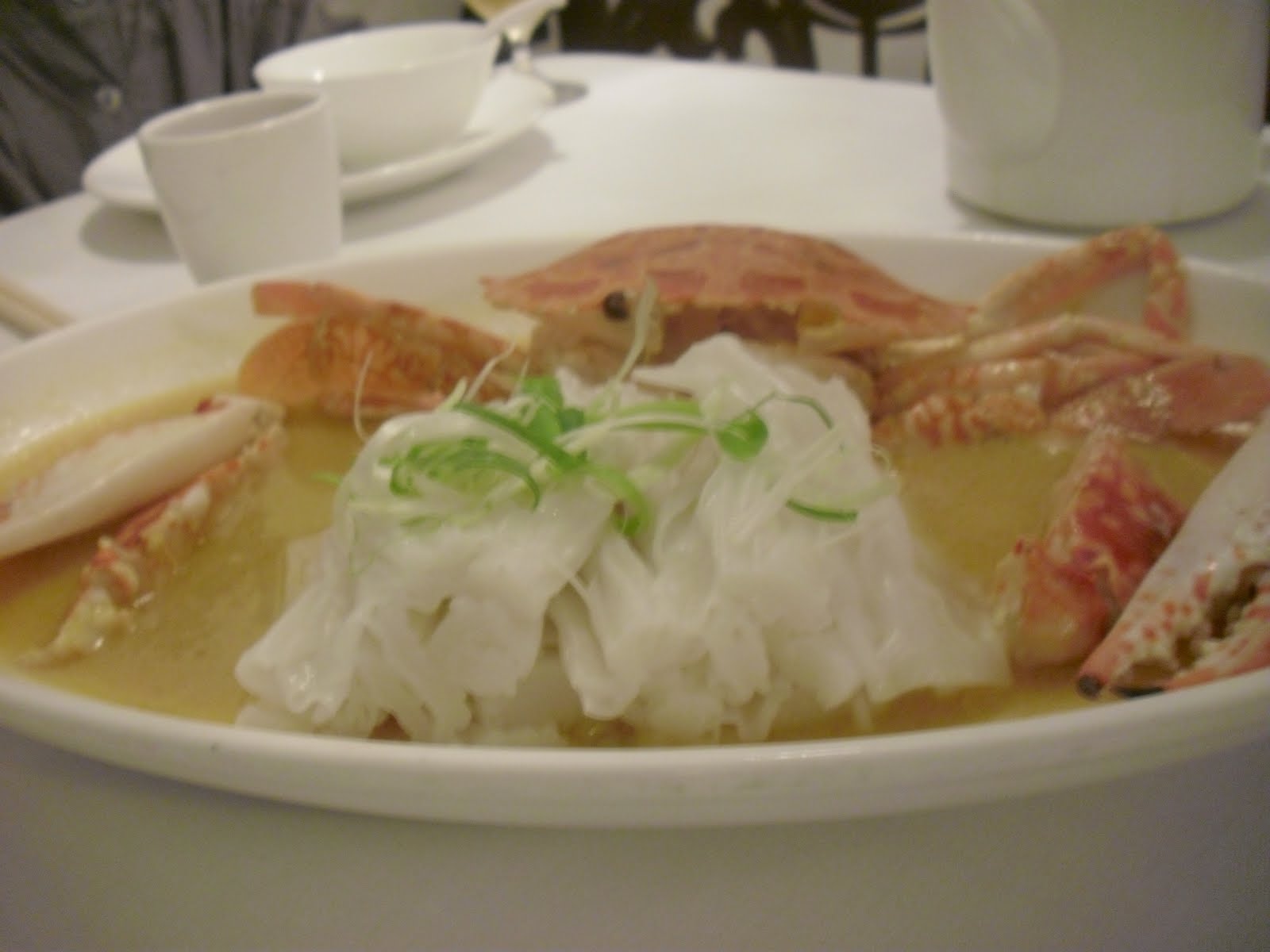
雞油花雕蒸花蟹配陳村粉 Steamed Fresh Flower Crab w/Aged Shaoxing Wine, Fragrant Chicken Oil & Flat Rice Noodles
十八味豉油雞 The Chairman's Soy Sauce Chicken
話梅肉桂糖醋排骨 Braised Spare Ribs w/Preserved Plums in Caramelized Black Vinegar
梅菜蒸芥籣 Steamed Kai Lan w/Pickled Chinese Vegetables

Steamed flower crab
The clams were a hard act to follow, but the crab surpassed them. Our server advised that we eat the steamed sweet crab first, whilst allowing the rice noodles to soak up the rich sauce consisting of Shaoxing wine and chicken fat. This sauce was so moreish that we asked for extra rice noodles to mop the rest up. This prompted our server to comment, 'many think the noodles are the support act, when in fact they're the main event'. Never a truer word said.

Extra rice noodles
The Chairman's soy chicken
Shortly after we finished our crab, the soy sauce chicken turned up. This is another of The Chairman's signature dishes, and one whose Chinese name boasts of 18 flavours from the same number of different herbs and spices used. I'll be buggered if I can work out what these are although the smooth tender chicken had a boozy medicinal quality rather than the usual predominant notes of star anise. Regardless, it was another winner.

Spare ribs
To round the mains off, the spare ribs and the steamed kai lan arrived. I liked the slightly tart flavour of the ribs (and the crispy fried 'bits' on the side) although Jen thought the meat should've slipped off the bone more easily. The crunchy kai lan and pickled veg was also a fine combo. However, as good as both these dishes were, I'd probably try something else, the next time I visit The Chairman.

Desserts
桂花杞子雪糕 Wolfberry Ice Cream
子薑雪糕 Pickled Ginger Ice Cream
生磨杏仁荼 Homemade Almond Milk

Wolfberry ice cream
All of these were homemade, and I enjoyed yet more pickled ginger in my ice cream. I'm not a big almond milk fan, but Jen liked hers. With hindsight though, I should've ordered the wolfberry ice cream based on the bit I had of Tom's.

The Details
With its retro red and gold signage, The Chairman looks like an archetypal Cantonese restaurant from the outside. However, once inside, apart from a massive chandelier, the interior is quite simple with white walls adorned by modern art. There's also a serenity that's absent from many a Hong Kong restaurant as exemplified by the quietly efficient service. I also liked that dinner was served 'banquet' style with a nice stagger to enable dishes like the clams and crab to be enjoyed without distraction.

Whilst some might find the portion sizes a bit nouveau and the price tag high (by Hong Kong standards), I think the extra quality outweighs these perceived shortcomings. Besides, if booze is taken out of the equation, I don't consider spending around HK$450/head (apx £37.50/head) on the food that we ordered as being particularly outrageous.

The Verdict
It's been a while since I've done one of these blow-by-blow reviews, and that's testament to how good The Chairman is. This restaurant really does capture the heart and soul of Cantonese cuisine: quality ingredients, simply cooked.

Other Stuff
For those on a budget, there is a three-course set lunch from HK$158 (£13). There's also a set dinner for groups of 4+ from HK$488/head (£40/head). Whilst the set dinner isn't necessarily better value than going a la carte, it is an easier way to sample The Chairman's delights if you're part of a larger group.

The Chairman 大班樓
18 Kau U Fong, Central, Hong Kong
香港 中環 九如坊18號
Tel: +852-2555-2202
e-mail: reservations@thechairmangroup.com
Nearest MTR: Sheung Wan
上環

Postscript: Being a food geek. I noticed that the rice noodles served with the crab were described as 陳村粉 in Chinese or Chencun fun rather than the more usual 河粉 or ho fun. My research reveals that Chencun 陳村 is a small village near the city of Shunde 順德 in Guangdong province, an area renowned for its rice noodles. However, I'm not sure what differentiates Chencun fun from normal ho fun - can anyone out there shed some light on this matter?

Sunday, 5 June 2011

Hong Kong Noodles X 3

It'd be fair to say that the district of Sham Shui Po (深水埗) isn't on the itinerary of most visitors to Hong Kong, be they on holiday or on business. And nor would it have been on mine but for Jason's blog post on the amazing bamboo log or jook sing noodles (竹昇麵) at Lau Sum Kee (劉森記麵家). Jook sing noodles are made by a chef riding a bamboo log – I know that sounds like a euphemism for something unwholesome, but this video explains all.


Like many hole in the wall joints in Hong Kong, the menu is written only in Chinese. Somehow I managed to pick out the 蝦子墨魚丸水餃撈麵 (har zi mak yu yuan shui jiao lo mein), or prawn roe noodles w/cuttlefish balls & shui jiao dumplings (HK$ 37) – at around the equivalent of £3; this is the most expensive dish at Lau Sum Kee.


As this is a lo-mein dish, the cuttlefish balls and dumplings are served in a separate bowl of soup. The cuttlefish balls were QQ springy and perfectly seasoned; if not own-made then they're from a very high quality source. The shui jiao dumplings were damn good too with a generous filling of prawn and wood-ear fungus (木耳).

However, both were eclipsed by the accompanying plate of springy jook sing noodles topped with a liberal sprinkling of dried prawn roe (the crack cocaine of seasonings – not that I know what crack is like). To eat these noodles, some of the soup is added to them whilst mixing in the prawn roe. Pure genius – I love everything about this dish.


Lau Sum Kee is a bugger to find, as there's no English signage and street numbers can be hard to find on Hong Kong shops. I walked past it twice before I realised that it was the place I was looking for. My excuse is that the Chinese name is written in the old-fashioned way (from right to left) rather than the modern way (from left to right).

After finishing my noodles, I stumbled across some freshly baked buns and cakes in a little caff. For the equivalent of a mere 20p, I bought a still warm pineapple bun (bolo bao 菠蘿包). And as I strolled around Sham Shui Po eating this soft sweet bun and its crunchy cookie-like topping, I marvelled at what a veritable foodies' paradise, this little corner of Kowloon is.

The streets are literally lined with hole-in-the-wall joints, each serving their own specialities, ranging from trad-Cantonese to other Chinese cuisines like Sichuan and Yunnan, as well as Thai and Vietnamese places. So it goes without saying that Sham Shui Po is well worth a visit – after all, it's only five MTR stops from Tsim Sha Tsui and seven from Central.

Lau Sum Kee Noodle 劉森記麵家
48 Kweilin Street, Sham Shui Po, Kowloon, Hong Kong
香港 九龍 深水埗 桂林街48號地下
Nearest MTR: Sham Shui Po 深水埗


So if Lau Sum Kee is perceived to be a bit out of the way, then Mak's Noodle 麥奀雲吞麵世家 and Tsim Chai Kee 沾仔記 are anything but, as both are located in Hong Kong's busy Central district. I pitched up first to Mak's to try their acclaimed wonton noodles (雲吞麵). The noodles were very elastic and served in a perfectly seasoned broth – I could understand why they are so famous. But what is it with the portion size? Four pretty tiny wontons consisting of a sole (smallish) prawn with not that many noodles for HK$30, granted that's only around £2.50 but you can get hell of a lot more for that kind of price in Hong Kong.


Given how small the portion was at Mak's, I popped across the road to Tsim Chai Kee for a bowl of two toppings noodles (HK$23). Compared to Mak's, this was a super-sized portion with two freshly made peppery fishballs (鮮新魚球) coupled with two wontons (雲吞) that had fatty pork as well as prawn. All told, both toppings were far superior to Mak's miniscule offerings. However, the noodles weren't quite as springy and the broth was a tad overseasoned for my liking.

So, if only you could combine the toppings from Tsim Chai Kee with the soup and noodles from Mak's then you might, just might, get a dish that's as good as Lau Sum Kee's jook sing noodles. But that's not going to happen so if you do find yourself in Hong Kong then pay a visit to Lau Sum Kee for some of the best noodles around.

Mak's Noodle 麥奀雲吞麵世家
77 Wellington Street, Central, Hong Kong
香港 中環 威靈頓街77號地下
Nearest MTR: Central 中環

Tsim Chai Kee 沾仔記
98 Wellington Street, Central, Hong Kong
香港 中環 威靈頓街98號
Nearest MTR: Central 中環

Thursday, 2 June 2011

The Cantonese Season

Fish-skin dumplings (魚皮餃)
'In Beijing, one talks; in Shanghai, one shops; and in Guangzhou, one eats.'

This famous saying neatly sums up the status of Guangzhou 廣州 (previously better known as Canton in the west) as China's culinary capital. And it's no exaggeration to say that Cantonese cuisine (粵菜 yue cai) is held in the highest esteem throughout the Chinese-speaking world. In contrast, it has a bit of an image problem in the west, as many people associate it with a bastardised version typified by gloopy multicoloured dishes.

Consequently, with the exception of dim sum, Cantonese food isn't that fashionable nowadays, especially when compared to other Asian cuisines. For example, Japanese food is perceived to be classier, and other Chinese cuisines, most notably Sichuan, are seen as more exciting.

More's the pity in my opinion, as there's so much more to my native cuisine than sweet & sour pork. And having just returned from Guangzhou and Hong Kong, I feel inspired to blog loads about it. That's why for the next month or so, it's going to be The Cantonese Season on Eat Noodles Love Noodles. But for those of you who can't wait 'til the start of the season, here's a few posts on Cantonese food that I made earlier:

Chinese Bakery
Guangzhou
Cantonese BBQ – The Three Roasts
Old School Dim Sum
How To Order Dim Sum
Dim Sum in London

Below are the links to The Cantonese Season posts:

Hong Kong Noodles X 3
Dinner @ The Chairman 大班樓
Dim Sum in Guangzhou @ 海雲軒
Eat Like A Local @ Tsui Wah 翠華餐廳 & Ocean Empire 海皇粥店
Cantonese Classics Part 1 @ Fu Sing 富聲
Cantonese Classics Part 2 @ Belly God 食为天
Under Bridge Spicy Crab 橋底辣蟹
Princess Garden - Going Cantonese in London
The Rustic Delights of Big Rock 大石
Hong Kong & Guangzhou Scrapbook