Thursday, 2 September 2010

I Heart Pork Belly

Dongpo pork
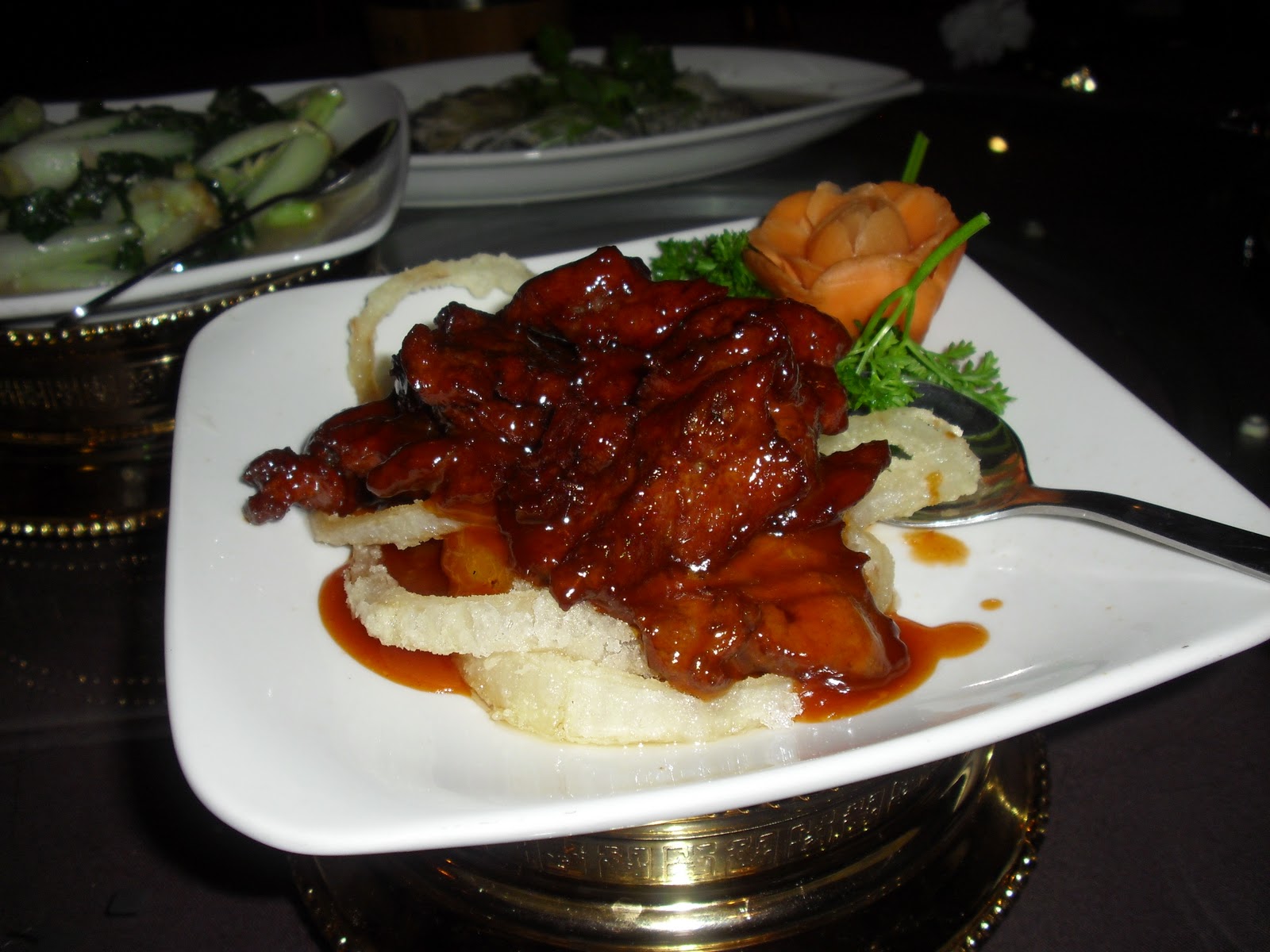
The Big Dish - Dongpo pork (東坡肉) 
Burgers are so last season. So what is the new black? Well it's pork belly. Now we've established that, I'll stop using laboured fashion metaphors! I love pork belly and I've already eulogised about Cantonese crispy pork belly (siu yuk 燒肉) as well as Japanese braised pork belly (kakuni 角煮).

However one dish I've neglected so far is Dongpo pork (東坡肉). Named after the 11th century poet, Su Dongpo, it is the very quintessence of Chinese cuisine. In this dish, the pork belly goes through several cooking processes before being braised using a technique called red cooking (hong shao 紅燒).

Red cooking utilises classic Chinese ingredients such as soy sauce, Shaoxing rice wine, rock sugar, and five-spice powder in a braising liquid. Last but not least, fermented red tofu is added to give these dishes their reddish hue, hence the term 'red cooked'. This technique is often associated with Shanghai cuisine but it actually originates from neighbouring Jiangsu province.

When dining recently at Phoenix Palace, the waiter spookily recommended Dongpo pork, just as I was about to order it anyway. This dish can be found in the 'Chef's Selection' section at the back of the menu, where it's listed as 蘇州東波肉(曼頭) with an imprecise English translation of five-spices pork belly with Peking bun (£13.80). Mind you I shouldn't complain about the translation as Phoenix Palace actually go to the trouble of having a fully bilingual Chinese-English menu.

So was this version any good? It was and to use the old cliché, the pork belly did melt in the mouth. The sauce was lovely too; it was sweet but not overly so as the soy sauce, five-spice powder and Shaoxing wine balanced it out. The Peking bun (mantou 曼頭) was an inspired addition, as it was perfect for mopping up the sauce. What would have made it even better is if they deep-fried the bun to give it a crispy outer but that's just me being super-picky.

Peking dumpling (left) and baby octopus (right) 
Crispy wasabi prawns
The Starters
水晶墨魚 Spicy baby octopus in chilli, garlic & pickled onion dressing (£6.80)
日式芥辣脆蝦球 Crispy wasabi king prawn (£11.80/8 pcs)
紅油水餃 Peking dumpling in soya chilli dressing (£5.80/4pcs)

The first two dishes came from the tabletop specials card of which I preferred the baby octopus with its sharp and zingy dressing. Mind you the prawns were very more-ish with their wasabi mayo coating. The pork and prawn Peking dumplings, which came from an abridged evening dim sum selection, were competently rendered but could have done with more soya chilli dressing.

Steamed Chilean sea bass fillet 
Cantonese fillet steak
The Mains
蘇州東波肉(曼頭) Five-spices pork belly w/Peking bun (£13.80)
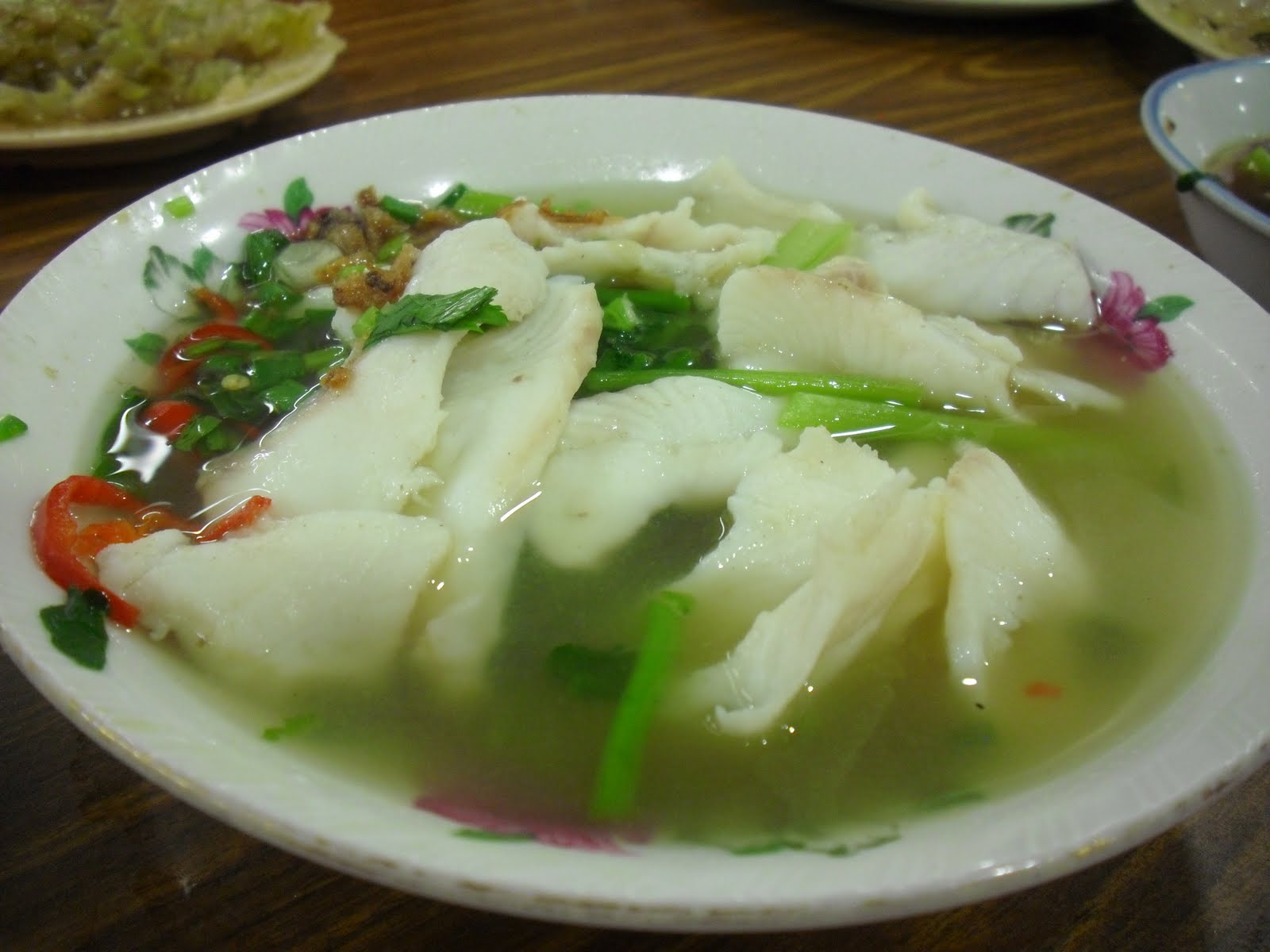
清蒸智利海鱸魚 Steamed Chilean sea bass fillet w/ginger & scallion (£25.80)
中式牛柳 Cantonese fillet steak (£10.80)
燒味雙拼 Two kinds rotisserie (£11.80)
蒜茸白菜 Pak choi w/garlic sauce (£9.80)

I think you may have gathered that the pork belly was the dish of the night but running it close was the Chilean sea bass fillet. We ordered this on the recommendation of the waiter, as he reckoned that cold-water fish such as Chilean sea bass are superior to their warm water counterparts. I have no idea whether he's right or not but it's a great line to drop into conversation. With the classic Cantonese accompaniment of ginger and scallions, this perfectly steamed fish was a winner.

We also liked the slightly 'dirty' dish of Cantonese fillet steak (here's a recipe) with its tangy Worcester sauce based marinade and superior onion rings (the best I've had in ages). For our two kinds of rotisserie (siu mei 燒味) we chose Cantonese roast duck (siu aap 潮漣燒鴨) and honey BBQ roast pork (cha siu 蜜汁叉燒). As I've come to expect, both roasts were excellent as was the pak choi w/garlic sauce.

Sesame paste
The Dessert
芝麻糊 Sesame paste (complimentary)

I'll let you into a secret; I occasionally score free desserts in Chinese restaurants. It's usually just a bowl of sweet Cantonese soup (tong sui 糖水) as was the case with our complimentary sesame paste. It's not the best looking dish but I enjoyed it even if it was a bit too sweet.

I know what you're thinking but I was being offered complimentary desserts long before I started taking photos of my food. I'm not sure why I get the occasional freebie but I think it's like getting an upgrade on a flight; it occurs randomly but won't happen if you're seen to be trying.

The Vibe
Full disclosure. Phoenix Palace is one of my favourite restaurants in London and I have fond memories of dim sum feasts and great nights out. I love the ambience and following a refurb, it's better than ever. Even on a Wednesday night in August, it was buzzing although the lighting meant it was hard to take decent photos. Service was better than normal with great recommendations and free dessert.

The Bill
With a bottle of average South African Gewurztraminer, rice and a pot of tea, the bill racked up to £147.20 including 12.5% service between four. That's roughly £37 per head, which I think is good value given the quality of the food.

What The Others Thought
Joining me for dinner was Mr Wine, Soft Aussie and Dr M and they loved almost everything. The hard to please Dr M even went so far to proclaim Phoenix Palace as the best Chinese restaurant that I'd taken him to. The only slightly negative note was the dessert, as only Soft Aussie liked it. Mind you, the others acknowledged that it was a matter of personal taste rather than it being a bad dessert per se. Moreover it was free.

The Verdict
I had no intention of blogging about this restaurant for a third time but I enjoyed this meal so much, I wanted to share it with you. Phoenix Palace can have its off days but on this occasion everything came together. On this kind of form it's well worth a visit.

Phoenix Palace on Urbanspoon

Phoenix Palace, Glentworth St, London NW1 5PG (Tel: 020-7486-3515)
Nearest tube: Baker St, Marylebone

Wednesday, 1 September 2010

I'm Back

Selection of butter, Eastside Inn  (photo courtesy, The Grubworm)
I'm back but before I dive in, I just want to let you know of some changes that I'm planning. Restaurant reviews can get a bit formulaic so I'm going to experiment in how I present mine. I'm not sure what direction I'm going to take but one decision I've made is to use Chinese characters in my reviews where appropriate.

I'm doing this because Chinese food can be inaccessible with the same dish having a number of different names in English. It can be confusing and it often deters non-Chinese speakers from being adventurous. In the past, I've used Mandarin pin yin and transliterated Cantonese to describe dishes but unless you speak Chinese, it isn't entirely helpful. By using Chinese characters in my reviews, you can print them out and show staff the dish you want to order, no matter which restaurant you end up in.

If you want to learn more about reading Chinese menus then I can recommend the excellent Adventures in Kake. I'm also hoping to use native languages for my write-up's of other Asian cuisines. Although this will be trickier, as my knowledge of Japanese, Thai, Vietnamese etc is non-existent.

Back to the photo of the butter at the beginning of the post, this was from the Eastside Inn. I was lucky enough to tag along with The Grubworm, who had been invited by co-owner Justine to check out their new bar snack menu. I thought the bar snacks were brilliant but who'd have though that the butter would be the star of the evening. My favourite was the seaweed butter in the middle of the photo.

My outing here was an unexpected pleasure and this post is a belated thank you to Justine (and Bjorn) for their kind hospitality, fine cocktails and excellent bar snacks. For a proper write-up of the evening, please click here.

{Update - a few short days after writing this, Eastside Inn closed for business. It's always sad when a decent joint closes and I'd like to wish Bjorn and Justine, the best of luck in their future endeavours.}

Thursday, 19 August 2010

A Break

I'm taking a break for a few weeks. In the meantime, if you've come across this blog for the first time, there are a few recent posts that I'd like to draw your attention to.

Cha siu
As well as recently celebrating its 1st birthday, the blog also celebrated its 100th post with a guest recipe from 3 Hungry Tummies. I've also had the honour of writing a guest post on The Grubworm where you can read about my efforts at making cha siu.

In recent years, Chinese regional cuisine has taken off in London and whilst Sichuan cuisine has broken through, could the food of Hunan province make a similar impact? Check out what I thought of traditional Hunan cuisine at Golden Day and in its Americanised guise in the form of General Tso's chicken.

I love eating on my travels and I really enjoyed the food in Kuala Lumpur and in Singapore, where I enjoyed the cheap eats as much as the restaurants. Closer to home, The Golden Noodle Awards 2009-10 celebrates some of London's finest restaurants and noodles.

See you in September!

Sunday, 15 August 2010

Singapore Part 2 - Cheap Eats

I love Singapore's hawker centres. There's something great about checking out the different stalls and buying a snack or two, as you decide what to eat next. One of the most famous hawker centres in the island state is Lau Pa Sat, which means 'old market' in the local vernacular.

Mixed satay
Lau Pa Sat satay stalls
You come here for one dish above all others, the satay. You know when you're getting close to Lau Pa Sat when you can see the plumes of smoke coming from the outdoor grills. First up bag a seat outside and watch the satay being grilled but try to not to get too close to the smoky grill.

We ordered a combo of chicken, beef, and mutton satay. I thought it was all good although some thought that the honey baste was too sweet. I didn't mind so much as the accompanying zingy sauce counterbalanced the sweetness.

BBQ stingray w/chilli sauce
fried bee hoon
We also ordered bbq stingray w/chilli sauce and a dish of fried bee hoon (rice vermicelli). I really liked the chiili sauce that came with fish; so much so, I stirred it into the vermicelli. My hosts were truly mortified when I told them that in the UK, curry powder is added to fried bee hoon to make 'Singapore noodles'.

We then went inside this fine Victorian building for more food. To be honest, other than the satay, I don't think the stalls at Lau Pa Sat are the best in Singapore. I had trouble finding a decent laksa stall so I played it safe and went with an old fave, a bowl of shrimp dumpling soup noodle (sui gow mein) – a mere S$3.50 for a giant bowl including six plump dumplings.

Bak kut teh is another iconic dish found in Singapore and the name literally translates as 'meat bone tea'. Originally introduced to the region by Hokkien Chinese, there are many different versions of this pork rib broth found across Malaysia and Singapore. I'd previously tried the darker medicinal version but this was the first time that I'd sampled this lighter peppery variant.

bak kut teh
We sampled the bak kut teh at Outram Park Ya Hua Rou Gu Cha located on the ground floor of the PSA Tanjong Pagar complex on Keppel Rd. This was like a hawker centre stall-restaurant hybrid in that it had its own seating – we even reserved a table – but the ambience was very much like a hawker centre.

you tiao (fried dough stick)
I adored the bak kut teh, as the fatty meat fell away from the bone full of the flavour of the 'tea' (you can order lean rib but really what's the point in that?). This peppery version was quite different from the medicinal version I'd previously tried but enjoyable nonetheless. Some of the guys thought that it was too peppery but I didn't mind. I also liked dipping the you tiao (fried dough stick) into the 'tea'.

Whilst the bak kut teh may look like a meagre portion, there are unlimited top-up's of the 'tea' throughout the meal. We also shared loads of different dishes in addition to our individual bowls of bak kut teh and rice.

fish slices in broth
liver & kidney in broth
My favourites included separate bowls of fish slices, liver & kidney, and watercress – all served in broth. Oh and I managed to sneak in a crafty bowl of mee sua noodles! This rustic home-style food was a great counterbalance to some of the richer fare I'd eaten during the course of this trip.

The bak kut teh was my last lunch in Singapore and during the afternoon in the office, my thoughts started to drift to what to have for dinner. Although like many a Friday night, my plans for dinner were interrupted by an excursion to the pub. For a change I was vaguely sensible, as I still had to get to the airport that night. I stopped drinking, said my goodbyes and took a cab to the Maxwell Rd food centre.


I'd already had some nibbles at the pub so I didn't have room for a big meal. I went for an old favourite, chicken murtabak at a stall I vaguely remember visiting a couple of years ago, Hajmeer Kwaja Muslim Food. To the uninitiated, murtabak is a roti filled with meat (usually mutton or chicken), onion, and egg that's served with curry sauce.


This dish was introduced to Singapore by Tamil Muslims and you can't really get it in the UK, so I was glad that I managed to squeeze it in before I left. It was as good as I remembered, the flaky filled roti combining really well with the curry sauce. It was just what I needed before picking up my bags at the hotel. Now that I come to think of it, my last meal in Singapore was a curry after a few beers on a Friday night! Some things are universal.

As I left for home, I realised that there were so many other dishes I hadn't got round to sampling on this visit. In particular, nasi lemak, prawn noodle, laksa, and fish head curry. Next time, I hope there'll be a next time.

Wednesday, 11 August 2010

Singapore Part 1 - The Restaurants

I was fortunate enough to be in Singapore recently and I'm looking forward to share with you some of my foodie experiences. In this post, I'll be running the rule over restaurants serving up famous local dishes such as Hainanese chicken rice and chilli crab. For those of you who love food from Singapore's hawker centres, I'll be turning my attention to cheap eats in the next post.

Hainanese chicken rice
What is Singapore's national dish ? A strong contender is Hainanese chicken rice, so it was a bit of a no-brainer when I was asked what I wanted for dinner on my first night in Singapore. I left it to my colleagues to choose the venue, as I'm a great believer in tapping into local knowledge.

I had no idea where I was going to be taken when we left the office and the CBD behind us. Normally, I am intolerant of taxi drivers who don't know where they're going but strangely I took it as a good sign that he got lost. I had visions of being taken to some illicit backstreet chicken rice shebeen.

I was therefore a little disappointed that we ended up on the East Coast Road, about 10km from the CBD. Just how the cabbie got lost is beyond me, as this was a brightly lit main road. My disappointment soon faded when I was told that the East Coast is a great foodie area. As we left the taxi, I could see a row of eateries jostling for our attention. My colleagues then pointed out where we were going to eat and all was well with the world again.

Our destination was Boon Tong Kee, a mini-chain of Chinese home-style restaurants specialising in chicken. This place seemed strangely familiar and then it dawned on me that Su-Lin of Tamarind and Thyme had already sung the praises of this place. That's just bloody typical of Su-Lin, not content to be the first to blog about London's more interesting eateries; she also gets there first in Singapore too !

white-cut poached chicken
We went for their signature poached chicken aka 'white-cut' chicken, which was served separately from the rice that was cooked in chicken stock. The bird was juicy and moist and actually tasted of chicken; it went really well with the ginger paste and the special chilli sauce. One minor grumble was that the chicken soup wasn't served with this dish. That said the rice was that tasty, it probably didn't need the broth.

sotong sambal
Other dishes included sotong sambal (stir-fried chilli squid), deep fried tofu, and stir-fried gai-lan. These were all OK but you only really come here for the chicken. They also do a crispy fried chicken but we didn't try that. By the way, they also sell jars of the sauces such as ginger paste and chilli sauce (I am now a proud owner of both). Highly recommended but try to get a cabbie who knows his way round Singapore.

The other contender to be Singapore's national dish is chilli crab. Whilst Hainanese chicken rice is a dish that originated from China, chilli crab is an indigenous Singaporean creation. In common with Hong Kong, chefs from China that settled in Singapore utilised Western ingredients to create dishes long before the term 'fusion' ever came into use.

chilli crab
deep-fried mantou
The crab is served with rich gravy made with chilli sauce, garlic, rice vinegar, soy sauce, and good old tomato ketchup. Egg is swirled in at the last minute to make it even richer, this gravy demands to be mopped up with deep-fried mantou (Chinese buns). Mixing my food metaphors, this is the Asian equivalent of soul food.

My Singapore colleagues really know the meaning of hospitality and they took me to the No Signboard Seafood restaurant to sample this dish. This mini-chain has a number of outlets and we pitched up at the Esplanade branch but if possible, try and get to the Geylang branch, which is the most atmospheric.

Their chilli crab is renowned and the meat just eased out of the slightly pre-cracked claw. I loved it and couldn't get enough of the gravy, which I ended up spooning into the shell before eating it with the hai-gou (crab innards).

butter crab
In comparison, the butter crab was a bit boring but it would still better most crabs served in western restaurants. They also serve crab with ginger & spring onion as well as white pepper crab but strangely not the more renowned black pepper crab.

cereal prawns
I also liked the cereal prawns, which is another Singapore creation, big fat prawns deep-fried with cereal. I could pick out cornflakes but maybe they were Frosties, as they were quite sweet. Actually, such is the popularity of this dish, a special cereal meal has been developed to be used in cereal prawns (or so I've been told!).

steamed bamboo clams w/garlic
Many of the dishes here aren't exactly healthy so I was glad that we ordered steamed bamboo clams w/garlic. The just cooked sweet clam meat with garlic was a joy. Whilst crab is their signature dish, they also serve lobster, steamed fish, and a wide range of seafood. Another must visit.

Despite most of Singapore's population being ethnic Chinese, the Cantonese community is relatively small. However their influence on the local food scene is massive with many of the classier eateries being Cantonese.

One such example is Lei Garden, the Singapore outpost of a renowned Hong Kong restaurant group. This elegant restaurant is located in the Chijmes complex, a converted convent. Sometimes food in opulent surroundings can disappoint but the dim sum here didn't. In fact it was amongst the finest I've had in ages. Just look at how translucent the har gau wrappers are.

har gau (prawn dumplings)
black sesame balls
This exceptional quality ran through nearly all of the dim sum with the highlights being soupy Shanghai xiao long bao, silky smooth cheung fun, an amazing gingery cha siu bao filling and last but not least, wonderful black sesame balls. Oh and let's not forget the pork and century egg congee that was so tasty, we ordered an extra bowl. The dim sum menu is a bit on the short side but who cares when it's this good. If only London had a Cantonese restaurant of this quality.

PS: I've also been moonlighting and you can check out my guest post on The Grubworm by clicking here. Don't laugh but it's a recipe.