Showing posts with label China. Show all posts

Monday, 3 June 2013

Din Tai Fung in Tokyo & Hong Kong


What with my track record, I know you're not going to believe me when I say I didn't mean to visit Din Tai Fung (鼎泰豐) three times in eight days in two different cities. But I did. First up was a solo visit to the Takashimaya Times Square branch in Tokyo. This was followed with a couple of visits to the Causeway Bay branch in Hong Kong, where I had one meal with a colleague and another one with family.

Three kinds of seafood XLB
Pork & scallop XLB
Naturally, as with any trip to Din Tai Fung, I decided to check out the signature soup-filled xiao long bao (小籠包). I've probably banged on about these far too much over the years and the classic pork xlb in Tokyo didn't disappoint. I also ordered a steamer of three kinds of seafood xiao long bao (海鮮三種小籠包). Of these, my favourite was the pork & scallop with the pork & crab a close second, but I wasn't overly keen on the pork & sea urchin, as the sea urchin was a bit overpowering.

Pork & black truffle XLB
Angled luffa & shrimp XLB
Over in Hong Kong, I thought the classic pork xlb and pork & crab xlb were better than in Tokyo but of these were eclipsed by the sublime pork & black truffle xlb (黑松露小籠包), where the rich truffle filling was out of this world. I also enjoyed the unusual angled luffa & shrimp xlb (絲瓜蝦仁小籠包) – this is a little different with its clean tasting, refreshing filling of silk gourd (aka angled luffa).


Of the other dishes in Tokyo, I was a bit disappointed with the steamed chicken soup (原盅鮮雞湯). In other branches of Din Tai Fung I've been to, this soup has been outstanding, but the version here was lacking flavour and a bit oily to boot. And the shrimp fried rice (蝦仁蛋炒飯) was decidedly lacklustre, too. I mean, just look at the photo of the version in Tokyo on the left compared to the one in Hong Kong on the right. Rather bizarrely, the fried rice came with a konbu seaweed soup, which is a Japanese, not Chinese, affectation. That and the use of local vinegar rather than Chinkiang vinegar also grated.

So while the signature xiao long bao were excellent in Tokyo, the support acts were the weakest I've come across in any branch of Din Tai Fung I've visited. However, this is all relative, and the positives far outweigh the negatives. In particular, I was very impressed by the service. Having sensed my total lack of Japanese language skills, a Mandarin-speaking waitress from Taiwan was assigned to look after me. My Mandarin is pretty shoddy, but it was a nice gesture nonetheless.


Any lingering disappointment from my visit to the Tokyo branch was soon eradicated in Hong Kong. To be precise, it was a cold noodle salad, bizarrely described in English as garlic pork green bean fettuccine (蒜泥粉皮肉), which restored my faith in Din Tai Fung. I just loved this winning combination of soft pork slices, crunchy cucumber slithers and wobbly broad fen-pei noodles in a garlicky soy vinegar dressing.


We also tried the fried shrimp & pork potstickers (肉蝦仁煎餃) for the first time, which were, as is the fashion nowadays, served upturned stuck onto a fried dumpling pastry sheet. This is a bit gimmicky in my opinion, but it did spark off a conversation of how they were constructed. These were good, but there are probably other things I'd order off the menu first.


Stuff like the open-topped shrimp & pork shao mai (蝦仁燒賣) and the various wonton dishes are higher up in the pecking order in my opinion. Of the wonton dishes I preferred the spicy shrimp & pork (紅油抄手), which had a real kick, to the ones in special sauce (乾拌菜肉餛飩). Memo to Din Tai Fung management, I wouldn't use the term 'special sauce' should you decide to open in Britain.

There was other stuff, but I thought I'd go over to one of my dining companions to give his opinion. After all, he's not some dilettante blogger, but someone who's worked in kitchens most of his life and really knows his stuff. I am of course talking about Pa Noodles, and his comments over the course of the meal have been translated from Cantonese into italics:

How meticulous, there's a guy weighing out dumpling dough in the kitchen. The dumplings here really are quite exceptional; this is a PROPER restaurant, they don't take short cuts. Mind you, they could've been a bit more generous with the crab in the pork & crab XLB. My favourite? Probably the wontons in spicy sauce; the sauce has a proper kick. The pork chop with soup noodles (油炸排骨湯麵) is good, too – nice tender meat with good 5-spice flavour. But the rice, the fried rice, it wasn't fluffy enough, a bit too hard. But anyway, I like it here. Is there one of these in London? It'd make a fortune there.

A fair assessment by Pa Noodles, although I think he was a tad harsh about the rice! My mum liked Din Tai Fung too, although she didn't really rave about it. The thing is she's rarely effusive about food that isn't Cantonese. And my colleague liked it so much he's planning to visit the branch in his hometown of Sydney. Me? I've been to the Causeway Bay branch in Hong Kong four times now, and I love it. If only they could open one in London – I know it's a forlorn hope, but here's the link to my petition anyway.

Tuesday, 14 May 2013

Seven Things You MUST Eat In Hong Kong

Rather than bore you senseless with loads of blog posts about Hong Kong I thought I'd lazily rehash some Instagram shots put together a list of must-eats. It's not an exhaustive list and nor is it ranked in any order; it just consists of some of my favourite foods that just so happen to capture the soul of Hong Kong.

SEAFOOD
Hong Kong was originally a fishing village, and while those days are long gone, the love of fish and seafood lives on in the many eateries specialising in the life aquatic. Dishes such as lobster in superior stock with e-fu noodles (上湯龍蝦伊麵); steamed scallops with garlic & glass noodles (粉絲蒜茸蒸扇貝); chilli salt mantis shrimp (椒鹽攋尿蝦) and typhoon shelter crab (避風塘炒蟹) amongst others are all classics.


Left: lobster noodles, Right: steamed scallops

To spot places that serve seafood, look for the characters: 海鮮酒家, which means seafood restaurant, or if your Chinese is ropey just look for giant fish tanks by the entrance. Hong Kong isn't just urban sprawl so why not take a trip to quieter seaside spots such as Sai Kung or Lamma Island to eat seafood? I can recommend Rainbow Seafood Restaurant (天虹海鮮酒家) on Lamma Island, where I took the photos of the lobster and scallops.


Left: roast goose, Right: braised goose

GOOSE
It breaks my heart that Chinese restaurants in London don't serve goose, which is why when I'm in Hong Kong I eat it like there's no tomorrow. My favourite is Cantonese roast goose (燒鵝), prepared in much the same way as roast duck is, with crispy skin and succulent meat that's served with plum sauce. Whisper it, but such is its richness I prefer my roast goose on a bed of rice rather than noodles. I also love the Teochew/Chiu Chow-style braised goose in master stock (鹵水鵝). I especially adore gnawing on goose wings cooked in this way known as lou sui in Cantonese.


Left: dace fishballs, Right: cuttlefish balls with noodles

BALLS
By balls I don't mean the testicles of various animals, I mean meatballs and fishballs. Think of balls on sticks, balls in soup noodles, balls in congee, balls as dim sum and so on. When in Hong Kong I like to sample the balls that aren't easily found back home. During this trip I was seduced by dace fishballs (鯪魚球) with their alluring citrusy scent. These fishballs can be deep-fried but I prefer mine boiled. Another favourite of mine is cuttlefish balls (墨魚丸) served in a bowl of soup noodles.

DIM SUM
There are excellent dim sum restaurants all around the world but there is something special about eating these tiny morsels of delight in their natural habitat of Hong Kong and southern China. Why? Well, for starters the dim sum masters are continually innovating. A good example of this is the flaky baked cha siu bao (酥皮焗叉燒包) as invented by Mak Kwai Pui, he of Tim Ho Wan (添好運) fame. These buns are always served freshly baked and they are good, damn good although I'm not sure if the rest of Tim Ho Wan's offerings are anything that special based on my visit there.


Left: baked cha siu bao, Right: lau sa bao

Other dim sum that are worth trying include lau sha bao (流沙包), a variant on the more common custard bun known as lai wong bao (奶黃包) - the difference being the former has a molten filling. And in general, I recommend trying dim sum that you haven't come across before. Some of these might be trendy new creations while others might be some old specialities from the dim sum master's ancestral hometown across the border in China. Regardless, you'll be in for a good time.


Left: bolo bao, Right: mango jelly drink

HONGKONGER POINTS
To properly explain the difference between Hong Kong culture and Chinese culture, I might need to do a dissertation. Even Cantonese culture, with which Hong Kong shares a common language, is not quite the same thing. In a food context the bakeries, cake shops and dessert shops found in Hong Kong are very much a local creation due in part to exposure to western ideas. That said, while there are western influences the food has taken on a local flavour. For example, creations such as the pineapple bun (bolo bao 菠蘿包) and egg tarts (daan taat 蛋撻) are very Hong Kong despite utilising western baking techniques. Other stuff that you should try in order to accrue Hongkonger points include a trip to a dessert shop such as Hui Lau Shan (許留山) to try various desserts and drinks like mango jelly drink.


Left: French toast, Right: ham and egg in crispy bun

'WESTERN' BREAKFAST
What do Hongkongers eat for breakfast? There are those that go for traditional Chinese fare such as dim sum or congee, but many people eat a 'western' breakfast in a cha chaan teng (茶餐廳) or an 'ice room' (冰室). These places serve a mix of Chinese and Hong Kong-style western food – sometimes on the same plate (macaroni with cha siu in soup, anyone?). Popular breakfast items include HK-style French toast (西多士) and various sandwiches containing ham, SPAM, egg and other things. To drink, coffee, HK-style milk tea, lemon tea as well as the half tea-half coffee drink called 'yin-yang' are all popular. It goes without saying that eating this kind of breakfast results in further Hongkonger points!


Left: sui gow noodles, Right: beef brisket noodles

NOODLES
Oh come on now, you didn't really think I was going to omit noodles from my list? These are the ultimate convenience food, as you are never more than five minutes away from a noodle shop in Hong Kong. My favourite are the various noodle dishes served in soup with stuff like wontons, fishballs and sui gow dumplings. My choice of noodle depends on the topping served, but I tend to plump for the thin fresh noodles commonly served with wontons and sui gow (see photo above left). Over the years I've been ticking off the famous noodle shops of Hong Kong and on this visit I finally got to visit Kau Kee (九記牛腩) famed for its beef brisket noodles. I went for the classic beef brisket noodles in superior stock (上湯牛腩麵) and I also had a taste of brisket and tendon noodles in curry broth – both were excellent!

Friday, 10 August 2012

The Golden Noodle Awards 2011-12

Eat Noodles Love Noodles is three today, and there's no better way to celebrate than with The Golden Noodle Awards. The awards are a bit slimmed down this year, but to keep things interesting I've introduced a couple of new awards.

The Golden Noodle
Winner: Phở sốt vang by Phở Thinh, Hanoi

In common with last year's contenders, all of my favourite noodle dishes over the past year are from overseas, specifically China and Vietnam. And it's from the latter that the winner hails. Quite simply, the phở sốt vang from Phở Thinh in Hanoi is one of the best bowls of noodles I've ever eaten. The combination of anise-scented broth, slippery smooth broad rice noodles and stewed beef in wine with a side of fried dough sticks was simply amazing.

phở sốt vang @ Phở Thinh
But as much as I enjoyed the noodles in Vietnam, the silver and bronze medals go to Chinese dishes I sampled in Beijing. Din Tai Fung, better known for their xiao long bao, takes the silver for a rather special steamed chicken noodle soup. While taking bronze is a massive dish of belt noodles in spicy garlic sauce (originating from Shaanxi province) from Qin Tang Fu.

The Golden Dim Sum
Winner: Wasabi prawn dumplings by Phoenix Palace

This Golden Dim Sum is awarded to my favourite dim sum dish in London. There are many contenders for this accolade, but the award goes to an old favourite with a twist: wasabi prawn dumplings. These slightly plumper har gau (prawn dumplings) with a nasal passage-clearing wasabi hit are a must-order at Phoenix Palace. They're so good that I don't mind the £4.20 price-tag that their presence on the specials menu demands.

Wasabi prawn dumplings @ Phoenix Palace
Coming in a close second is Princess Garden's golden cuttlefish cheung fun. This triple textural delight consisting of springy cuttlefish paste, crispy tofu skin, and slippery smooth rice noodle is the best cheung fun dish in London. In bronze medal position is the capital's finest sweet dim sum dish: chrysanthemum custard buns by Pearl Liang – remember to order these deep-fried, not steamed.

The London Gold Award
Winner: Eat St

This award celebrates what I love best about London's food scene. However, it isn't the number of Michelin stars that I want to shout out about, it's the grassroots as represented by Eat St. To the uninitiated, this collective of street food traders most famous for its stalls on King's Boulevard (round the back of King's Cross station). My favourite vendors include The Rib Man, Banhmi11 and Eat My Pies. I visit Eat St most lunchtimes and it has improved my quality of life no end, which is why they win the inaugural London Gold award.

Rib Man @ Eat St
I'd also like to give a quick mention (and joint-silver medals) to Maltby St Market and Brixton Market/Village where the likes of Bea's Diner, Kaosarn and Mama Lan ply their trade. Sadly, there are some contrary voices deeming the various stalls and traders to be too hipster/middle class/gentrified. While we're all entitled to our opinions, I find much of the criticism to be lazy, shrill and self-loathing, and I think all of these places are a welcome addition to the capital's food scene.

Anyway, that's all folks! It's time for my blog to take its summer break - see you all in September!

Wednesday, 25 July 2012

THAT Black Truffle Xiao Long Bao @ Din Tai Fung


Come on now, you didn't think I'd go all the way to a city with a branch of Din Tai Fung 鼎泰豐 and not pay a visit? And so it was I ended up in one of the four Beijing outlets of this superior dumpling chain. Dining solo, I went for a small steamer of pork & crab xiao long bao 蟹粉小笼包 (5 pcs) and I tried pork & black truffle xiao long bao 黑松露小笼包 (5 pcs) for the first time.


To be honest, my first reaction was that the soup-filled dumplings had shrunk compared to previous visits to Din Tai Fung. That said, I might have been conditioned by having spent a week in Beijing where the portions are far from delicate.


Naturally, the dumplings were of the highest quality. In particular, the black truffle ones were in a league of their own, as the steaming process seemed to accentuate the flavour of the truffle. Simply, if you ever get the chance to try the pork & black truffle xiao long bao then you must take it with both hands.


But it's not just the dumplings that mark out Din Tai Fung. Rather like the annoying classmate at school who was academically smart and excelled at sport and anything else that took his or her fancy, Din Tai Fung has many strings to its bow. Take for example, its steamed chicken noodle soup (元盅鸡面), which ranks up there as one of the finest noodle dishes I've ever tasted – a perfect marriage of superior chicken soup to springy noodles.


To round off my meal, I went for some steamed sesame buns (芝麻大包), and these were also bloody excellent. Fluffy white buns with a melting black sesame filling; this was the perfect end to another exceptional meal at Din Tai Fung.

In addition to the excellent food, I would like to single out the service at this restaurant, as it ranks up there as some of the best I've ever experienced in China or for that matter anywhere. By that I mean the servers had a preternatural sense as to when I needed assistance as opposed to the phoney, pre-programmed 'is everything alright, sir?' school of service. Looking back, if anything, the service was too good, as it stretched me to my limits in Mandarin!

The only slight downside was the location. I'm not really a fan of the Asian practice of locating restaurants in shopping malls, but if you are sat looking in, not out, then you can just about imagine you're not eating in the basement of a department store. Having said that, there are worse examples of shopping mall restaurants than this particular one.

And as is customary on my blog, this is the point in my review of Din Tai Fung to implore you to sign the petition to bring this superior chain to London. Do it, now!

Din Tai Fung 鼎泰豐 @ Grand Pacific Mall 君太百货
Address 地址: 北京 西单北大街133号1楼/B1(君太百货)
Tel 电话:+86-10-6615-9028

I'd also like to give a quick mention to another xiao long bao specialist by the name of 一品小籠 (there's no English name but its name in pinyin is Yi Pin Xiao Long). The vibe at this eatery is more casual than Din Tai Fung, and while the dumplings aren't quite as good, they're a lot cheaper.


As well as xiao long bao, the menu consists of dim sum-sized dishes such as steamed egg. There are branches of 一品小籠 across Beijing, and they are ideal for a quick pit stop although I should warn you that the menu order sheet is written solely in Chinese.

Wednesday, 4 July 2012

Three Famous Beijing Restaurants

By chance, and by choice, I ended up at three Beijing restaurants regularly mentioned in guidebooks and the interweb: Xiao Wang's Home Restaurant (小王府), Shun Yi Fu (顺一府) and Noodle Bar (面吧).

Xiao Wang's Home Restaurant 小王府
I am someone whose foodie mindset has been conditioned by living in the UK, where mediocre restaurant chains, peddling all things to all people, blight the landscape. In particular, tourist areas are badly afflicted by chain-blight; London's South Bank is a prime example. So one might assume that I would have issues with Xiao Wang's. After all, it has a pan-Chinese 'Greatest Hits' menu, is a mini-chain, and the branch I visited is located in Ritan Park, a popular Beijing tourist spot.


I needn't have worried. Dishes like the fried hot spicy chicken wings in Xinjiang-style (孜然鸡翅), which were liberally laced with not only chilli but also cumin, and deep-fried pork ribs with pepper salt (飘香排骨) really hit the spot. And for those of you who like to match booze to food, I recommend ice-cold lager in the form of the local Yanjing Beer (燕京啤酒).


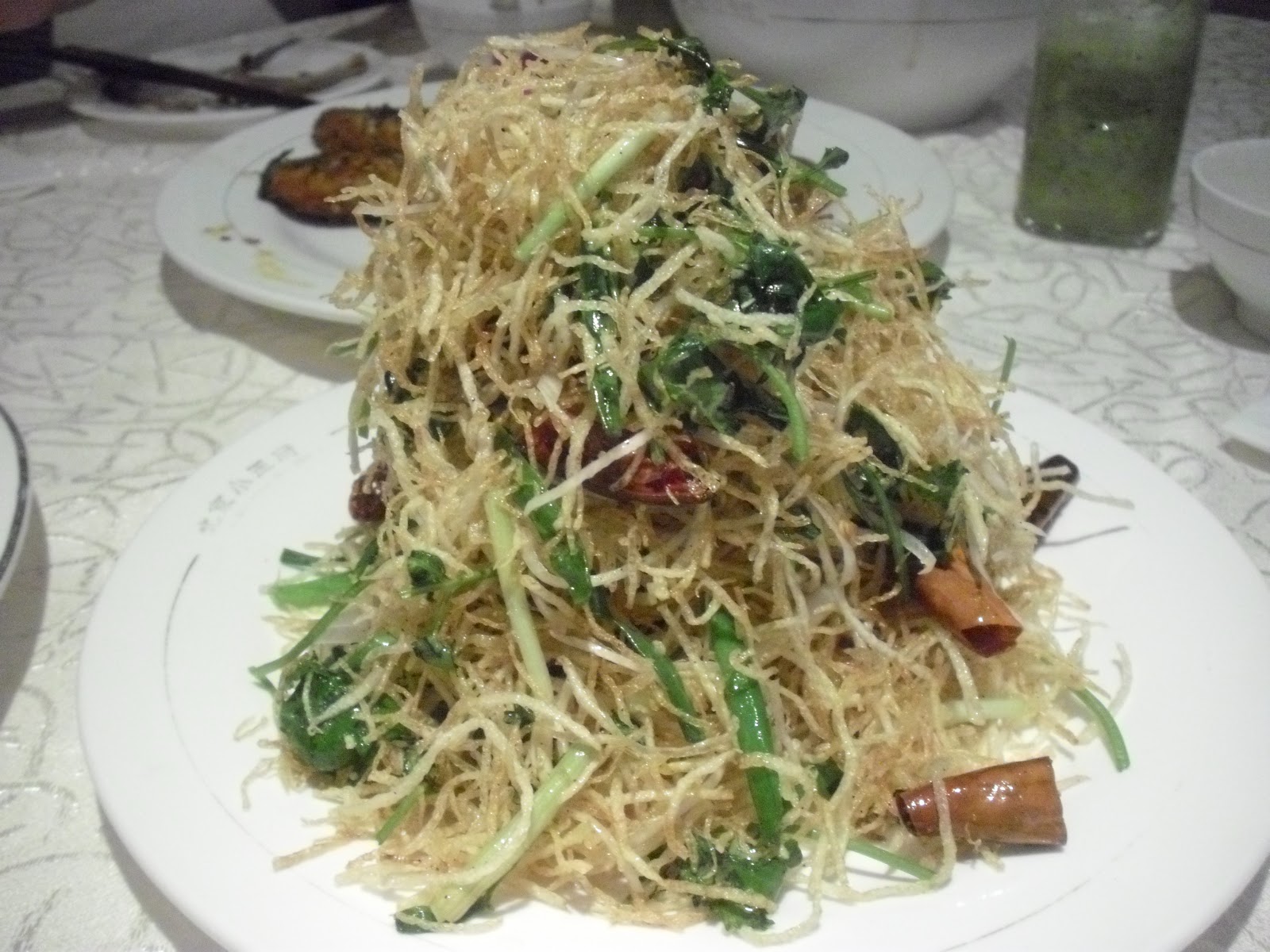
Another beer-friendly dish was an amazing giant mountain of fried potato slivers laced with spring onion, coriander & dried chillies. I know this dish is more than a bit trashy, but by god, these crispy spicy slivers of spud were SO addictive.


The squirrel-shaped Mandarin fish (松鼠桂鱼), so named because it's carved and cut up to look like a squirrel, was another winner. Don't be put off by the radioactive sweet & sour sauce; it went really well with the perfectly deep-fried Mandarin fish and pine nuts. Note to food geeks, although often thought of as a Shanghai speciality, it actually originates from Suzhou.


The classic hot & sour soup (酸辣汤) from Shandong province is found on Chinese menus worldwide, but like many famous dishes, it is often abused. Not at Xiao Wang's, where the use of top quality vinegar gave it a depth so often missing from versions that use the cheap stuff. And nor did they skimp on the other ingredients, especially the egg!

I know this meal appears to be a bit unbalanced with a, quite literally, unhealthy reliance on deep-fried treats. However, we did balance it out by ordering Cantonese-style pak choi with garlic, Sichuan cucumber salad and fresh wai-san in honey with cassia flower (the photo doesn't really do it any justice).


Wai-san (淮山) aka mountain yam is one of those Chinese ingredients that doesn't really taste of anything, but is highly valued due to its perceived health benefits. More commonly used in dried form in slow-cooked Cantonese soups; this was the first time I had tried it fresh. I really liked this dish with the slightly crunchy yam nicely complemented by the sweet honey. And as it's so healthy, it meant that I could bag that extra chicken wing without feeling guilty!

I like Xiao Wang's, and it shows that with enough expertise, a geographically diverse menu needn't mean compromises in the quality of the food. Combined with a comfortable European-style dining room and efficient service, this restaurant is an excellent option for those occasions when one is paralysed by the myriad choices found in Beijing.

Xiao Wang's Home Restaurant 北京小王府
Address 地址: 北京 日坛公园内北天门东侧
Tel 电话: +86-10-8561-7859 or +86-10-8561-5985

Shun Yi Fu 顺一府
Dinner at Xiao Wang's was my last meal with my Beijing colleagues, a fine bunch who looked after me really well. However, my food exploits were far from over, as I had a couple of days to myself armed with a shortlist of Beijing eateries. First on my list was Shun Yi Fu; I was really looking forward to eating at this dumpling joint after a previous visit three years ago. So you can't even begin to imagine how pissed off I was when I saw that the restaurant had been bricked up.

Mercifully, there was another branch about five minutes walk away, and once I found it, I ordered a steamer of pork & fennel dumplings (猪肉茴香蒸饺). There wasn't anything wrong with these but they could have done with having a more intense fennel flavour.


While I'm sure some of the other varieties of dumplings would have been more to my taste, there was something else that was wrong. The location. This newer branch is located in a shopping mall, and is totally devoid of the charm and character that made the original Shun Yi Fu so great. And while I wouldn't discount visiting this restaurant again, I won't go out of my way to do so.

Shun Yi Fu 顺一府饺子馆
Address 地址: 北京 王府井138号 APM Shopping Mall 5/F 新东安广场5层
Tel 电话: +86-10-6513-9558

Noodle Bar (面吧)
The simply named Noodle Bar is located in an upscale development called 1949 - The Hidden City that is also home to an art gallery, a wine bar, a cocktail bar, a private club, and two other restaurants including the highly rated Duck de Chine.


Noodle Bar is a tiny joint with just a dozen or so seats at a counter surrounding an open kitchen. Given the small scale of operations, the menu is brief with a few small plates supplementing the soup noodle selection. For the latter, the choice is beef brisket, tendon, tripe, a combination of all three, or wild mushroom (for the veggies) with a further choice of thin or thick noodles. I chose the beef brisket with thin noodles and from the selection of small plates I dodged the salads and went with spicy chicken wings.


Whilst the al dente hand-pulled noodles that I saw made before my very eyes were excellent, the rest of the combo was a big letdown. In particular, the broth lacked depth with little evidence of star anise, cinnamon or any of the other spices usually found in beef noodle soup. I had to give it a big kick-start from the pots of chilli oil and roasted garlic on the side along with the crispy bits from the spicy chicken wings. I also got the hump at how little beef there was, especially as there was a massive chunk of (unadvertised) mooli. I may have caught it on a bad day, but I find little to recommend Noodle Bar.

Noodle Bar 面吧 @ 1949 - The Hidden City
Address 地址: 北京 工体北路 太平洋百货南门对面
Tel 电话: +86-10-6501-1949

Friday, 29 June 2012

A Bite of China 舌尖上的中国

When I was in China recently, my Beijing colleagues were raving about a TV series called A Bite of China (舌尖上的中国). It turns out that this show is causing quite a stir in China, and when I returned to the UK, I tracked it down on YouTube.


As my Mandarin is distinctly ropey (OK, non existent), I was relieved to find some episodes had been subtitled, and so far I've watched the first two. They've both been brilliant, with production values and cinematography more reminiscent of a David Attenborough documentary as opposed to bog-standard food television. And the fact that there's no swaggering egotistical presenter (yes, I do mean you, Mr Ramsay, sorry, Chef Ramsay) means that this narrated show allows the food to take centre stage.

The episode featured in this post is about staple foods, and there's some stunning footage showing how different kinds of bread, dumplings and noodles are made. But A Bite of China isn't just about the food; it's also about the stories of the people and the traditions behind the food. Guys like Mr Wang, who makes beautiful steamed yellow buns the old fashioned way, then cycles for an hour and a half from his home in rural Shanxi to the nearest city to sell them.

Compared to some of the vacuous crap that passes for food programming on British television, this profound Chinese documentary is in a different class. Even if you don't understand a word of Mandarin and just watch the pictures, you will learn more about Chinese food in a single episode of A Bite of China than an entire series of Gok Cooks Chinese.

A Bite of China deserves a wider audience, and wouldn't it be great if a British TV channel had the imagination to acquire this series and adapt it with an English narration?

Sunday, 24 June 2012

The Staples of Shanxi 山西 & Shaanxi 陝西

The neighbouring northern Chinese provinces of Shanxi (山西) and Shaanxi (陝西) are often confused with one another. Not only do they sound alike but their respective cuisines also share many similarities. In particular, both provinces are famous for their noodles, and to a lesser extent, their bread. I know that this is a bit of a generalisation, but as people in China can't access my blog (Blogger is banned) it's one I'm going to try and get away with!


Beijing has many Shanxi restaurants, and I was taken to one called Datanghong (大唐红) where noodles are the main draw. Indeed, the noodle kitchen is on open view by the entrance of the restaurant. There are many different kinds of Shanxi noodles but arguably the most famous are honeycomb noodles (youmian kao laolao 莜面栲栳栳). Made from a grain indigenous to the province called naked oat, these noodles are intricately arranged in a honeycomb-shape in a bamboo steamer before being cooked. Simply served with a chilli oil-vinegar dip, they were really addictive.

As well as being eaten straight from the steamer, honeycomb noodles are also used in other dishes such as stir-fried honeycomb noodles with egg. Wok frying gave the noodles a slight char, and the texture, if not the flavour, was reminiscent of dry-fried ho fun noodles. It's a tough call to say whether these were better than the standard steamed version.

Other noodles I tried included cat's ears (mao er duo 猫耳朵) and knife-cut noodles (dao xiao mian 刀削面). These were served with sauces on the side such as egg & tomato, which are then stirred into the noodles. I could've eaten these all day, but for the fact that there was loads of other dishes to check out.


Just as impressive as the noodles were the sesame buns served with glass noodles, chillies and other bits and bobs. It was great fun making noodle sandwiches with the soft, spicy filling going really well with the buns that were slightly crispy on the outside.

I would have liked to write more about this restaurant, but alas I was disorientated by jetlag and the unfamiliarity of the food when I ate there. That said, between my camera and Instagram, I can tell you that I enjoyed tucking into Shanxi-style crispy duck, roast mutton, mixed mushrooms in a mini-wok, and some psychedelic multi-coloured buns amongst other treats. I really enjoyed eating at Datanghong, and I hope this first experience of Shanxi cuisine won't be my last.

Datanghong 大唐红酒楼
Address 地址: 北京 安定门外大街2号安贞大厦2楼(近环球贸易中心)
Tel 电话: +86-10-6448-2299


Given the ubiquity of roujiamo (肉夹馍) in Beijing, one might assume that it's a local speciality, but in fact these sandwiches (sometimes nicknamed Chinese burgers) originate from Shaanxi province. The ones at Qin Tang Fu (秦唐府) were damn tasty with strands of moist, slowly braised pork seasoned with five-spice encased in a crispy unleavened bun. These were so popular that it seemed compulsory for every diner to order one. I think these would go down a storm in the UK.


There's also a wide selection of noodles, and I chose a dish that went by the English name of noodles with garlic sauce. This name didn't really do justice to what was one of the best noodle dishes I've eaten in a long time. In one bowl came 'belt' noodles (think pappardelle, but even broader) in an intentionally bland soup with some greens. In a smaller bowl came a quite stunning spicy garlic sauce laced with sesame, bits of tomato, egg, wood-ear fungus and spring onion.


To eat this dish properly, the noodles are transferred into the bowl of sauce, and given a good old mix to make sure that they are all coated. With hindsight, I shouldn't have supersized my noodles, but when it only cost the equivalent of 20p to go large, the temptation was too great. Be warned, the portions very are generous and filling at this restaurant, and I barely made any inroads into my order of stir-fried greens.

I would love to revisit Qin Tang Fu, as there are loads of interesting Shaanxi dishes that I'd like to try. For more detailed reviews of this restaurant, please check out Rice & Pickle and Hungry Female (thanks for the tip, Shu).

There are four branches of Qin Tang Fu in Beijing, and the address below is of the one I visited:

Qin Tang Fu 秦唐府
Address 地址: 北京 东城区朝阳门 内南小街69号
Tel 电话: +86-10-6559-8135