Showing posts with label Teochew. Show all posts
Sunday, 21 July 2013
Eating In Bangkok
Whilst I steadfastly insisted on ordering dishes 'Thai-spicy' at every opportunity during my stay in Hua Hin, I was ready to give my guts a breather by the time I arrived in Bangkok. This could only mean one thing for a good Chinese boy such as myself: a trip to Chinatown.
As darkness falls, the streets of Chinatown come alive with hawkers selling southern Chinese treats such as Cantonese BBQ, Teochew braised duck and Hainanese chicken rice. While the roast duck and wontons in my soup noodles aren't going to win awards, they were pretty good for the equivalent of 75p I spent on them.
The Chinese influence on how Bangkokians eat isn't just limited to Chinatown. This is most evident at breakfast time judging by the gusto at which the locals were tucking into bowls of congee and soup noodles. Naturally I started the day with the latter, which came with loads of goodies including fish balls, fish cake, pork slices, minced pork, some veg and fried wonton skin. I tended to go for the broad ho fun rice noodles (called sen yai in Thai) but most stalls offer a choice of noodles. The soup is often quite mild (ideal for breakfast) but there are loads of condiments on the side if you want to pimp your bowl up.
As you might have gathered I ate lots of noodles in Bangkok, and my favourite came from a stall on the edge of Chinatown. Through pointing and uttering random words of English, Chinese and Thai I ended up with a bowl of noodles that appeared to be the lovechild of Vietnamese pho and Chinese braised brisket noodle. By that I mean the herbs and crunchy beansprouts reminded me of pho whilst the anise-scented, melt-in-the-mouth brisket (with bits of tendon, too) was most definitely Chinese. My only regret was that I didn't order a second bowl.
Away from the soup noodles I also enjoyed eating in small hole-in-the-wall joints serving dishes such as duck red curry with kanom jin noodles and pad kra pow with pork. The latter with its aniseedy hit from the holy basil is one of my favourite dishes (remember to ask for it to be served with a crispy fried egg). In other places I may have baulked at the undersized portions but this isn't a problem in Bangkok's hot climate where it's better to eat small and eat often.
One thing I didn't dabble in as much as I would have liked is desserts and sweet snacks. That said I did enjoy crispy pancakes called mae prapha that were filled with egg, coconut, sugar and other stuff. They do look like tacos but I will resist the temptation to call them Thai tacos!
I wouldn't go so far to call it a disappointment but I expected more from the Soi 38 Night Market in Sukhumvit. The food I ate was OK and I may have been unlucky in my choice of stall, but there's a good buzz and when prices for pork skewers start at Baht 10 (less than 20p) one can't really complain.
By contrast I was more than pleasantly surprised by the offerings in food courts such as the one in the MBK Center. I particularly enjoyed the som tam Thai there; it was a damn fine green papaya salad which left me perspiring heavily as I insisted on Thai spicy.
Thinking about it I preferred the som tam from the food court to the one I had at Somtam Convent in Silom. Thankfully, their larb was a far better offering and it went down well with sticky rice. While I liked this hole-in-the-wall, the food was a mixed bag; the dry and overcooked gai yang (Isarn-style grilled chicken) was particularly disappointing. There probably is better Isarn-style food in Bangkok but I lacked the language skills and radar to have discovered it.
Wednesday, 10 July 2013
Eating In Hua Hin
Hua Hin is about three hours by road from Bangkok, and as such is a very popular getaway for those from the Thai capital. It isn't, by any stretch, the liveliest resort in Thailand, but I'm an old git so I don’t really care. Besides, who needs full moon parties when there is abundant seafood!
My favourite restaurant in Hua Hin is Lung Ja Seafood, which can be found on a stretch of Daychanuchit Road where the night market is located. On my first visit I ordered a whole red snapper in tom yum soup laced with coconut milk. This was a quite amazing dish with a proper spicy soup (just look at the amount of aromatics they put in it) coupled with tender, just-cooked fish. I wasn't sure about the coconut milk at first, but it made the dish into a kind of hot and sour curry, which is no bad thing in my book. By the way, remember to insist on this dish to be cooked 'Thai spicy'.
On my second visit I went for lobster. Whilst it was perfectly cooked on the barbecue, with hindsight I wouldn't have gone with the sweet tamarind sauce, as there just wasn't enough zing. On the other hand I was very pleased with the morning glory, which was stir-fried with plenty of garlic and chilli.
Of the other places I tried in Hua Hin, Koti Restaurant is probably my next favourite. It can also be found on Daychanuchit Road albeit across the road from where the night market starts. The menu is quite comprehensive with all the greatest hits from the Thai canon along with a smattering of Chinese and Thai-Chinese dishes. I really liked the warm salad of seafood & glass noodle (yum woon sen), which had a pleasing yet powerful, spicy sour kick to it. The wok skills here are also very good as exemplified by dishes like stir-fried seafood with peppercorns.
I also liked the crab sausage, which is to all intents and purposes the Teochew-Chinese dish of ngo hiang 五香 - crab and pork meat wrapped in beancurd skin, then deep-fried. Unlike the Chinese version, I couldn't really discern any five-spice flavour, but it was tasty and moreish nonetheless. Incidentally, versions of this dish are very popular in Malaysia and Singapore.
Hua Hin's night market is great for a stroll although I didn't really eat any proper meals there. However, I did enjoy snacks such as rotee (the local Romanised spelling of roti) and the coconut custard puddings known as khanom krok (thanks to MiMi for letting me know what these are). I think I liked the idea of khanom krok, with its crispy outer and wobbly centre, more than the execution, as the ones I tried weren't that sweet or coconutty. Perhaps they're meant to be like that.
The various guidebooks and online guides often cite Sang Thai and Chao Lay as Hua Hin's 'go-to' seafood restaurants. Both have excellent locations with piers stretching into the sea and serve dishes such as fried mantis shrimp (pissing prawns) with garlic, blue swimmer crab & glass noodle claypot, oyster omelette and mixed seafood platters. Both places were decent enough, but I think Lung Ja Seafood is a better restaurant in terms of value and quality. Next stop, Bangkok.
Tuesday, 14 May 2013
Seven Things You MUST Eat In Hong Kong
Rather than bore you senseless with loads of blog posts about Hong Kong I thought I'd lazily rehash some Instagram shots put together a list of must-eats. It's not an exhaustive list and nor is it ranked in any order; it just consists of some of my favourite foods that just so happen to capture the soul of Hong Kong.
SEAFOOD
Hong Kong was originally a fishing village, and while those days are long gone, the love of fish and seafood lives on in the many eateries specialising in the life aquatic. Dishes such as lobster in superior stock with e-fu noodles (上湯龍蝦伊麵); steamed scallops with garlic & glass noodles (粉絲蒜茸蒸扇貝); chilli salt mantis shrimp (椒鹽攋尿蝦) and typhoon shelter crab (避風塘炒蟹) amongst others are all classics.

To spot places that serve seafood, look for the characters: 海鮮酒家, which means seafood restaurant, or if your Chinese is ropey just look for giant fish tanks by the entrance. Hong Kong isn't just urban sprawl so why not take a trip to quieter seaside spots such as Sai Kung or Lamma Island to eat seafood? I can recommend Rainbow Seafood Restaurant (天虹海鮮酒家) on Lamma Island, where I took the photos of the lobster and scallops.

GOOSE
It breaks my heart that Chinese restaurants in London don't serve goose, which is why when I'm in Hong Kong I eat it like there's no tomorrow. My favourite is Cantonese roast goose (燒鵝), prepared in much the same way as roast duck is, with crispy skin and succulent meat that's served with plum sauce. Whisper it, but such is its richness I prefer my roast goose on a bed of rice rather than noodles. I also love the Teochew/Chiu Chow-style braised goose in master stock (鹵水鵝). I especially adore gnawing on goose wings cooked in this way known as lou sui in Cantonese.

BALLS
By balls I don't mean the testicles of various animals, I mean meatballs and fishballs. Think of balls on sticks, balls in soup noodles, balls in congee, balls as dim sum and so on. When in Hong Kong I like to sample the balls that aren't easily found back home. During this trip I was seduced by dace fishballs (鯪魚球) with their alluring citrusy scent. These fishballs can be deep-fried but I prefer mine boiled. Another favourite of mine is cuttlefish balls (墨魚丸) served in a bowl of soup noodles.
DIM SUM
There are excellent dim sum restaurants all around the world but there is something special about eating these tiny morsels of delight in their natural habitat of Hong Kong and southern China. Why? Well, for starters the dim sum masters are continually innovating. A good example of this is the flaky baked cha siu bao (酥皮焗叉燒包) as invented by Mak Kwai Pui, he of Tim Ho Wan (添好運) fame. These buns are always served freshly baked and they are good, damn good although I'm not sure if the rest of Tim Ho Wan's offerings are anything that special based on my visit there.

Other dim sum that are worth trying include lau sha bao (流沙包), a variant on the more common custard bun known as lai wong bao (奶黃包) - the difference being the former has a molten filling. And in general, I recommend trying dim sum that you haven't come across before. Some of these might be trendy new creations while others might be some old specialities from the dim sum master's ancestral hometown across the border in China. Regardless, you'll be in for a good time.

HONGKONGER POINTS
To properly explain the difference between Hong Kong culture and Chinese culture, I might need to do a dissertation. Even Cantonese culture, with which Hong Kong shares a common language, is not quite the same thing. In a food context the bakeries, cake shops and dessert shops found in Hong Kong are very much a local creation due in part to exposure to western ideas. That said, while there are western influences the food has taken on a local flavour. For example, creations such as the pineapple bun (bolo bao 菠蘿包) and egg tarts (daan taat 蛋撻) are very Hong Kong despite utilising western baking techniques. Other stuff that you should try in order to accrue Hongkonger points include a trip to a dessert shop such as Hui Lau Shan (許留山) to try various desserts and drinks like mango jelly drink.

'WESTERN' BREAKFAST
What do Hongkongers eat for breakfast? There are those that go for traditional Chinese fare such as dim sum or congee, but many people eat a 'western' breakfast in a cha chaan teng (茶餐廳) or an 'ice room' (冰室). These places serve a mix of Chinese and Hong Kong-style western food – sometimes on the same plate (macaroni with cha siu in soup, anyone?). Popular breakfast items include HK-style French toast (西多士) and various sandwiches containing ham, SPAM, egg and other things. To drink, coffee, HK-style milk tea, lemon tea as well as the half tea-half coffee drink called 'yin-yang' are all popular. It goes without saying that eating this kind of breakfast results in further Hongkonger points!

NOODLES
Oh come on now, you didn't really think I was going to omit noodles from my list? These are the ultimate convenience food, as you are never more than five minutes away from a noodle shop in Hong Kong. My favourite are the various noodle dishes served in soup with stuff like wontons, fishballs and sui gow dumplings. My choice of noodle depends on the topping served, but I tend to plump for the thin fresh noodles commonly served with wontons and sui gow (see photo above left). Over the years I've been ticking off the famous noodle shops of Hong Kong and on this visit I finally got to visit Kau Kee (九記牛腩) famed for its beef brisket noodles. I went for the classic beef brisket noodles in superior stock (上湯牛腩麵) and I also had a taste of brisket and tendon noodles in curry broth – both were excellent!
SEAFOOD
Hong Kong was originally a fishing village, and while those days are long gone, the love of fish and seafood lives on in the many eateries specialising in the life aquatic. Dishes such as lobster in superior stock with e-fu noodles (上湯龍蝦伊麵); steamed scallops with garlic & glass noodles (粉絲蒜茸蒸扇貝); chilli salt mantis shrimp (椒鹽攋尿蝦) and typhoon shelter crab (避風塘炒蟹) amongst others are all classics.

Left: lobster noodles, Right: steamed scallops
To spot places that serve seafood, look for the characters: 海鮮酒家, which means seafood restaurant, or if your Chinese is ropey just look for giant fish tanks by the entrance. Hong Kong isn't just urban sprawl so why not take a trip to quieter seaside spots such as Sai Kung or Lamma Island to eat seafood? I can recommend Rainbow Seafood Restaurant (天虹海鮮酒家) on Lamma Island, where I took the photos of the lobster and scallops.

Left: roast goose, Right: braised goose
GOOSE
It breaks my heart that Chinese restaurants in London don't serve goose, which is why when I'm in Hong Kong I eat it like there's no tomorrow. My favourite is Cantonese roast goose (燒鵝), prepared in much the same way as roast duck is, with crispy skin and succulent meat that's served with plum sauce. Whisper it, but such is its richness I prefer my roast goose on a bed of rice rather than noodles. I also love the Teochew/Chiu Chow-style braised goose in master stock (鹵水鵝). I especially adore gnawing on goose wings cooked in this way known as lou sui in Cantonese.

Left: dace fishballs, Right: cuttlefish balls with noodles
BALLS
By balls I don't mean the testicles of various animals, I mean meatballs and fishballs. Think of balls on sticks, balls in soup noodles, balls in congee, balls as dim sum and so on. When in Hong Kong I like to sample the balls that aren't easily found back home. During this trip I was seduced by dace fishballs (鯪魚球) with their alluring citrusy scent. These fishballs can be deep-fried but I prefer mine boiled. Another favourite of mine is cuttlefish balls (墨魚丸) served in a bowl of soup noodles.
DIM SUM
There are excellent dim sum restaurants all around the world but there is something special about eating these tiny morsels of delight in their natural habitat of Hong Kong and southern China. Why? Well, for starters the dim sum masters are continually innovating. A good example of this is the flaky baked cha siu bao (酥皮焗叉燒包) as invented by Mak Kwai Pui, he of Tim Ho Wan (添好運) fame. These buns are always served freshly baked and they are good, damn good although I'm not sure if the rest of Tim Ho Wan's offerings are anything that special based on my visit there.

Left: baked cha siu bao, Right: lau sa bao
Other dim sum that are worth trying include lau sha bao (流沙包), a variant on the more common custard bun known as lai wong bao (奶黃包) - the difference being the former has a molten filling. And in general, I recommend trying dim sum that you haven't come across before. Some of these might be trendy new creations while others might be some old specialities from the dim sum master's ancestral hometown across the border in China. Regardless, you'll be in for a good time.

Left: bolo bao, Right: mango jelly drink
HONGKONGER POINTS
To properly explain the difference between Hong Kong culture and Chinese culture, I might need to do a dissertation. Even Cantonese culture, with which Hong Kong shares a common language, is not quite the same thing. In a food context the bakeries, cake shops and dessert shops found in Hong Kong are very much a local creation due in part to exposure to western ideas. That said, while there are western influences the food has taken on a local flavour. For example, creations such as the pineapple bun (bolo bao 菠蘿包) and egg tarts (daan taat 蛋撻) are very Hong Kong despite utilising western baking techniques. Other stuff that you should try in order to accrue Hongkonger points include a trip to a dessert shop such as Hui Lau Shan (許留山) to try various desserts and drinks like mango jelly drink.

Left: French toast, Right: ham and egg in crispy bun
'WESTERN' BREAKFAST
What do Hongkongers eat for breakfast? There are those that go for traditional Chinese fare such as dim sum or congee, but many people eat a 'western' breakfast in a cha chaan teng (茶餐廳) or an 'ice room' (冰室). These places serve a mix of Chinese and Hong Kong-style western food – sometimes on the same plate (macaroni with cha siu in soup, anyone?). Popular breakfast items include HK-style French toast (西多士) and various sandwiches containing ham, SPAM, egg and other things. To drink, coffee, HK-style milk tea, lemon tea as well as the half tea-half coffee drink called 'yin-yang' are all popular. It goes without saying that eating this kind of breakfast results in further Hongkonger points!

Left: sui gow noodles, Right: beef brisket noodles
NOODLES
Oh come on now, you didn't really think I was going to omit noodles from my list? These are the ultimate convenience food, as you are never more than five minutes away from a noodle shop in Hong Kong. My favourite are the various noodle dishes served in soup with stuff like wontons, fishballs and sui gow dumplings. My choice of noodle depends on the topping served, but I tend to plump for the thin fresh noodles commonly served with wontons and sui gow (see photo above left). Over the years I've been ticking off the famous noodle shops of Hong Kong and on this visit I finally got to visit Kau Kee (九記牛腩) famed for its beef brisket noodles. I went for the classic beef brisket noodles in superior stock (上湯牛腩麵) and I also had a taste of brisket and tendon noodles in curry broth – both were excellent!
Tuesday, 26 March 2013
Singapore Noodles X 3
Following my trip to Bangalore, I spent a couple of nights in Singapore. While it really was a flying visit, I did have a spare Sunday to kill. This, of course, could only mean one thing: a noodle crawl. But this wasn't any normal noodle crawl, as Shu Han, author of Mummy I Can Cook, provided me with a list of noodle stalls I HAD to sample in Singapore. I couldn't visit all of her suggestions, but I thought going to three of them was feasible.
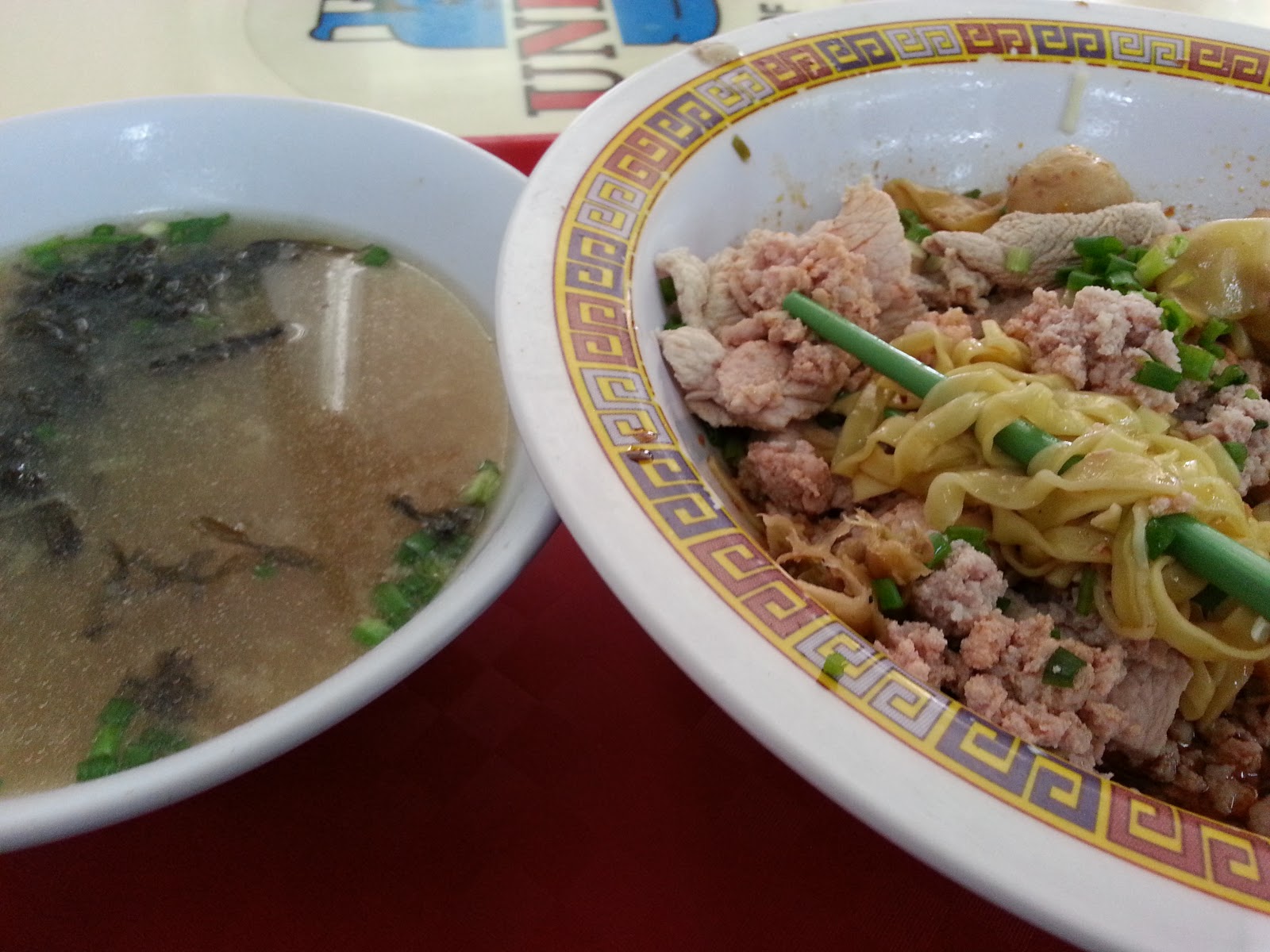
First up on my itinerary was a famous stall called Hill Street Tai Hwa Pork Noodle. Having arrived just before 11.30am, I thought I might miss the lunchtime rush. How wrong was I. In the end, I didn't get to eat my noodles until 12.50pm. I was going to go for either the S$6 or S$8 priced bowl, but having queued for so long I went for the large S$10 bowl of bak chor mee (肉脞面).
Given the length of time I queued, I was kind of cursing Shu Han. However, any ill will I may have had towards her soon dissipated when I tucked into this sumptuous dish of springy broad mee pok noodles (面薄) in a spiky mix of chilli and vinegar. The generous toppings of ground pork, sliced pork, meatballs, wontons and bits of crispy fried fish were good quality. (I asked for no liver, as I'm not the biggest fan.) On the side was a bowl of seaweed soup that I used to loosen up the noodles that can clag. With hindsight I should've asked for more chilli, but overall this was the finest bowl of noodles I've sampled so far this year.
I was ahead of schedule when I left the hotel but I was now some way behind. Having heard that the Hill Street Fried Kway Teow stall often sell out early, I decided to change my plans and headed east on the MRT to Bedok New Town to sample their char kway teow (炒粿条). Yet again there was a queue, but mercifully I managed to get my noodles by 2.10pm.
I'll be honest. Char kway teow isn't really one of my favourite noodle dishes, but this version could change my mind. It really did have the breath of the wok (鑊氣 wok hei) with a perfect balance of smoky, sweet with a hint of chilli heat. I went for the small S$3 portion, so there weren't as many cockles and Chinese sausage as I might have liked. This version had some egg noodles as well as ho fun rice noodles in the mix, but my favourite part of this dish were the crispy bits of pork fat. Mmm, pork fat.
After this second helping of noodles, I was a bit full. And having travelled so far out to Bedok, I decided to go for a stroll around the town centre. This would prove to be a big mistake. I thought I had time on my side, but by the time I rolled up to the Old Airport Road Food Centre, it was too late, too late to try the noodles at Nam Sing Hokkien Fried Mee. The guys at that stall had sold out of stuff by the time I got there. I felt that I had failed in my noodle quest, but then a phoenix rose from the flames. Well, more precisely a crumpled bit of paper with Shu Han's noodle tips on it. On there were the words: 'try fishball noodles at Old Airport Road???' and that's what I did.
I'm not sure how I came across the simply named Teochew Fishball 潮州魚丸 stall, but I do remember the fishball uncle asking me 'nei sik mat ye?' in Cantonese. Bowled over by his friendly greeting of 'what do you wanna eat?' I went through the various options with him: wet or dry? noodle type? fishballs or a mix of fishballs and fishcake? I plumped for dry fishball noodles (S$3). 'Dry' in this context means that the fishballs are served in a separate bowl of broth (by the way the broth is pretty flavourless, as its primary purpose is to loosen up the noodles). Springy is the word I would use to describe both the fishballs and thin noodles. Together with a zingy chilli dressing, this was a superior bowl of noodles.
Notwithstanding the Hokkien mee fail, the noodle crawl was a great success. If I were to do it again, I would have a late breakfast at Tai Hwa (I later found out the stall opens at 9am) before going onto the other stalls at Bedok and Old Airport Road. With a 9am start and allowing for travel time, I reckon you would be all done shortly after noon.
Hill Street Tai Hwa Pork Noodle, Block 466 Crawford Lane, #01-12 Singapore 190465
Nearest MRT: Lavender
Teochew Fishball, Old Airport Road Food Centre, Singapore 390019
Nearest MRT: Dakota
Hill Street Fried Kway Teow, #01-41 Bedok New Town Food Centre, Singapore 460549
Nearest MRT: Bedok
PS: Thanks once more to 面妹妹 aka Shu Han, I hope I did you proud!
First up on my itinerary was a famous stall called Hill Street Tai Hwa Pork Noodle. Having arrived just before 11.30am, I thought I might miss the lunchtime rush. How wrong was I. In the end, I didn't get to eat my noodles until 12.50pm. I was going to go for either the S$6 or S$8 priced bowl, but having queued for so long I went for the large S$10 bowl of bak chor mee (肉脞面).
Given the length of time I queued, I was kind of cursing Shu Han. However, any ill will I may have had towards her soon dissipated when I tucked into this sumptuous dish of springy broad mee pok noodles (面薄) in a spiky mix of chilli and vinegar. The generous toppings of ground pork, sliced pork, meatballs, wontons and bits of crispy fried fish were good quality. (I asked for no liver, as I'm not the biggest fan.) On the side was a bowl of seaweed soup that I used to loosen up the noodles that can clag. With hindsight I should've asked for more chilli, but overall this was the finest bowl of noodles I've sampled so far this year.
I was ahead of schedule when I left the hotel but I was now some way behind. Having heard that the Hill Street Fried Kway Teow stall often sell out early, I decided to change my plans and headed east on the MRT to Bedok New Town to sample their char kway teow (炒粿条). Yet again there was a queue, but mercifully I managed to get my noodles by 2.10pm.
I'll be honest. Char kway teow isn't really one of my favourite noodle dishes, but this version could change my mind. It really did have the breath of the wok (鑊氣 wok hei) with a perfect balance of smoky, sweet with a hint of chilli heat. I went for the small S$3 portion, so there weren't as many cockles and Chinese sausage as I might have liked. This version had some egg noodles as well as ho fun rice noodles in the mix, but my favourite part of this dish were the crispy bits of pork fat. Mmm, pork fat.
After this second helping of noodles, I was a bit full. And having travelled so far out to Bedok, I decided to go for a stroll around the town centre. This would prove to be a big mistake. I thought I had time on my side, but by the time I rolled up to the Old Airport Road Food Centre, it was too late, too late to try the noodles at Nam Sing Hokkien Fried Mee. The guys at that stall had sold out of stuff by the time I got there. I felt that I had failed in my noodle quest, but then a phoenix rose from the flames. Well, more precisely a crumpled bit of paper with Shu Han's noodle tips on it. On there were the words: 'try fishball noodles at Old Airport Road???' and that's what I did.
I'm not sure how I came across the simply named Teochew Fishball 潮州魚丸 stall, but I do remember the fishball uncle asking me 'nei sik mat ye?' in Cantonese. Bowled over by his friendly greeting of 'what do you wanna eat?' I went through the various options with him: wet or dry? noodle type? fishballs or a mix of fishballs and fishcake? I plumped for dry fishball noodles (S$3). 'Dry' in this context means that the fishballs are served in a separate bowl of broth (by the way the broth is pretty flavourless, as its primary purpose is to loosen up the noodles). Springy is the word I would use to describe both the fishballs and thin noodles. Together with a zingy chilli dressing, this was a superior bowl of noodles.
Notwithstanding the Hokkien mee fail, the noodle crawl was a great success. If I were to do it again, I would have a late breakfast at Tai Hwa (I later found out the stall opens at 9am) before going onto the other stalls at Bedok and Old Airport Road. With a 9am start and allowing for travel time, I reckon you would be all done shortly after noon.
Hill Street Tai Hwa Pork Noodle, Block 466 Crawford Lane, #01-12 Singapore 190465
Nearest MRT: Lavender
Teochew Fishball, Old Airport Road Food Centre, Singapore 390019
Nearest MRT: Dakota
Hill Street Fried Kway Teow, #01-41 Bedok New Town Food Centre, Singapore 460549
Nearest MRT: Bedok
PS: Thanks once more to 面妹妹 aka Shu Han, I hope I did you proud!
Tuesday, 18 September 2012
Braised Duck Wings In Master Stock 滷水鴨翼
My obsession with wings continues (at this rate I'm going to rename my blog: 'Eat Wings Love Wings'). First, a post on chicken wings, and now one on duck wings, specifically, braised duck wings in master stock (lou sui aap yik 滷水鴨翼).
I love this dish, as the master stock (lou sui 滷水), made with soy, star anise, cinnamon, citrus peel and heaps of other stuff, is absorbed by the duck wings as they slowly braise. Making master stock is best left to the professionals, which is my way of saying that this isn't a recipe post (come on now, you didn't really expect two recipe posts in a row?).
Dishes cooked with master stock are collectively known as lou mei 滷味, and this technique originated in the Chiu Chow (Teochew) area in Guangdong province. However, lou mei spread to other parts of southern China, which is why it can often be found in Cantonese restaurants around the world.
The most famous lou mei dish is braised goose in master stock, but for some frustrating reason Chinese goose dishes aren't available in blighty. As such, Cantonese restaurants in the UK tend to sell lou mei as a mixture, but I just order the braised duck wings because I'm a bad Chinese (please don't judge me, but entrails and gizzards aren't my thing).
The duck wings in the photo are from one of my favourite Chinatown haunts, Hung's, but you can find them in many Cantonese restaurants, usually the ones that sell Cantonese BBQ (siu mei 燒味). So the next time you find yourself in Chinatown, order a bag of duck wings to take home with you. You won’t regret it.
I love this dish, as the master stock (lou sui 滷水), made with soy, star anise, cinnamon, citrus peel and heaps of other stuff, is absorbed by the duck wings as they slowly braise. Making master stock is best left to the professionals, which is my way of saying that this isn't a recipe post (come on now, you didn't really expect two recipe posts in a row?).
Dishes cooked with master stock are collectively known as lou mei 滷味, and this technique originated in the Chiu Chow (Teochew) area in Guangdong province. However, lou mei spread to other parts of southern China, which is why it can often be found in Cantonese restaurants around the world.
The most famous lou mei dish is braised goose in master stock, but for some frustrating reason Chinese goose dishes aren't available in blighty. As such, Cantonese restaurants in the UK tend to sell lou mei as a mixture, but I just order the braised duck wings because I'm a bad Chinese (please don't judge me, but entrails and gizzards aren't my thing).
The duck wings in the photo are from one of my favourite Chinatown haunts, Hung's, but you can find them in many Cantonese restaurants, usually the ones that sell Cantonese BBQ (siu mei 燒味). So the next time you find yourself in Chinatown, order a bag of duck wings to take home with you. You won’t regret it.
Subscribe to:
Posts (Atom)